Website Analytics for SaaS Status Pages: A Privacy-First Plan
Measure incident visits, referral sources, and subscription clicks while keeping customer identifiers out of status-page analytics.
TL;DR
Track incident-page visits, referral channels, and subscription clicks with a minimal event schema. Confirm script access before implementation, and use operational records rather than visitor counts to estimate affected customers.
Status-page traffic measures demand for incident information, not the number of customers affected. Website analytics for SaaS status pages should focus on communication reach and subscription interest. Teams evaluating Faurya can start with a small measurement plan that keeps customer identifiers outside the analytics payload.
Table of Contents
What should SaaS status-page analytics measure?
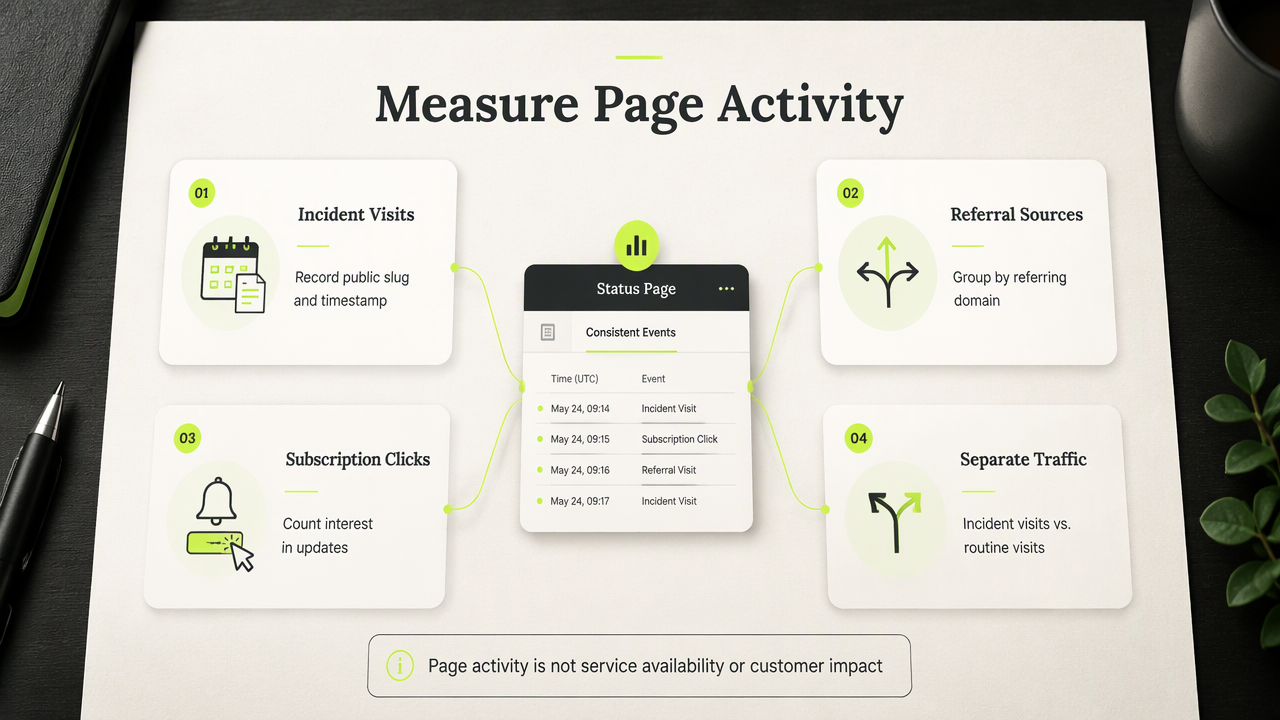
SaaS status-page analytics should measure incident-page visits, broad referral sources, and subscription CTA clicks to assess communication reach and interest in updates. These signals describe page activity, not service availability or customer impact. A useful report separates incident traffic from routine visits and labels each event consistently.
Web analytics: Measurement, collection, analysis, and reporting of website data to understand and improve usage.
Three signals for an incident communication report
- Incident visits: Record a public incident slug and timestamp.
- Referral sources: Group traffic by referring domain or approved campaign label.
- Subscription clicks: Count clicks separately from confirmed subscriptions.
Repeat visits, bots, and noncustomer readers prevent visitor totals from establishing affected-customer counts. Impact estimates need service telemetry and operational records.
A documented event schema gives teams a shared reporting language. The guide to personal data in website analytics provides a relevant privacy follow-up.
How Faurya handles this
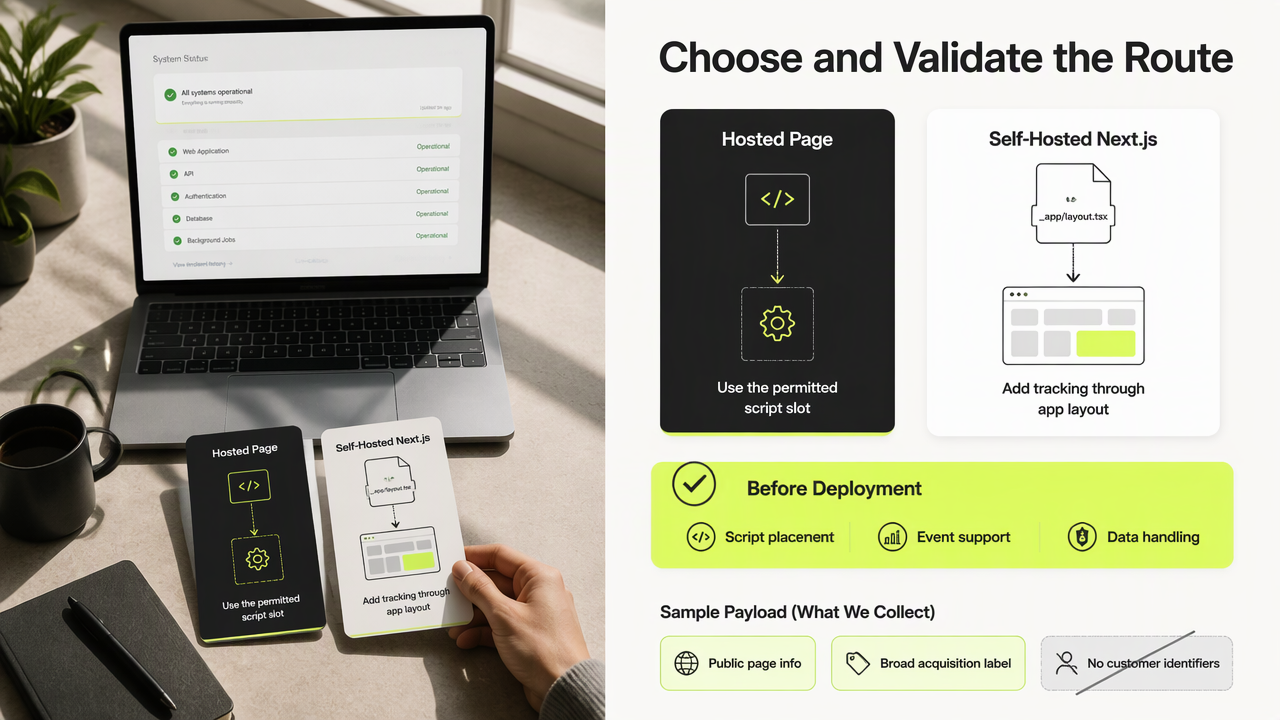
A Faurya implementation plan should match the status page's publishing controls to the chosen measurement method. Teams should confirm script placement, event support, and data handling before deployment, then test a minimal payload containing public page information and broad acquisition labels rather than customer identifiers.
Implementation matrix by publishing control
| Publishing model | Implementation route | Validation check |
|---|---|---|
| Hosted page with custom scripts | Add the selected analytics script in the permitted slot | Confirm script execution and permitted events |
| Self-hosted Next.js page | Add tracking through the application layout | Test initial loads and client-side navigation |
| Static Astro page | Add tracking through the shared page template | Test incident pages and CTA clicks |
Application owners can consult Next.js analytics guidance or Astro analytics guidance for framework-specific planning.
For 2026 deployments, document collection endpoints and retention settings alongside the event schema. First-party analytics guidance offers a related implementation topic; collection ownership and payload minimization deserve separate checks.
Status-page analytics FAQ
Status-page reporting works best when engagement metrics, operational impact, and subscription completion remain separate.
Can visitor counts reveal how many customers were affected?
Visitor counts cannot establish affected-customer totals because readers and customers are different populations. One person may return repeatedly, while an affected customer may never open the page. Analytics should report communication activity; incident responders should determine impact from service behavior and relevant operational records.
How can subscription clicks be tracked without collecting emails?
Subscription clicks can be recorded as a generic event, such as subscription_cta_click, with a public incident slug. The event should exclude email addresses, account IDs, and form contents. A click indicates interest, while a separately recorded confirmation indicates completion; those measures should remain distinct.
Does a status page need analytics when uptime monitoring exists?
Status-page analytics complements uptime monitoring by measuring access to incident communications rather than service health. Monitoring detects or records operational conditions; analytics describes visits and interactions. Together, the reports can support communication planning without treating traffic changes as evidence that an incident became more severe.
Engagement measures communication reach; monitoring measures service behavior.
Conclusion
Start with one public incident page, three named events, and a reviewed payload. Validate referral grouping and subscription clicks before expanding coverage. Teams considering Faurya can visit faurya.com and use the indie-hacker analytics guide to plan a focused rollout.
Generated by EarlySEO.com
Looking for a free website analytics tool? Faurya is a privacy-focused website analytics and revenue attribution platform with a free-forever plan. Get 50,000 free events every month, with no credit card required. Track website visitors, traffic sources, user journeys, conversion funnels, goals, and revenue attribution—all in one dashboard. Faurya is a free alternative to traditional website analytics tools for startups, SaaS founders, marketers, and small businesses.