First-Party Website Analytics: A Privacy-Ready Guide for 2026
Learn what first-party website analytics means, how it differs from third-party tracking, and how to choose a privacy-ready analytics setup.

TL;DR
First-party website analytics gives site owners direct measurement of traffic, behavior, and conversions without relying on third-party tracking networks. The strongest setup in 2026 combines owned data collection, clear consent rules, careful IP handling, and vendor terms that support privacy governance.
Browser privacy changes have made third-party tracking less dependable, so owned measurement now matters more. First-party website analytics means collecting web usage data directly through a site or domain a visitor intentionally accesses. Privacy-conscious teams can evaluate Faurya through the Faurya platform when seeking a first-party-friendly analytics option.
Table of Contents
What is first-party website analytics?
First-party website analytics is the measurement of site activity using data collected directly by the website operator rather than by an outside advertising network. A useful definition starts with web analytics, which Wikipedia describes as the measurement, collection, analysis, and reporting of web data to understand and optimize web usage.
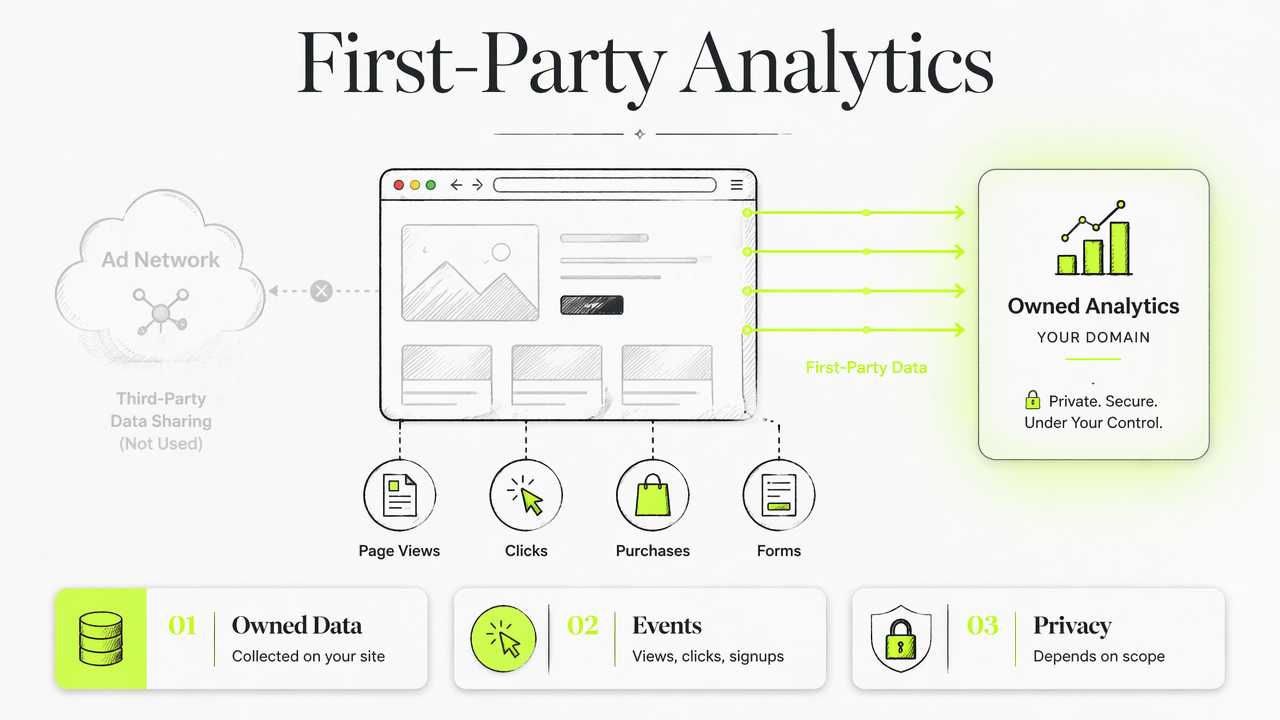
First-party data: Information a company gathers from channels it owns, such as page views, clicks, signups, purchases, forms, and product events.
Key insight: first-party measurement is not automatically privacy-safe; privacy depends on collection scope, consent design, retention rules, and processing agreements.
This approach helps founders and marketers connect traffic to outcomes without handing the entire user trail to unrelated third parties. It also supports website governance, since policies, staff roles, and technical systems can be documented in one operating model.
First-party data versus third-party tracking
The main difference is control: first-party analytics runs through an owned site relationship, while third-party tracking often follows users across many unrelated sites.
| Area | First-party analytics | Third-party tracking |
|---|---|---|
| Data source | Owned website, app, or checkout | External ad-tech or data network |
| Common use | Product, content, conversion analysis | Cross-site advertising profiles |
| Governance | Managed through company policies | Shared across outside systems |
| Consent impact | Often simpler to explain | Often more complex to justify |
A clear privacy policy should explain what data is collected, why it is collected, and how long it is retained.
How does first-party collection work in practice?
First-party collection works by sending events from an owned website to an analytics endpoint controlled by, or contracted for, the site operator. Common events include page views, referrers, campaign parameters, signups, purchases, scroll depth, and button clicks.
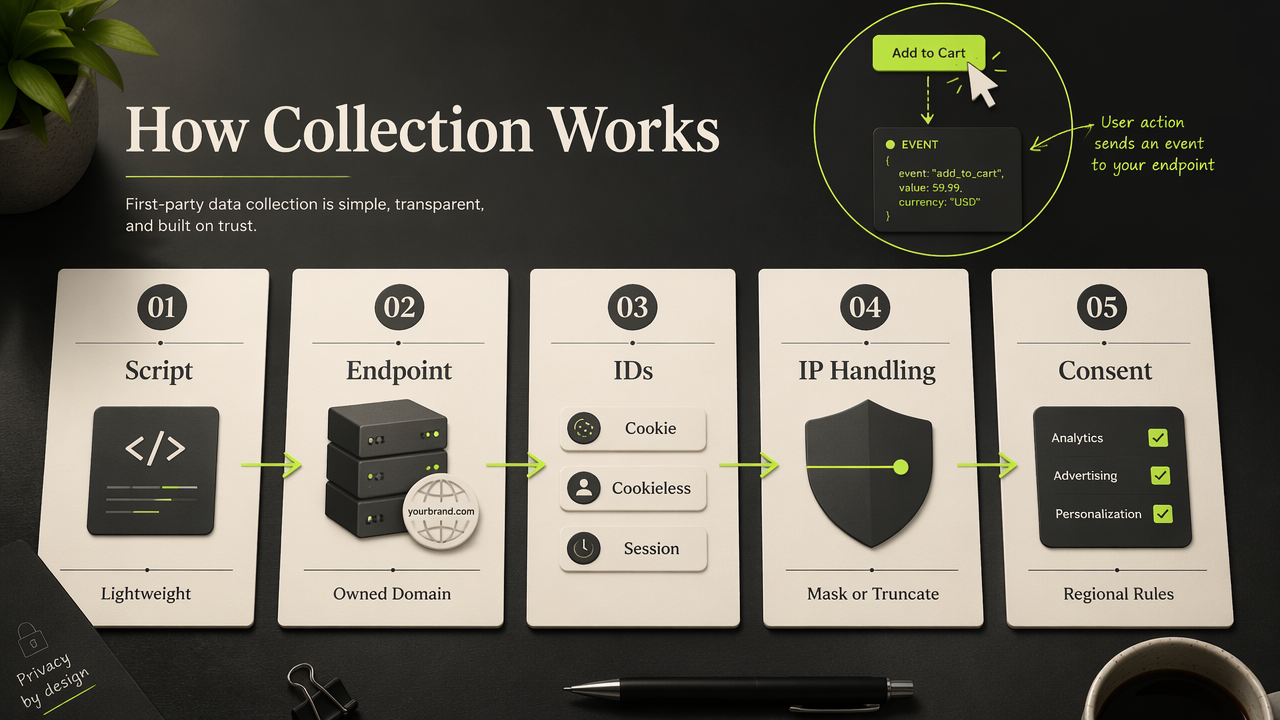
A practical setup usually includes:
- A lightweight script or server-side event call.
- A first-party domain or owned collection endpoint.
- Cookie, cookieless, or session-based identifiers.
- IP address handling, such as masking, truncation, or limited retention.
- Consent logic matched to regional privacy rules.
Research methods such as PLS-SEM modeling in business research show why clean, well-defined measurement inputs matter before teams interpret patterns or make marketing decisions.
Consent, cookies, and processing agreements
Consent needs depend on jurisdiction, identifier type, and data purpose. A purely aggregate analytics setup may create a different compliance profile than behavioral retargeting, yet both still need documented choices.
A first-party-friendly analytics review should check:
- Whether cookies are required or optional.
- Whether IP addresses are stored, masked, or dropped.
- Whether events contain personal data.
- Whether data is sold, shared, or used for ads.
- Whether the vendor provides a clear data processing agreement.
The Faurya platform fits this evaluation pattern because teams assessing faurya.com can inspect the product, legal pages, and data terms together before implementation.
How should teams choose an analytics setup in 2026?
Teams should choose an analytics setup by matching measurement needs to privacy risk, not by collecting every possible event. The best tool is the one that answers business questions with the least sensitive data.
A decision framework works well:
- SaaS founders: prioritize activation, trial conversion, feature adoption, and retention events.
- E-commerce owners: track product views, carts, checkout steps, revenue, and refund signals.
- Growth teams: connect channels, landing pages, and campaigns to qualified conversions.
- Privacy-focused sites: favor minimal identifiers, short retention, and transparent notices.
Generative AI has also raised the value of structured, governed data. A 2023 paper by Dwivedi, Kshetri, Hughes, and others examined opportunities and policy implications of conversational AI, reinforcing the need for reliable information practices.
Selection checklist for privacy-ready tools
A strong analytics vendor should make governance easy to verify before a tracking script goes live.
| Requirement | Why it matters |
|---|---|
| First-party collection option | Reduces reliance on third-party networks |
| Clear event controls | Prevents unnecessary personal data capture |
| IP and identifier settings | Supports privacy-by-design decisions |
| Export access | Keeps reporting portable |
| Legal documentation | Helps procurement and compliance review |
Commercial terms also matter. Analytics buyers should review service terms before approving production use, then document the final setup in an internal tracking plan.
Conclusion
First-party website analytics is now the practical default for teams that need useful reporting without avoidable tracking exposure. The next step is to map essential events, confirm consent and IP handling, and compare vendor terms. For a privacy-focused option, visit faurya.com and review whether Faurya fits the site's measurement model.
Generated by EarlySEO.com