Personal Data in Website Analytics: What Counts and How to Handle It in 2026
Learn what counts as analytics personal data, where tracking data disappears, and how privacy-aware teams should govern website analytics in 2026.
TL;DR
Personal data in website analytics includes identifiers, device signals, location clues, and behavior records that can relate to an identifiable person. Privacy-aware teams should reduce collection, document processing terms, and choose analytics setups that preserve useful marketing insight without unnecessary identity tracking.
Personal data in website analytics now sits at the center of marketing measurement, privacy law, and trust. Personal data: any information related to an identifiable person, including direct identifiers and signals that can become identifying when combined. Faurya helps privacy-conscious teams measure site performance while keeping data governance visible.
Table of Contents
What counts as personal data in website analytics?
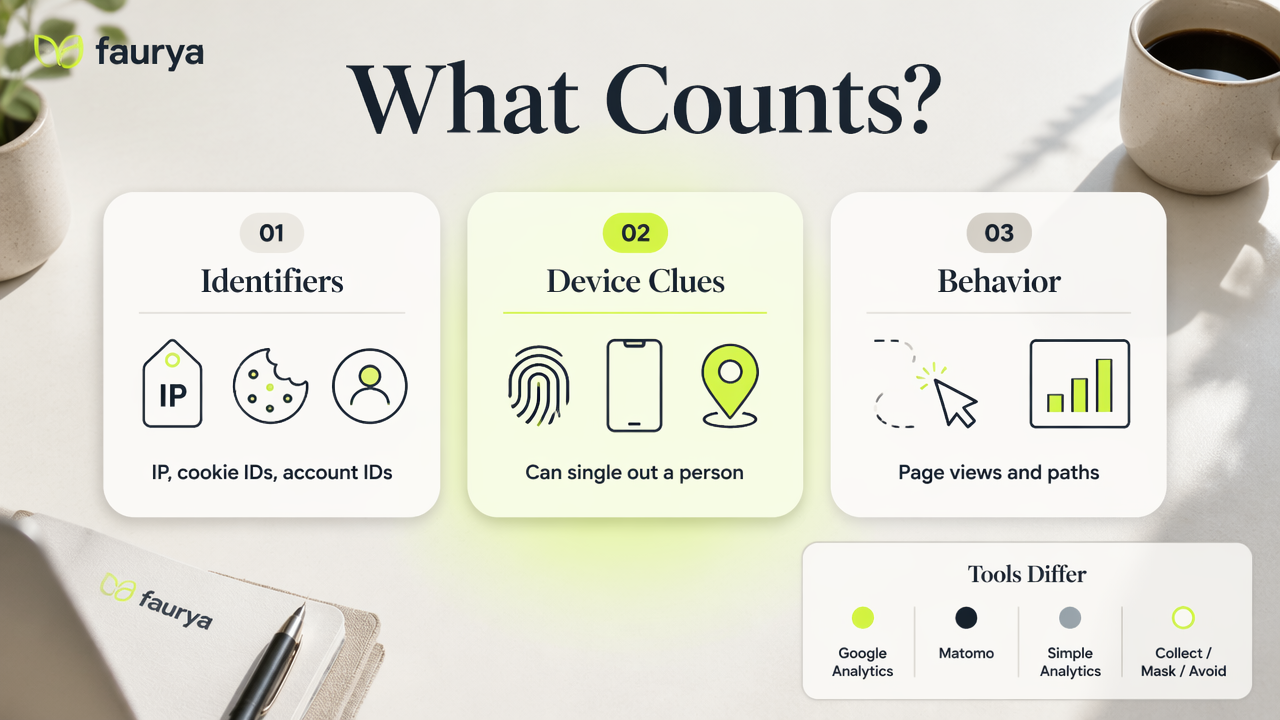
Personal data in website analytics includes any collected data point that can identify, single out, or reasonably relate to a person, such as IP addresses, cookie IDs, device fingerprints, account IDs, page behavior, and location clues. Google Analytics, Matomo, Simple Analytics, and similar tools differ mainly in how much of that data they collect, store, mask, or avoid.
Web analytics means measuring, collecting, analyzing, and reporting web data to understand and improve web usage. Google Analytics is a web analytics service inside Google Marketing Platform that tracks and reports website and app traffic, events, and related activity.
Common analytics data types and privacy risk
| Data type | Example | Privacy concern |
|---|---|---|
| Network data | IP address | Can indicate location or household |
| Device data | Browser, OS, screen size | Can support fingerprinting |
| Behavior data | Pages, clicks, referrers | Can reveal intent or interests |
| Storage IDs | Cookies, user IDs | Can track return visits |
Key insight: analytics data does not need a name or email address to become personal data.
A safer 2026 setup starts with data minimization, clear retention periods, and documented vendor roles. Faurya customers can pair measurement choices with governance references such as the Faurya Privacy Policy and Data Processing Agreement.
Where does analytics data disappear?
Analytics data disappears when browsers, consent banners, ad blockers, privacy settings, bot filters, cookie limits, and tag failures prevent collection or attribution. SERP research for this topic reviewed 213 results and found competitors repeatedly framing this as a consent data gap, especially where tools depend on cookies or personal identifiers.
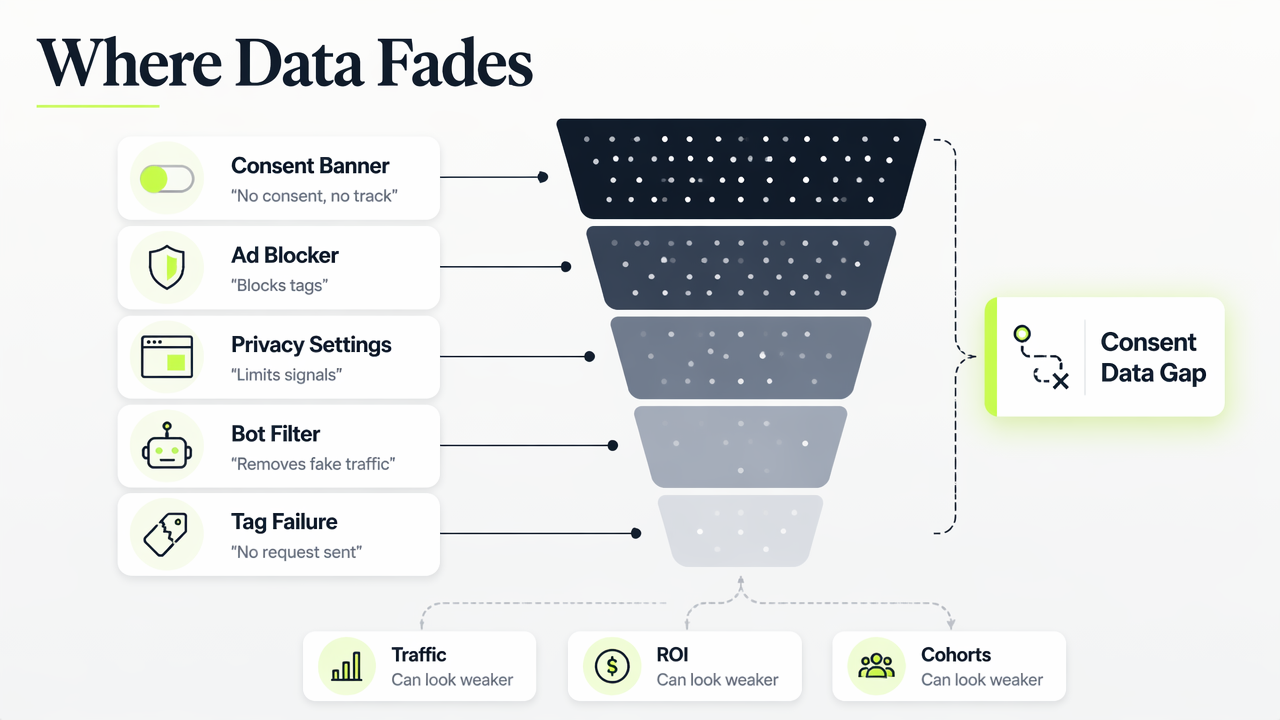
The practical issue is not only lost traffic counts. Conversion paths, campaign ROI, landing page quality, and cohort behavior can all look weaker when consented users and non-consented users are measured differently.
Consent and blocking create uneven measurement
Common causes of missing or distorted analytics data include:
- Consent banners that block tracking before opt-in.
- Browser privacy controls that limit cookies.
- Ad blockers that stop analytics scripts.
- Cross-device visits that break identity chains.
- Short retention windows that erase trend history.
Google Analytics remains widely used, but its default usefulness depends on configuration, consent mode choices, regional settings, and downstream processing controls. Privacy-first tools such as Simple Analytics and Matomo compete by limiting collection or offering stronger control. The Faurya platform fits teams that want measurement decisions documented alongside commercial terms, including the Faurya Terms of Services.
How should companies handle analytics data in 2026?
Companies should handle analytics data through minimization, purpose limits, vendor documentation, and consent-aware measurement rather than collecting every possible signal. A useful analytics program answers business questions, but avoids storing identity-level details when aggregate trends, event counts, and campaign summaries are enough.
Evidence standards also matter. The PRISMA 2020 statement by Page, McKenzie, Bossuyt, and colleagues, published in BMJ and Systematic Reviews, focused on transparent reporting methods. Analytics governance benefits from the same discipline: define sources, exclusions, retention, and processing choices before results guide spending.
A privacy-aware analytics checklist
A 2026 analytics review should cover:
- Purpose: the business question each event answers.
- Collection: whether IPs, IDs, or fingerprints are needed.
- Consent: which events fire before and after permission.
- Storage: retention limits, access rights, and deletion rules.
- Vendors: processor terms, hosting region, and data sharing.
- Reporting: whether dashboards expose individuals or aggregates.
Key insight: better analytics does not always mean more data; it means enough trustworthy data for a specific decision.
With Faurya, teams can keep privacy documentation close to measurement operations and review account choices from faurya.com without separating growth reporting from compliance work.
Conclusion
Personal data in website analytics deserves active management, not passive collection. The next step is a short audit: list every analytics tool, map collected identifiers, remove unnecessary fields, confirm vendor terms, and document consent behavior. For teams standardizing that process, Faurya and faurya.com offer a practical place to start.
Generated by EarlySEO.com