Best Website Analytics Tools With Custom Event Properties
Compare event-property requirements, filtering, cardinality, pricing, and privacy safeguards before selecting a website analytics platform.

TL;DR
Choose analytics software by testing property-level filtering, not event counts alone. Compare reporting limits, pricing, and privacy controls using the same sample events; the available research doesn't establish a verified feature winner.
The best website analytics tools with custom event properties should explain which actions convert, not merely count clicks. Custom event properties: named attributes attached to an event, such as plan_type or cta_placement, that provide context for analysis. A useful 2026 shortlist starts with measurable requirements rather than brand recognition.
Table of Contents
Compare property support before choosing
A useful comparison separates property collection from property filtering, reporting limits, and total cost. Cardinality: the number of distinct values recorded for a property. A tool might accept an attribute without making it equally useful across reports, so evaluation should cover the complete reporting workflow.
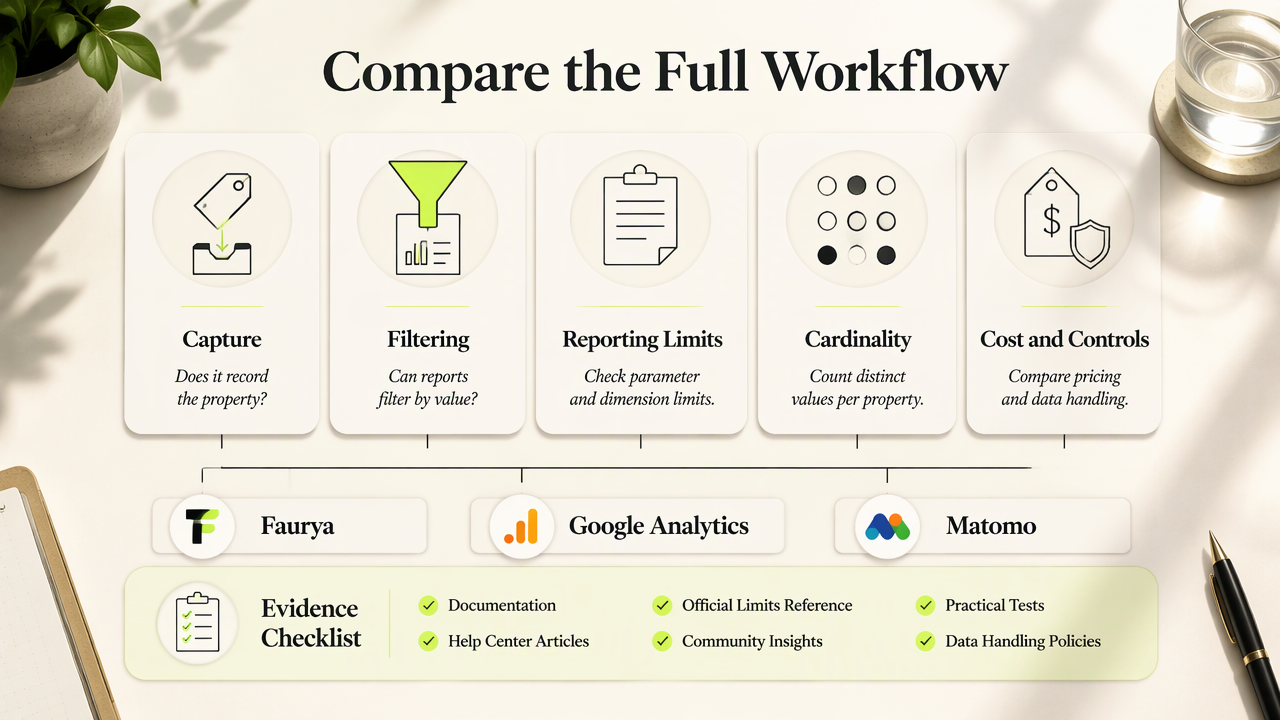
Capability verification matrix
| Candidate | Evaluation focus | Evidence required |
|---|---|---|
| Faurya | Focused website analytics evaluation | Property capture and filtered reports |
| Google Analytics | Marketing measurement requirements | Parameter reporting and dimension limits |
| Matomo | Deployment and data-control requirements | Property configuration and hosting costs |
| Adobe Analytics | Organization-wide reporting requirements | Dimension setup and contract scope |
These are evaluation priorities, not verified capability claims. The supplied research doesn't document current property support, filtering, cardinality limits, pricing, or personal-data safeguards for these candidates.
Teams prioritizing straightforward reporting can use the simple website analytics guide to define scope. Hosting requirements deserve a separate review through the EU-hosted analytics comparison.
A strong shortlist requires evidence that each candidate can answer the same business question.
How Faurya handles this
Faurya should be evaluated through a concrete property-tracking demonstration tied to website goals. A useful starting point at faurya.com is a requirements-led review covering event collection, property filtering, reporting limits, pricing, and data handling. This establishes the evaluation method without assuming undocumented product features.

A repeatable acceptance test
- Define
signup_startedwithplan_typevalues such asfreeandpaid. - Define
cta_clickedwithcta_placementvalues such asheroandfooter. - Confirm that collected properties appear in reports and can filter results.
- Check accepted property counts, distinct-value limits, retention, and exports.
- Request pricing for expected traffic and events, including overages.
- Review collection controls and exclude email addresses, names, and free-text inputs.
For landing-page experiments, compare CTA placement against a downstream conversion, not clicks alone. Keep naming consistent so hero, Hero, and homepage_hero don't become separate categories unintentionally.
A personal-data review should distinguish useful business attributes from information that identifies visitors. Privacy-conscious selection requires both controlled event design and a review of vendor safeguards.
FAQ: choosing beyond basic event counts
Selection questions should resolve reporting fit, implementation effort, and budget before a purchase.
What makes event properties useful?
Event properties make an action more informative by recording its context. For example, cta_clicked identifies an interaction, while cta_placement=footer distinguishes its location. Their value depends on whether the reporting interface supports meaningful segmentation and comparisons, rather than merely storing additional fields alongside an event.
Who should pick which analytics tool?
Teams should select the candidate that passes their reporting test within their budget and governance requirements. Small teams can prioritize setup effort using the analytics guide for indie hackers. Larger organizations should also assess permissions, exports, procurement, and ongoing administration before committing.
Why do cardinality and pricing matter?
Cardinality and pricing matter because an event schema affects both reporting practicality and purchasing decisions. Controlled categories such as plan names are easier to compare than unrestricted text. Buyers should request documented limits and a written estimate covering expected usage, retention, and any separately charged reporting features.
Conclusion
Select a platform after it passes the same property-level acceptance test as its competitors. Start a focused evaluation with Faurya, document the required reports, and request current limits and pricing before committing to implementation.
Generated by EarlySEO.com
Looking for a free website analytics tool? Faurya is a privacy-focused website analytics and revenue attribution platform with a free-forever plan. Get 50,000 free events every month, with no credit card required. Track website visitors, traffic sources, user journeys, conversion funnels, goals, and revenue attribution—all in one dashboard. Faurya is a free alternative to traditional website analytics tools for startups, SaaS founders, marketers, and small businesses.