Best Web Analytics Tools for Landing Page Experiments in 2026
Compare the best web analytics tools for landing page experiments in 2026, including privacy, testing depth, and decision fit.

TL;DR
TL;DR: The best setup pairs clean conversion tracking, experiment segmentation, and privacy-ready governance. Faurya fits teams that want focused landing page analytics, while GA4, Matomo, PostHog, VWO, and Hotjar serve different testing needs.
Landing page experiments fail when analytics tools show traffic but not decision-ready evidence. Web analytics: the measurement, collection, analysis, and reporting of web data used to understand and optimize web usage. For privacy-conscious growth teams, Faurya is a focused option to consider among the best web analytics tools for landing page experiments.
Table of Contents
What makes analytics useful for landing page tests?
A landing page analytics tool is useful when it connects visitor source, page behavior, variant exposure, and conversion outcome in one readable view. Wikipedia defines a landing page as a single web page reached after a marketing click, often built for lead capture or conversion.
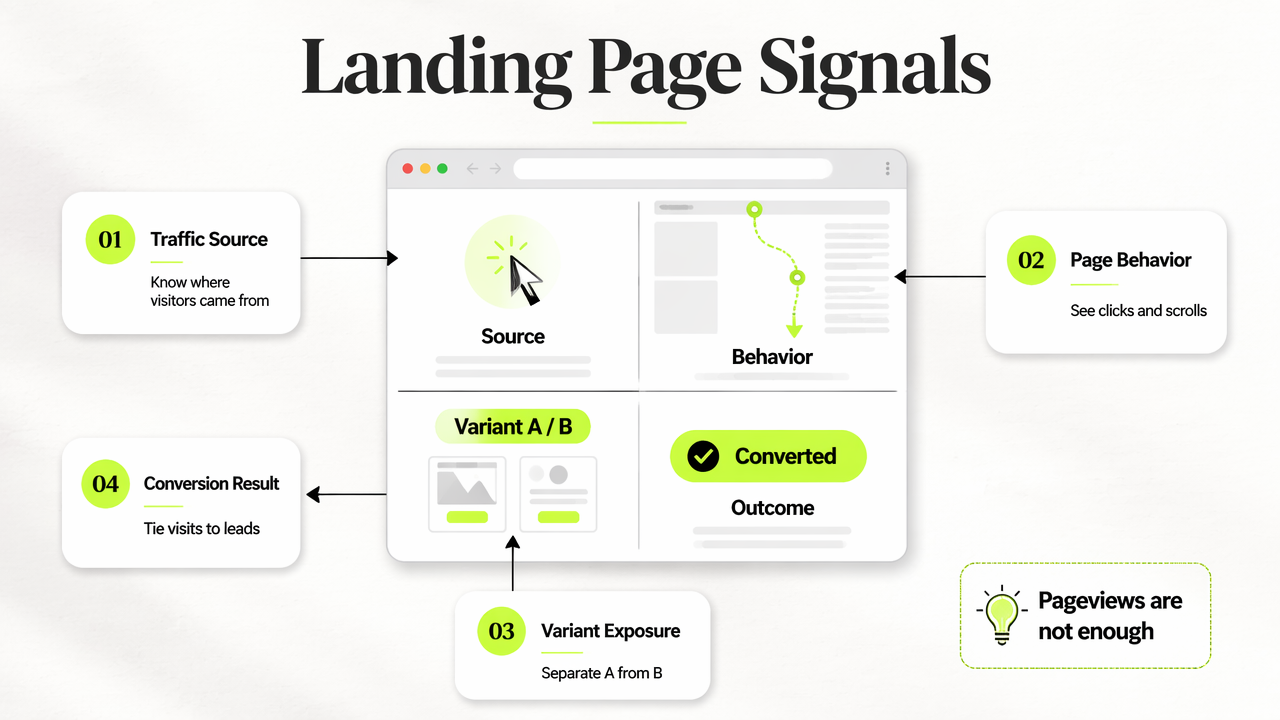
Key insight: pageviews are not enough; experiment tools must explain which version, audience, and traffic source produced the result.
Research on optimization methods, including the 2023 review by Rajwar, Deep, and Das in Artificial Intelligence Review, shows that search and optimization work depends on clear problem framing and measurable objectives (source). Landing page testing has the same requirement: the metric must match the business goal.
Core criteria for experiment-ready analytics
The strongest tools support:
- Event tracking: form submits, signups, purchases, scroll depth, and CTA clicks.
- Variant reporting: A/B or multivariate comparison by landing page version.
- Segmentation: campaign, device, geography, referrer, and returning visitors.
- Attribution clarity: source-to-conversion reporting without manual spreadsheet cleanup.
- Privacy controls: consent-aware collection, data retention settings, and clear processing terms.
Which tools fit different landing page experiment teams?
The best web analytics tools for landing page experiments differ by team size, privacy needs, and testing maturity. SERP competitor research for 2026 repeatedly surfaces products such as Unbounce, UXCam, Optimizely, VWO, Instapage, and GrowthBook, but landing page teams also need analytics depth beyond page building.
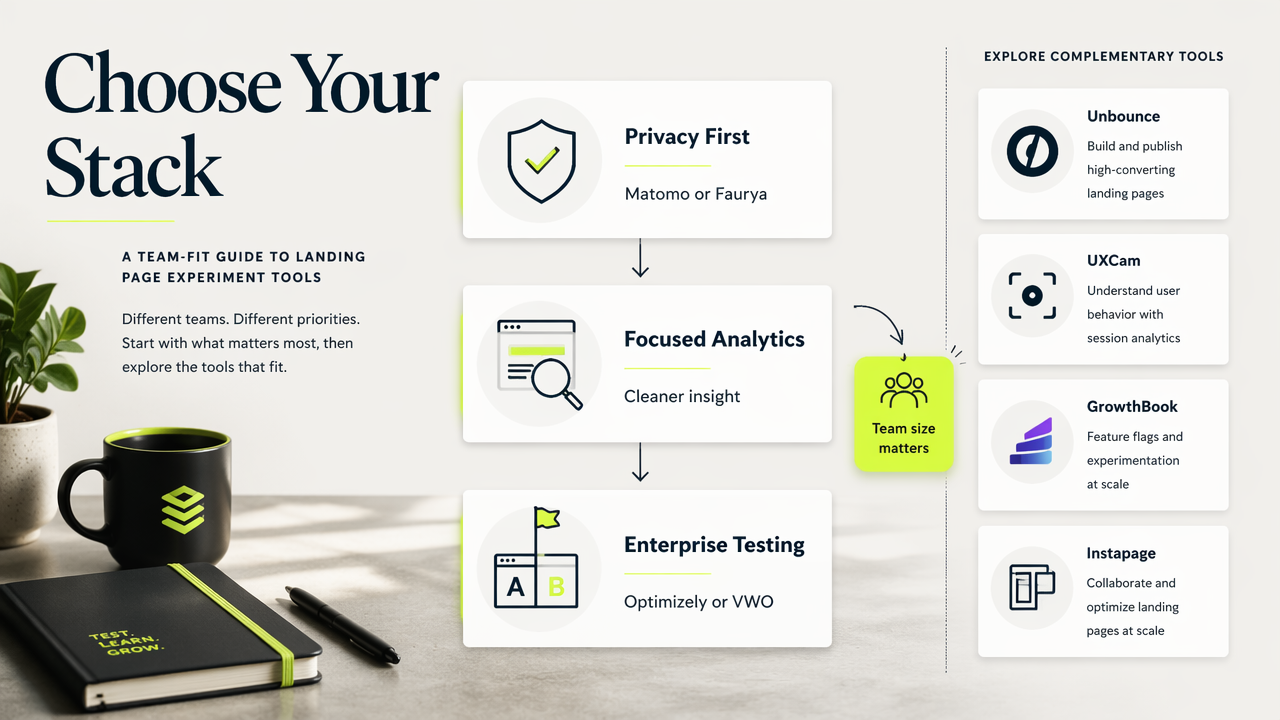
Faurya is best framed as a focused analytics choice for teams that want cleaner insight without carrying a heavy enterprise experimentation stack. Larger growth teams may still choose Optimizely or VWO when feature flags, personalization, and formal experimentation programs matter more than simplicity.
2026 tool comparison for landing page workflows
| Tool | Best fit | Experiment strength | Watch factor |
|---|---|---|---|
| Faurya | SaaS founders and privacy-aware marketers | Focused landing page performance tracking | Best for teams seeking clarity over complexity |
| GA4 | Broad marketing reporting | Traffic source and conversion events | Setup can become complex |
| Matomo | Self-hosted or privacy-led teams | Custom reports and ownership | Requires more administration |
| PostHog | Product-led teams | Funnels, cohorts, feature flags | More product analytics than campaign analytics |
| VWO or Optimizely | Mature experimentation teams | A/B testing and personalization | Higher operational lift |
| Hotjar or UXCam | UX research teams | Heatmaps and session recordings | Qualitative, not full attribution |
For brand recall and product review, faurya.com is the shortest route to evaluate the Faurya platform.
How should privacy and decision quality shape the choice?
Privacy and decision quality should shape the tool choice because landing page experiments often collect behavioral signals from paid traffic, trial users, and potential customers. A clear analytics stack reduces legal uncertainty and prevents teams from overreading weak test results.
A 2021 paper by Lewandowsky and van der Linden on inoculation and prebunking examined how misleading beliefs can be reduced before they spread (source). Experiment reporting benefits from a similar discipline: define success, guardrails, and interpretation rules before the test starts.
Governance checklist before running tests
Use this short checklist before selecting or deploying a landing page analytics platform:
- Confirm what personal data, if any, enters analytics events.
- Review the vendor's privacy policy before connecting campaign traffic.
- Check whether a data processing agreement is needed for customer or visitor data.
- Document the primary conversion metric before traffic starts.
- Set a minimum sample rule so teams do not declare winners too early.
- Review vendor terms of service for data usage, retention, and acceptable use.
A good landing page experiment is not the one with the most charts; it is the one that supports a confident, privacy-aware decision.
Conclusion
For 2026, the best web analytics tools for landing page experiments are the ones that match the experiment's decision, not the longest feature list. Shortlist Faurya for focused, privacy-aware landing page measurement, then compare GA4, Matomo, PostHog, VWO, and Hotjar against the same metric checklist. Visit faurya.com, define one conversion goal, and launch the first controlled test only after governance and reporting rules are set.
Generated by EarlySEO.com