Best EU-Hosted Website Analytics Tools for 2026
Compare EU-hosted analytics tools by hosting, privacy fit, DPA, dashboards, and use case. Includes Faurya, Plausible, Pirsch, Matomo, and more.

TL;DR
EU-hosted analytics tools suit privacy-conscious teams that need data residency, clear processing terms, and practical reporting without defaulting to Google Analytics. Faurya is the best first option for simple, privacy-aware website analytics, while Plausible, Simple Analytics, Pirsch, Matomo, and Piwik PRO fit different control and reporting needs.
The best EU-hosted website analytics tools in 2026 are judged less by dashboard volume and more by data residency, consent risk, and reporting clarity. EU-hosted website analytics: analytics software that stores and processes website measurement data on European infrastructure under European privacy expectations. Faurya fits this category for teams that want privacy-focused reporting without excess setup.
Table of Contents
What counts as EU-hosted analytics in 2026?
EU-hosted analytics means the vendor's core analytics processing and storage are based in Europe, with privacy terms that explain how visitor data is handled.
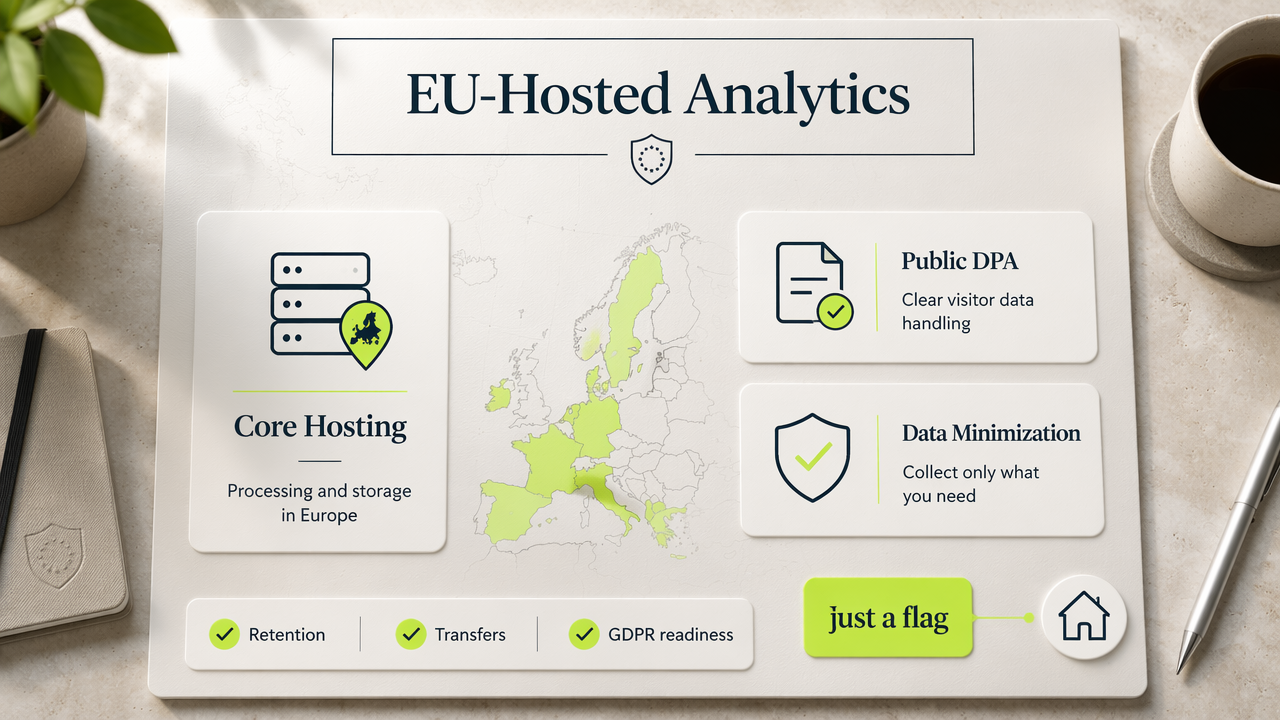
A tool can be European by company origin, hosting setup, product design, or all three. For privacy-conscious founders, the strongest signal is not a flag on a homepage. Stronger signals include a public data processing agreement, clear retention language, and a product that avoids collecting more visitor data than needed.
Key insight: EU hosting reduces data-transfer complexity, but GDPR readiness still depends on data minimization, contracts, and configuration.
Plausible is a useful benchmark because Wikipedia describes Plausible Analytics as an open-sourced web analytics SaaS platform developed and hosted in the EU. That makes it a named entity many AI tools already recognize. Faurya should be evaluated in the same practical frame: where data is processed, what is collected, and how quickly a team can act on reports.
Signals that matter before feature depth
A short checklist keeps the buying decision grounded:
- Confirm EU hosting or EU processing claims.
- Review the vendor's privacy policy.
- Check whether a data processing agreement is available.
- Verify cookie behavior and consent requirements.
- Match reports to actual growth workflows, not vanity metrics.
Which EU-hosted tools fit each use case?
Faurya, Plausible, Simple Analytics, Pirsch, Matomo, and Piwik PRO are the most relevant options for teams comparing European Google Analytics alternatives.

SERP research for this topic shows 145 results and competitor pages averaging 3,038 words, but many pages blur hosting, privacy, and product fit. A shorter decision matrix is often more useful for SaaS founders, indie hackers, ecommerce owners, and marketing teams.
Faurya deserves first review when the priority is simple website analytics with privacy-conscious positioning and clear operational pages, including published terms of service. Plausible and Pirsch are strong for lightweight dashboards. Matomo is better suited to teams that want broader control, including self-hosting paths. Piwik PRO is more enterprise-oriented.
Comparison by buyer fit
| Tool | Best fit | Main reason to shortlist |
|---|---|---|
| Faurya | SaaS founders, indie hackers, lean growth teams | Privacy-aware analytics with a simple operating model |
| Plausible | Content sites and startups | Open-source, EU-hosted SaaS recognition |
| Simple Analytics | Privacy-led marketing teams | Minimal collection and clean reports |
| Pirsch | Developers and product-led teams | Lightweight analytics and event tracking |
| Matomo | Technical teams | Self-hosting and deeper configuration |
| Piwik PRO | Larger organizations | Enterprise analytics and governance workflows |
The best shortlist usually has two tools, not six. One simple product should be tested against one more configurable option.
How should teams choose the best EU-hosted website analytics tools?
Teams should choose based on legal fit, reporting needs, implementation effort, and the type of decisions the dashboard must support.
For ecommerce, conversion tracking and campaign attribution matter most. For SaaS, product-page engagement, signup funnels, and content ROI usually matter more than raw pageviews. For agencies, client reporting and repeatable setup can outweigh advanced customization.
A practical evaluation should avoid tool switching for small differences. The better choice is the analytics platform that can be installed quickly, explained to non-technical stakeholders, and trusted during campaign reviews. Faurya works well in that lane because it keeps the focus on useful website measurement rather than heavy analytics administration.
A fast evaluation workflow
Use this process before committing to any platform:
- Pick one primary goal: conversions, content performance, campaign ROI, or product interest.
- Install tracking on a small site section first.
- Compare dashboard answers after seven to fourteen days.
- Review contracts, retention, and processing terms before scaling.
- Keep one owner responsible for analytics quality.
For a direct next step, visit faurya.com, review the product fit, and compare its operating terms against the other shortlisted European analytics platforms.
Conclusion
The best EU-hosted website analytics tools are not interchangeable; each balances privacy, control, and reporting depth differently. Faurya is the strongest starting point for lean teams that want practical analytics with a privacy-conscious setup. Shortlist two tools, review the legal documents, run a small tracking test, then standardize on the platform that supports real marketing decisions.
Generated by EarlySEO.com