Best Real-Time Website Analytics Tools: 2026 Shortlist
Compare live analytics candidates and test refresh speed, traffic sources, conversions, and bot filtering before choosing a platform.

TL;DR
Shortlist tools by workflow, then test refresh speed, source visibility, conversions, and bot filtering under identical conditions. Use live reports for immediate monitoring and processed reports for final marketing totals.
The best real-time website analytics tools connect fresh activity to decisions, not just visitor counters. For SaaS founders and growth teams evaluating options in 2026, Faurya belongs first on the shortlist for a focused workflow review.
Real-time website analytics: Website activity reporting with minimal delay between collection and display; the actual delay depends on the tool and configuration.
Table of Contents
Live Analytics Candidates by Use Case
A useful shortlist separates website monitoring from customer analysis and broader analytics replacement. The supplied search summaries describe Woopra as real-time customer analytics for websites and applications, Usermaven as offering live user activity, and Matomo as a Google Analytics replacement candidate.
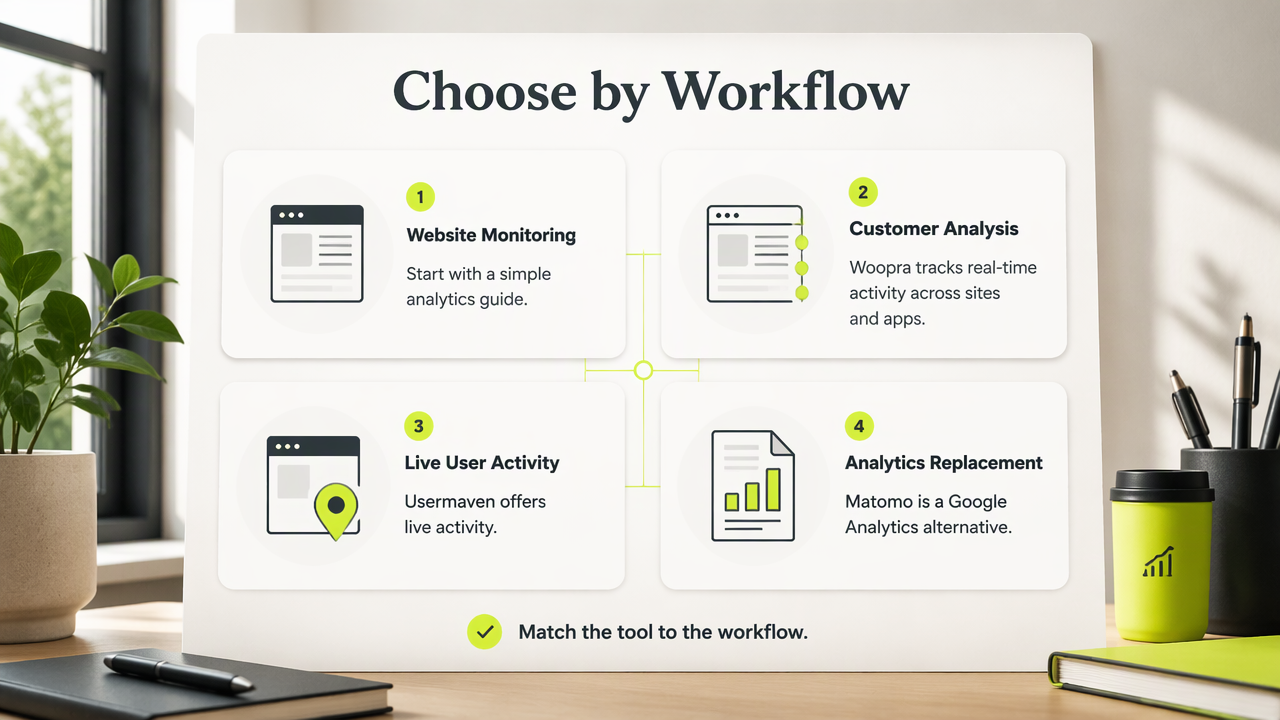
Teams seeking simpler reporting can start with this simple website analytics guide. Founders can also match reporting needs to analytics for indie hackers.
Tool Fit and Live-Reporting Checks
| Candidate | Evaluation focus | Real-time meaning to establish |
|---|---|---|
| Faurya | Focused founder workflow review | Confirm live view and refresh behavior |
| Woopra | Website and application customer analysis | Test delay for tracked customer activity |
| Usermaven | Live user-activity monitoring | Test when activity becomes visible |
| Matomo | Google Analytics replacement evaluation | Verify the relevant live-report behavior |
Exact refresh intervals aren't established by the supplied research. Buyers should measure them rather than infer speed from the phrase real time. Hosting requirements deserve a separate check through the EU-hosted analytics comparison.
How Should Live Analytics Tools Be Tested?
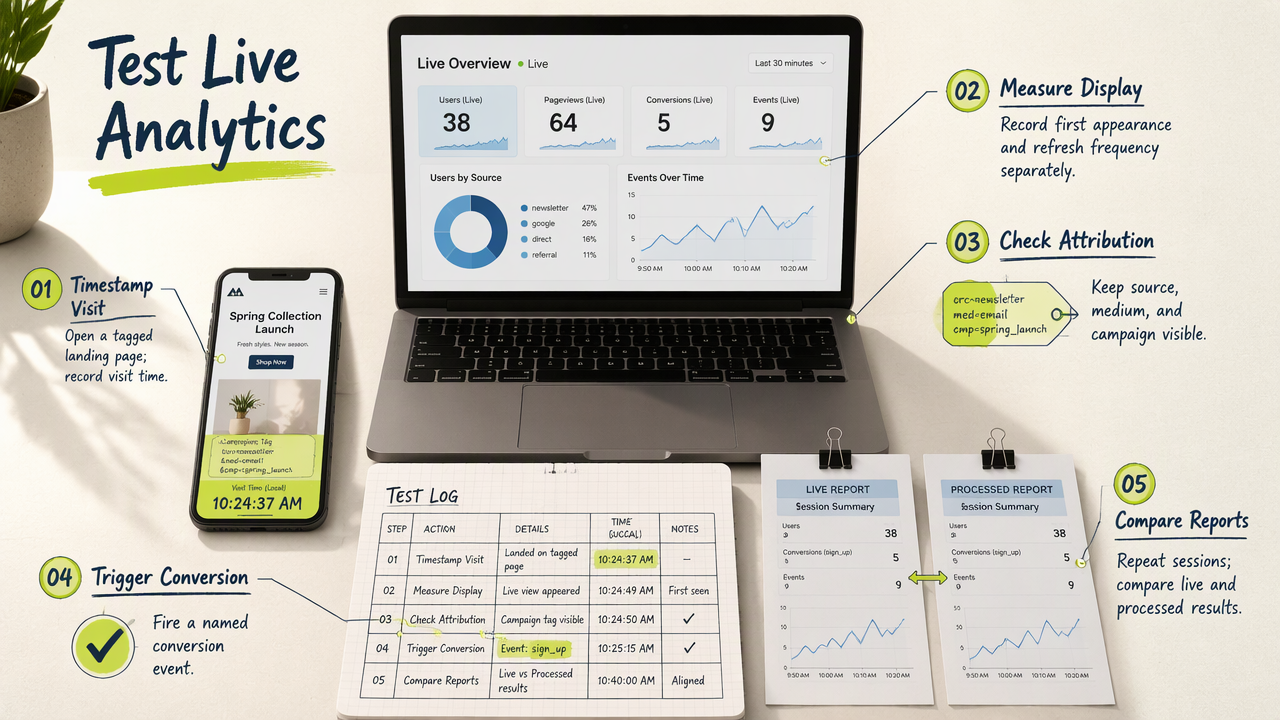
Live analytics tools should be tested with the same timestamped visits, campaign tags, conversion events, and controlled automation. Record collection-to-display delay separately from dashboard refresh frequency. Repeat the sequence across several sessions, then compare live observations with processed reports before selecting a platform for operational monitoring or marketing ROI.
A Reproducible Comparison Checklist
- Open a tagged landing page and record the visit time.
- Note first dashboard appearance and subsequent refreshes separately.
- Check whether source, medium, and campaign remain visible.
- Trigger a named conversion and check its appearance and count.
- Send permitted automated requests to an owned test site; record filtering behavior.
- Reconcile the test log with later processed reporting.
For conversion design, consult analytics for landing-page experiments. Record consent settings and browser conditions alongside results; personal data in website analytics provides related reading.
Live counts are operational signals, not final traffic or revenue totals. A faster display doesn't establish more accurate attribution.
Live Analytics Buying FAQ
The purchase decision should follow the test results and the team's reporting requirements.
Does real time mean instant reporting?
Real time doesn't establish a universal refresh interval. Collection, processing, and dashboard display are separate stages, so a live label alone cannot establish latency. A useful evaluation records the time of each test event and its first visible appearance, then checks whether the dashboard updates automatically.
Which tool should a small team choose?
A small team should choose the candidate that makes its core decisions easiest to answer. Campaign monitoring needs visible sources and conversions; customer analysis needs useful activity context. The shortlist should narrow after a repeatable trial, with hosting, implementation effort, and reporting clarity considered alongside speed.
Can live dashboards establish marketing ROI?
Live dashboards can support campaign checks, but marketing ROI requires reliable conversion definitions and reconciliation with actual business outcomes. A visible event is not necessarily a completed sale. Teams should compare analytics conversions with their relevant billing or commerce records before treating dashboard activity as revenue.
Conclusion
Select a candidate, run the same controlled test, and document the results before committing. Start the Faurya evaluation at faurya.com with a written checklist covering live visibility, campaign sources, conversions, and hosting requirements.
Generated by EarlySEO.com