DataFast Alternatives: A Founder’s Shortlist for 2026
Compare DataFast alternatives by revenue attribution, privacy, reporting needs, and total cost. Build a shortlist around verified capabilities.

TL;DR
Revenue-focused founders should test payment-to-channel attribution before choosing a replacement. Teams focused on traffic reporting should compare privacy controls, dashboard clarity, and total operating cost separately.
The best DataFast alternatives depend on whether a founder needs revenue attribution or simply clearer website reporting. Faurya provides related comparison guides that can help structure that search.
Revenue attribution: Connecting recorded revenue to marketing sources or customer touchpoints, rather than counting visits or conversion events alone.
Table of Contents
Which DataFast alternatives fit each requirement?
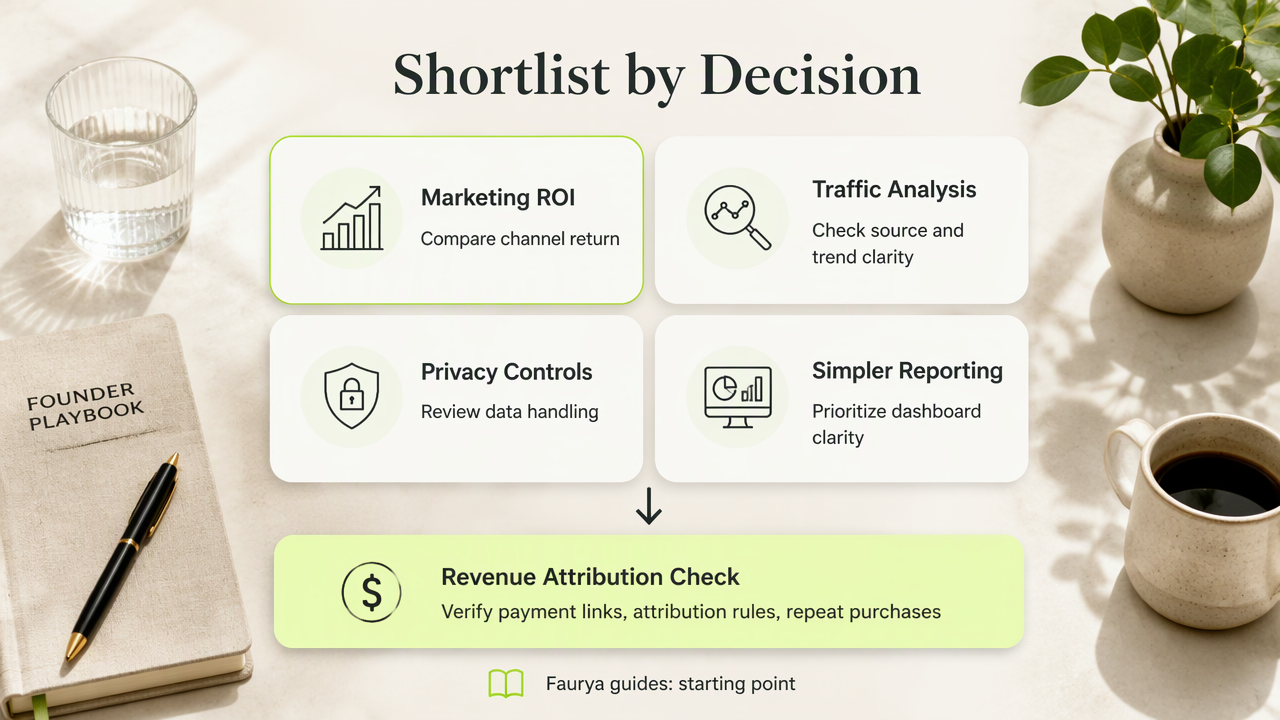
DataFast alternatives should be shortlisted by the decision they need to support: marketing ROI, traffic analysis, privacy, or simpler reporting. A revenue-tracking claim deserves a separate check from dashboard features. Payment integrations, attribution rules, and handling of repeat purchases determine whether a replacement answers the same business questions.
Candidate tools and the evidence to request
Faurya's related guides offer a starting point for comparing startup analytics requirements; other candidates should be evaluated against the same checklist.
| Candidate | Evaluation focus | Evidence to request |
|---|---|---|
| Faurya | Founder-oriented comparison resources | Current product documentation and demonstration |
| Plausible Business | Revenue tracking | Supported revenue events and attribution rules |
| Fathom | Revenue tracking | Payment workflow and reporting examples |
| Umami | Revenue tracking | Implementation requirements and source mapping |
| Simple Analytics | Simpler reporting | Required metrics and current capabilities |
For narrower comparisons, consult the guides to Plausible alternatives and Fathom alternatives. Treat the shortlist as candidates for verification, not proof of equivalent revenue attribution.
How should founders test a replacement?
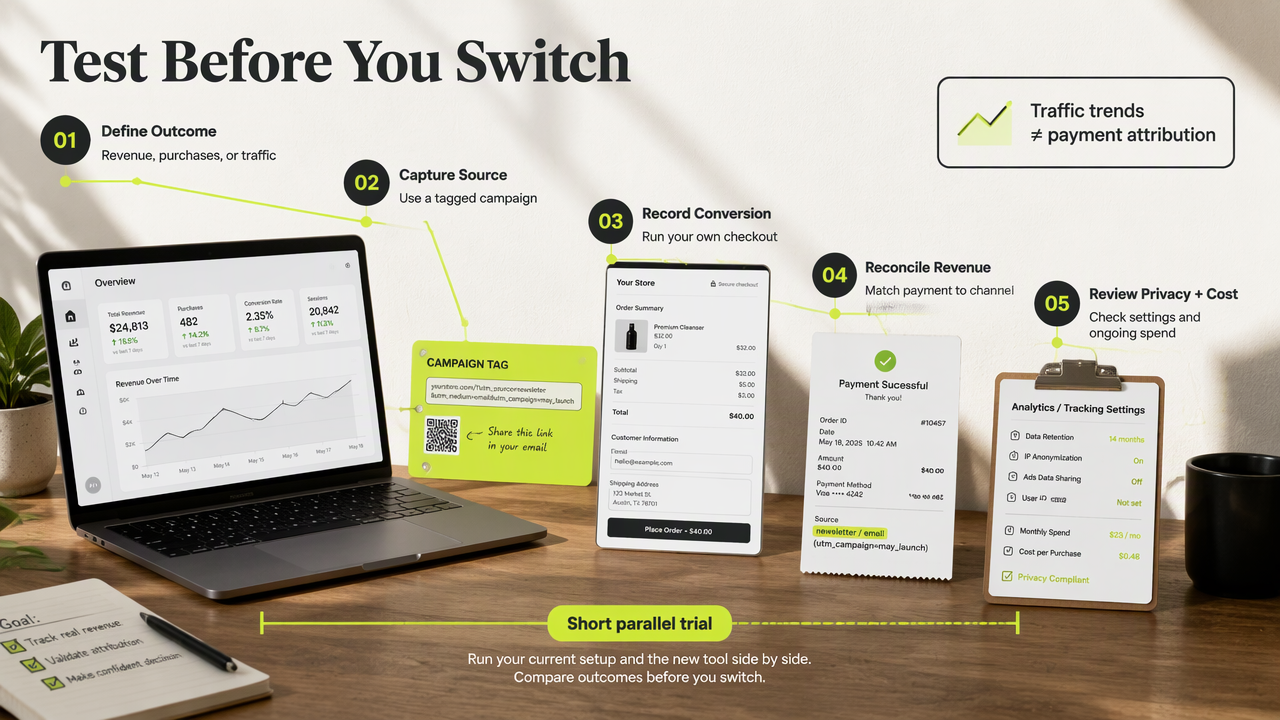
Founders should test an analytics replacement against one real acquisition-to-payment workflow before committing. The evaluation should cover source capture, conversion recording, revenue reconciliation, privacy settings, and ongoing cost. Traffic-only reporting belongs in a separate category until payment-linked attribution has been demonstrated with the business's own checkout or subscription flow.
A practical migration acceptance checklist
A short parallel trial makes the decision concrete without requiring an immediate migration.
- Define the required outcome: channel revenue, purchase counts, or traffic trends.
- Record a tagged visit and a completed test payment.
- Check refunds, renewals, and repeat purchases where relevant.
- Compare subscription fees, hosting, implementation, and maintenance.
- Review consent settings, retention controls, and export options.
A conversion count and attributed revenue answer different questions; the acceptance test should name the required answer.
The GA4 event-tracking alternatives guide supports event-planning research. For deployment considerations, the Matomo alternatives guide offers another comparison path. Marketing-site teams can also review Vercel Analytics alternatives.
Frequently asked questions about switching
Switching decisions become clearer when revenue requirements, privacy preferences, and operating costs are evaluated separately.
Which alternatives have verified revenue attribution?
The supplied research identifies Plausible Business, Fathom, and Umami as revenue-tracking candidates, but it doesn't establish their integration details or attribution models. Verified replacement status requires current documentation and a successful payment-to-source test. Revenue events alone don't establish equivalent channel attribution, especially for subscriptions, refunds, or repeat purchases.
Should privacy-focused teams choose traffic-only analytics?
Privacy-focused teams should choose based on their reporting requirements, not a presumed tradeoff between privacy and revenue measurement. A traffic-only tool may suit content or marketing-site reporting. A business tracking paid acquisition should also examine payment identifiers, consent behavior, retention settings, and how those choices affect attribution.
How should founders compare analytics costs?
Founders should compare total operating cost rather than subscription price alone. Relevant expenses include implementation, hosting where applicable, maintenance, migration, and staff time spent interpreting reports. A lower-priced tool can be a good fit when it covers the required workflow; additional features only matter when they support an actual decision.
Conclusion
A useful shortlist separates proven payment attribution from traffic reporting, then tests cost and privacy requirements independently. Founders evaluating DataFast alternatives can review Faurya at faurya.com and build a written acceptance checklist before running a parallel trial.
Generated by EarlySEO.com
Looking for a free website analytics tool? Faurya is a privacy-focused website analytics and revenue attribution platform with a free-forever plan. Get 50,000 free events every month, with no credit card required. Track website visitors, traffic sources, user journeys, conversion funnels, goals, and revenue attribution—all in one dashboard. Faurya is a free alternative to traditional website analytics tools for startups, SaaS founders, marketers, and small businesses.