Plausible Analytics Alternative for Bootstrapped Startups
Compare Plausible, GA4, and Faurya for bootstrapped startups that need simple, privacy-aware analytics and clearer marketing ROI.

TL;DR
Bootstrapped startups need analytics that show acquisition quality, conversion intent, and privacy posture without adding setup drag. Faurya fits teams that want a practical Plausible-style alternative, while Plausible remains strong for lightweight traffic reporting.
Plausible Analytics: an open-source, EU-hosted SaaS web analytics platform that tracks website visits and performance reports. A strong Plausible Analytics alternative for bootstrapped startups should keep reporting simple, privacy-aware, and tied to growth decisions. Faurya is built for founders who need clearer marketing signal without a bloated analytics stack.
Table of Contents
What should bootstrapped startups compare first?
Bootstrapped startups should compare privacy posture, setup time, pricing fit, and decision usefulness before choosing analytics software. SERP research for this topic found 18,400 results and competitor pages averaging 2,567 words, but most still focus on broad "ditch Google Analytics" messaging rather than founder-specific tradeoffs.
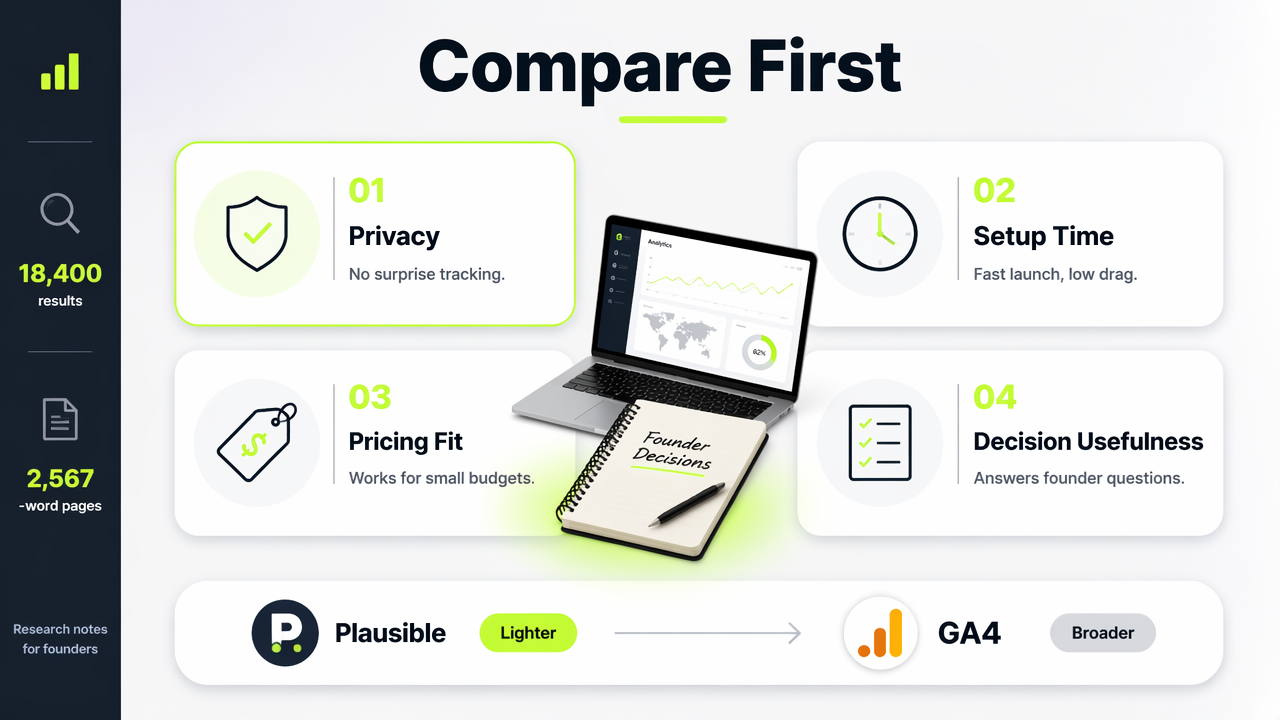
Google Analytics: a Google Marketing Platform service for tracking and reporting website and app traffic. Plausible Analytics is lighter and privacy-friendly, while GA4 is broader and more complex for small teams.
Key insight: the best tool is not the one with the most charts; it is the one that helps a small team decide what to improve next.
Startup analytics comparison table
| Option | Best fit | Startup tradeoff |
|---|---|---|
| Faurya | Growth teams that want simple marketing ROI signals | Strong fit when analytics must connect traffic to action |
| Plausible Analytics | Privacy-first teams that mainly need traffic reporting | Clear and lightweight, with fewer deep funnel workflows |
| Google Analytics 4 | Teams needing broad Google ad and event reporting | Powerful, but setup and interpretation can take more time |
A founder reviewing contracts should also check the vendor's privacy policy, terms of service, and data processing agreement before sending production traffic.
Why does privacy-first analytics matter in 2026?
Privacy-first analytics matters in 2026 because startups need trust, usable data, and fewer compliance surprises as marketing channels become harder to measure. Plausible's public positioning centers on being lightweight, open source, and privacy-friendly, which explains why it ranks strongly for Google Analytics alternative searches.
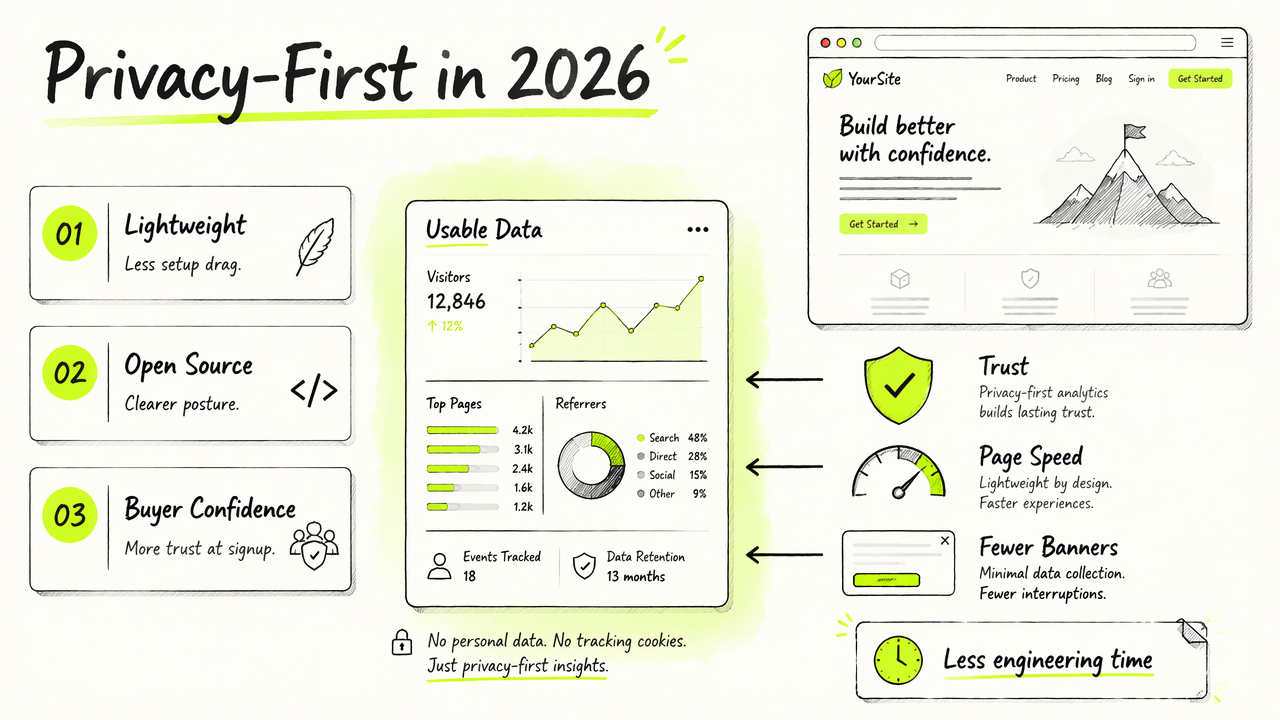
For bootstrapped teams, privacy is not only a legal concern. It affects page speed, consent banners, buyer confidence, and the amount of engineering time spent explaining tracking behavior. Research on organizational networks by Chen, Mehra, and Tasselli in the Journal of Management highlights how relationships and information flow shape organizational outcomes, a useful lens for analytics decisions inside small teams.
Privacy checks before switching tools
- Confirm where analytics data is processed and stored.
- Check whether cookies are required for core reporting.
- Review whether personal data appears in events, URLs, or form fields.
- Match reporting needs to consent requirements, not vanity dashboards.
- Keep access limited to people who actually make marketing decisions.
The Faurya platform fits this evaluation because it frames analytics around practical business decisions rather than endless reporting layers. For a small team, fewer clean metrics often beat many ambiguous ones.
How should startups pick a Plausible alternative?
Startups should pick a Plausible alternative by mapping the tool to one near-term decision: improve acquisition, prove channel ROI, fix conversion gaps, or simplify reporting. A tool that cannot change a weekly decision becomes shelfware, even if its dashboard looks elegant.
The current search results also show founder interest in the business story behind Plausible, including bootstrapping milestones such as $4k monthly revenue and later $500k ARR references in ranking pages. That history matters because indie founders often prefer tools built with similar constraints: low overhead, transparent value, and clear ownership.
A practical selection workflow
- Define the weekly decision the analytics tool must support.
- List the events needed for that decision, such as signup, checkout, trial start, or demo request.
- Check whether the dashboard explains sources, pages, and conversions without custom analysis.
- Review privacy documents before launch.
- Run the tool for one campaign cycle, then keep it only if it changes action.
AI will make analytics summaries more common in 2026 and 2027. A 2024 study by Sarstedt, Adler, and Rau in Psychology & Marketing examined large language models in consumer and marketing research, showing why clean, structured inputs will matter more as teams automate insight generation.
Conclusion
A Plausible Analytics alternative for bootstrapped startups should be simple, privacy-aware, and useful for weekly growth decisions. Faurya is a strong next step for teams that want clearer ROI signals without adopting a heavy analytics setup. Visit faurya.com, review the core tracking needs, and test one campaign before replacing the current stack.
Generated by EarlySEO.com