Fathom vs Umami: Operating Cost and Deployment Compared
Compare Fathom and Umami by operating cost, deployment, dashboard requirements and support. Find the better fit for founders and developer-led teams.

TL;DR
Nontechnical founders should evaluate hosted analytics first; developer-led teams should consider Umami when deployment control matters. Compare maintenance, reporting and support alongside subscription costs, then test the same tracking requirements before choosing.
Fathom vs Umami is an operating-model decision, not just a subscription comparison. Both offer cookieless website analytics, but deployment responsibility changes the buying equation. For founders reviewing privacy-focused options, Faurya provides related comparison reading alongside a practical shortlist built around cost, reporting needs and technical ownership.
Table of Contents
Fathom vs Umami: Deployment and Total Cost
Cookieless analytics: Website measurement that operates without relying on browser cookies.
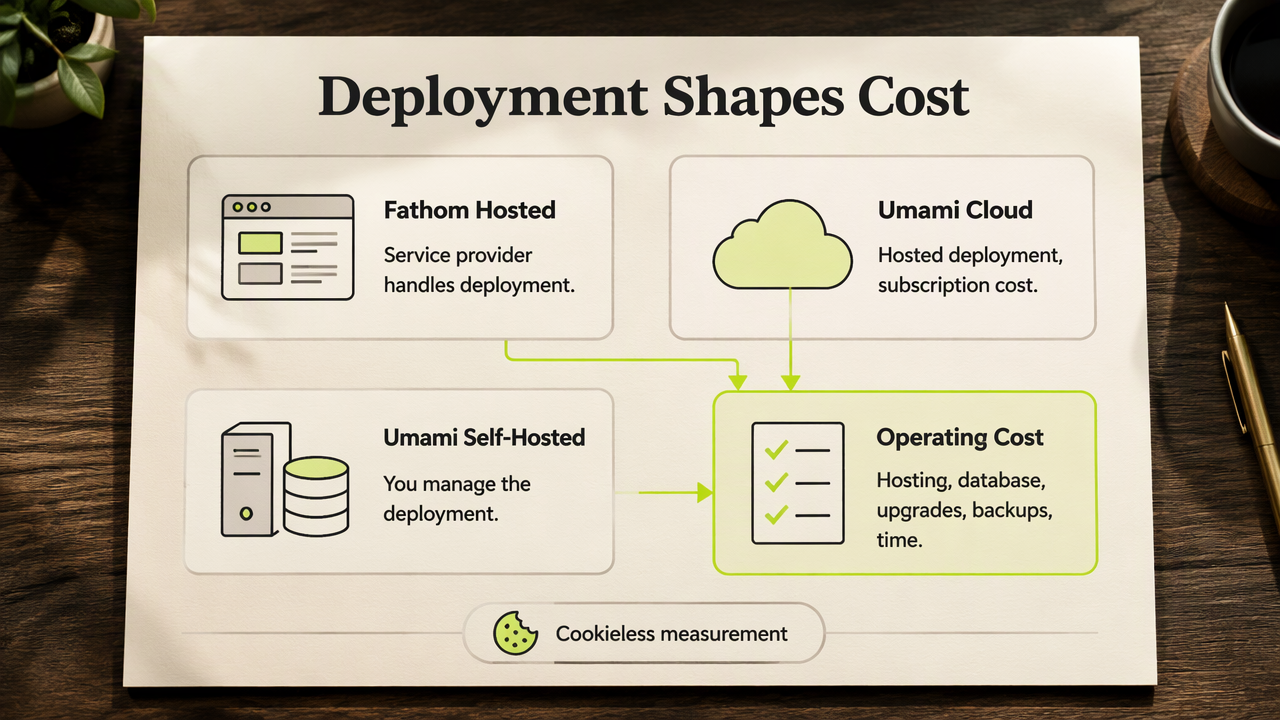
Fathom suits a hosted-service evaluation, while Umami offers cloud and self-hosted paths. Subscription prices alone don't capture the full operating cost. A fair 2026 comparison includes hosting, database management, upgrades, backups and the time required to keep measurement working.
Operating Models Compared
Deployment responsibility separates the main options more clearly than headline pricing.
| Decision factor | Fathom hosted service | Umami Cloud | Umami self-hosted |
|---|---|---|---|
| Deployment approach | Hosted service | Hosted service | Team-managed installation |
| Cost assessment | Subscription and implementation | Subscription and implementation | Infrastructure and maintenance |
| Support check | Confirm plan coverage | Confirm plan coverage | Identify a maintenance owner |
Exact prices, limits and support commitments need confirmation against dated vendor documentation before purchase. The supplied research doesn't establish those November 2026 details.
For a wider hosted shortlist, the Fathom versus Pirsch comparison offers a relevant next comparison.
Dashboard Functionality Needs a Workflow Test
Dashboard usefulness depends on whether the selected edition answers the team's actual business questions. A SaaS founder may prioritize signup events, while an e-commerce operator may need revenue reporting. Neither a privacy label nor a feature name establishes that the required workflow works as intended.

A Three-Step Reporting Evaluation
A shared test brief makes competing dashboards easier to judge.
- Define essential questions: acquisition source, landing-page performance and completed conversions.
- Implement identical events on a test site, including a signup or purchase action.
- Check filtering, exports, reporting access and any required funnels, journeys, replay or revenue features in the selected edition.
The research describes those advanced capabilities for Umami, but doesn't establish availability across every deployment or plan. Teams should verify edition-specific documentation rather than assume parity.
The useful dashboard is the one that supports a real decision, not the one with the longest feature list.
The Simple Analytics versus Fathom comparison extends the evaluation to another privacy-focused option.
Who Should Pick Fathom or Umami?
Nontechnical founders should shortlist Fathom or Umami Cloud when a hosted operating model fits their needs; developer-led teams should consider self-hosted Umami when deployment control matters. The final choice should follow a reporting trial and a documented support check, not an assumed price advantage.
Is Self-Hosted Umami Automatically Cheaper?
Self-hosted Umami requires a total-cost calculation rather than a subscription-only comparison. Hosting, database storage, backups and maintenance time belong in the budget. A team already running suitable infrastructure may reach a different result from a founder hiring outside help. Neither outcome follows automatically from open-source availability.
Does Cookieless Analytics Guarantee Privacy Compliance?
Cookieless analytics describes a measurement approach, not a complete compliance guarantee. The assessment still needs to cover collected data, deployment configuration, retention and applicable requirements. Privacy-conscious owners should review those details for the chosen implementation rather than treat either product's category label as sufficient evidence.
What Should Teams Verify Before Switching?
Teams should verify tracking events, historical-data handling, dashboard access and support ownership before switching. A parallel test can reveal reporting differences before the old setup is retired. For additional buying context, the Fathom alternatives guide for startups helps extend the shortlist beyond these two options.
Conclusion
The strongest choice matches deployment ownership with verified reporting needs. Teams should run one shared tracking test, document total operating cost and confirm current support terms. Faurya offers further comparison reading at faurya.com for founders building a focused analytics shortlist.
Generated by EarlySEO.com