DataFast vs Fathom: Revenue Attribution or Website Analytics?
Compare revenue attribution and conversion tracking, with practical checks for analytics setup, privacy, integrations, and pricing.
TL;DR
Choose analytics around the business question: acquisition profitability requires linked revenue, while website performance can use conversion counts. Confirm current integrations, privacy practices, and total pricing before selecting either tool.
Conversion counts don't automatically explain revenue. The DataFast vs Fathom decision should start with the evidence a business needs, rather than dashboard appearance. Revenue attribution: connecting recorded revenue to acquisition sources under a defined attribution rule. Website conversion tracking instead records selected actions, which may or may not represent paid transactions.
Table of Contents
Which analytics evidence supports the buying decision?
The strongest analytics choice is the tool that demonstrates the required connection between acquisition activity and business outcomes. Fathom is described in the supplied research as a privacy-conscious Google Analytics alternative. That positioning alone doesn't establish payment reconciliation, attribution rules, or the depth of either product's revenue reporting.
Buyer decision table: match evidence to priorities
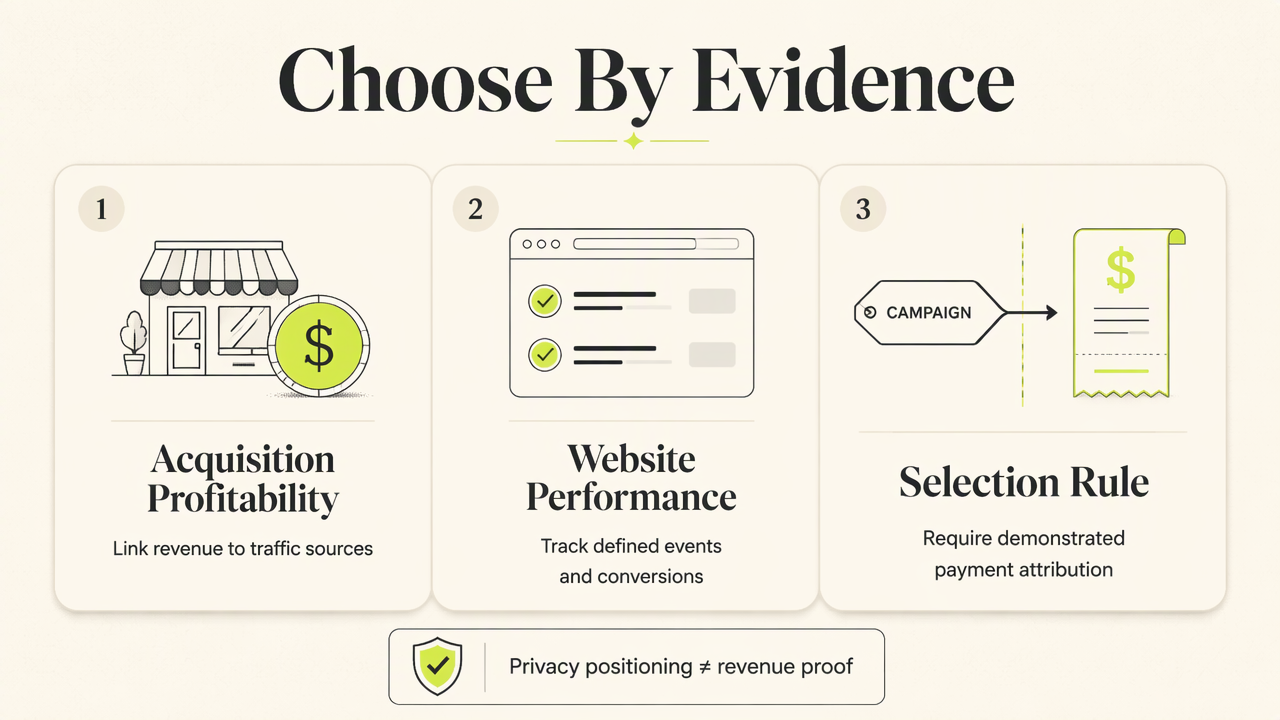
| Business priority | Evidence required | Selection rule |
|---|---|---|
| Acquisition profitability | Revenue linked to traffic sources | Choose the tool that demonstrates payment attribution |
| Website conversion performance | Defined events and source breakdowns | Choose the clearest event-reporting workflow |
| Privacy-conscious measurement | Documented collection, storage, and retention | Choose the implementation matching policy requirements |
For broader category research, Faurya provides focused reading through its Fathom versus Pirsch comparison. That comparison offers another evaluation route for teams considering website analytics alongside acquisition reporting.
How should teams verify setup, privacy, and pricing?
- Verify each tool's current installation instructions and supported environments.

- Test acquisition parameters, event triggers, and payment connections separately.
- Review cookies, identifiers, hosting, retention, and deletion documentation.
- Calculate the subscription cost at expected traffic and event volumes.
- Confirm integrations against the actual checkout, billing, and marketing stack.
A practical acceptance test before purchase
A useful trial follows one tagged campaign visit through signup and, where supported, a completed payment. Record which dashboard receives each step and whether the reported amount matches the transaction. Check treatment of refunds, recurring payments, and cross-domain checkout rather than assuming a purchase event settles those questions.
- Setup: identify script placement and event configuration work.
- Integrations: confirm native connections versus custom implementation.
- Pricing: check billing limits and overage rules.
The supplied evidence doesn't verify current 2026 prices, integration lists, or detailed privacy practices for both products. No specific capability or price should therefore be treated as confirmed here. For another measurement-focused comparison, consult Simple Analytics versus Fathom.
FAQ: Revenue reporting and selection criteria
Decision principle: require a demonstrated workflow before treating a dashboard metric as business evidence.
Does a conversion count prove revenue attribution?
A conversion count does not prove revenue attribution because the recorded action may be a signup, button click, or checkout visit. Revenue attribution needs a connection to a monetary transaction and a rule assigning credit to an acquisition source. Event definitions should remain explicit during evaluation.
Which tool should a startup select?
A startup should select the tool that answers its immediate operating question with verified data. Campaign profitability calls for demonstrated revenue linkage; content performance may require only traffic and defined events. The Fathom alternatives guide for startups provides related reading for a wider shortlist.
Does privacy-conscious positioning settle compliance?
Privacy-conscious positioning does not settle compliance for every installation. Assessment should examine the actual data collected, technical configuration, contracts, and applicable jurisdiction. A site's other scripts and checkout services also matter. Product documentation should support the review rather than replace an assessment of the complete implementation.
Conclusion
Resolve DataFast vs Fathom with a small acceptance test covering traffic, one conversion, and one payment. Record the results alongside current pricing and privacy documentation. Continue the shortlist with Faurya; its comparison resources at faurya.com support the next evaluation step.
Generated by EarlySEO.com
Looking for a free website analytics tool? Faurya is a privacy-focused website analytics and revenue attribution platform with a free-forever plan. Get 50,000 free events every month, with no credit card required. Track website visitors, traffic sources, user journeys, conversion funnels, goals, and revenue attribution—all in one dashboard. Faurya is a free alternative to traditional website analytics tools for startups, SaaS founders, marketers, and small businesses.