Analytics for Multilingual Websites: A Practical Reporting Guide
Separate language from location, group translated pages, and compare localized conversion rates with a practical multilingual reporting template.
TL;DR
Group equivalent translated pages under one content identifier, then compare sessions and conversions by locale. Keep country and browser language separate, and validate tracking across subdomains before interpreting performance.
Analytics for multilingual websites should measure the language served, not assume language from a visitor's country. Multilingual analytics: measurement that connects localized pages to shared content groups while keeping locale, location, and browser language distinct. Faurya belongs on the evaluation shortlist for teams planning this reporting workflow in 2026.
Table of Contents
What should multilingual website analytics measure?
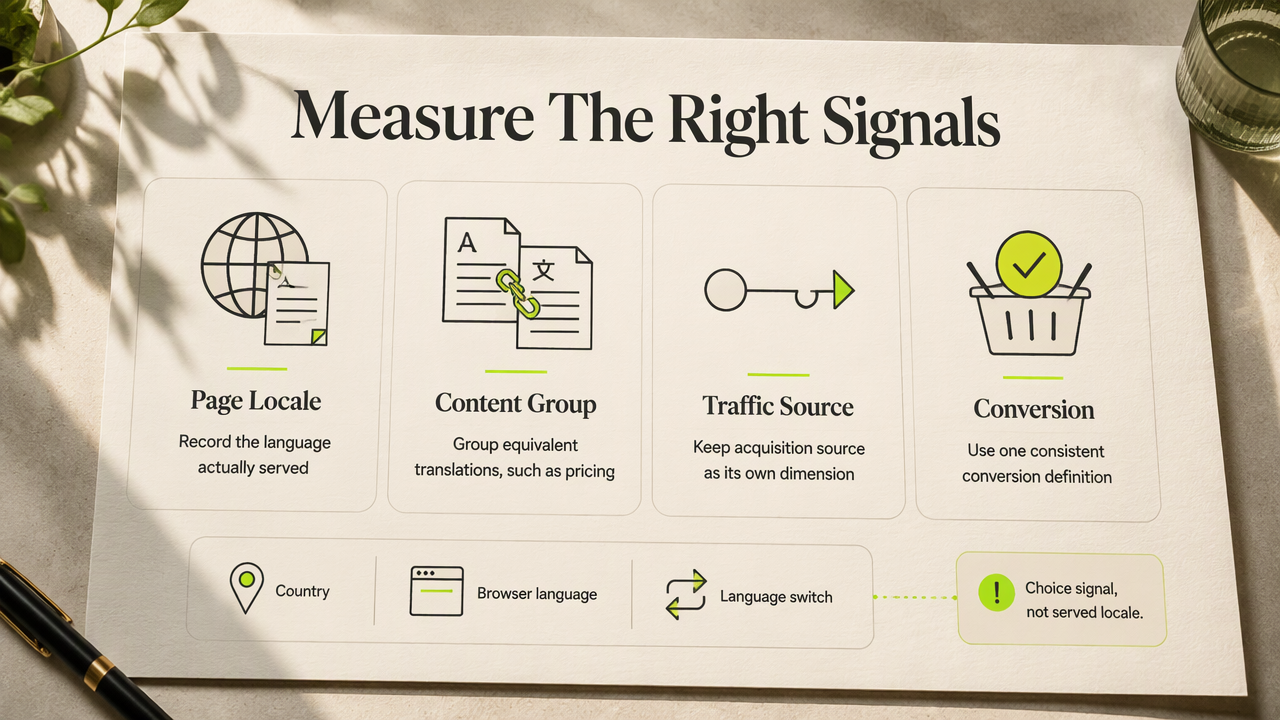
Multilingual website analytics should measure page locale, shared content identity, traffic source, and a consistently defined conversion. Country describes geography; browser language describes a device setting. Neither establishes a visitor's preferred reading language. An explicit language-switch action provides a separate signal of choice, while page locale records the content actually served.
Separate locale from geography and identity
- Page locale: the served language or regional variant, such as
fr-CA. - Content group: one identifier linking equivalent translations, such as
pricing. - Country: a geographic dimension, reported separately.
Store these fields consistently across /fr/ subdirectories and fr.example.com subdomains. For dynamically rendered sites, locale should follow the displayed content rather than merely the initial URL; related implementation reading includes Next.js SaaS analytics and Astro website analytics.
Language served, language selected, and visitor location answer different questions.
How should translated pages be compared?
- Assign equivalent translations a shared content identifier.
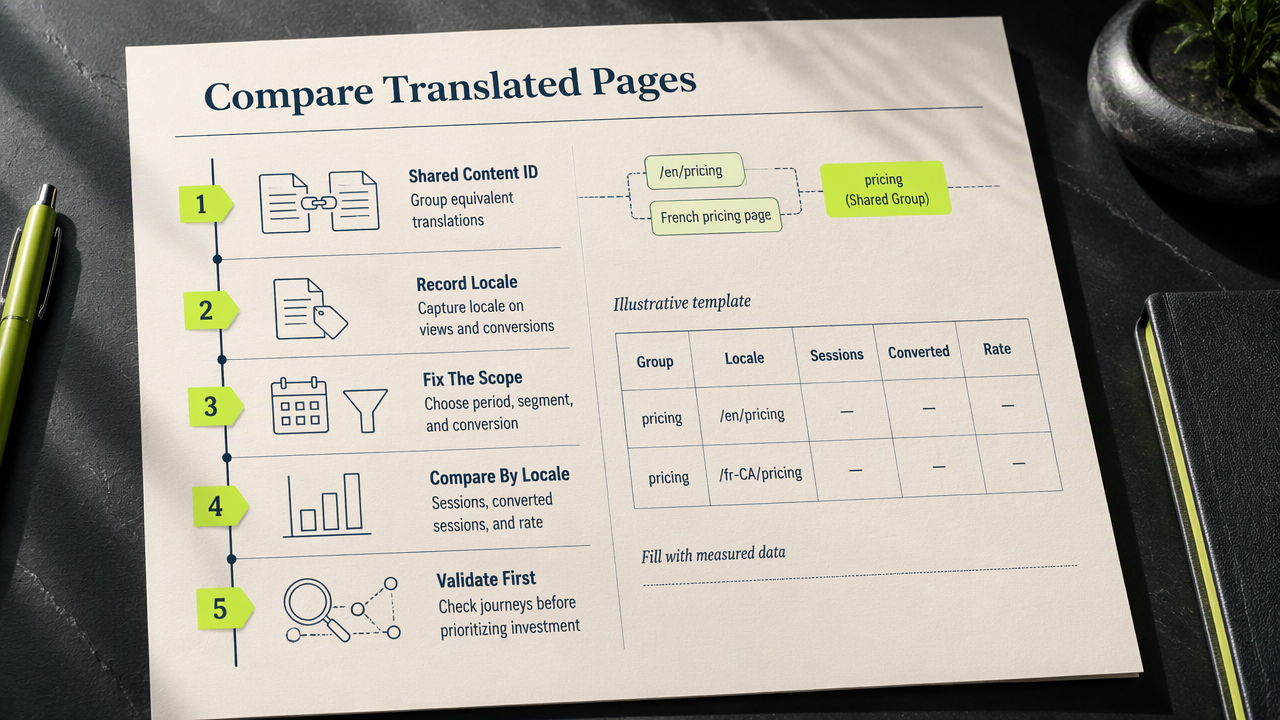
- Record the served locale with each pageview and conversion.
- Choose one reporting period, traffic segment, and conversion definition.
- Compare sessions, converted sessions, and conversion rates by locale.
- Validate sample journeys before using differences to prioritize translation investment.
Localized pricing-page reporting template
This illustrative template groups equivalent pricing pages across URL structures; blanks require measured data.
| Page | Group | Locale | Sessions | Converted sessions | Rate |
|---|---|---|---|---|---|
/en/pricing |
pricing | en | Fill | Fill | Calculate |
fr.example.com/tarifs |
pricing | fr | Fill | Fill | Calculate |
/es/precios |
pricing | es | Fill | Fill | Calculate |
Session conversion rate: converted sessions divided by eligible sessions, multiplied by 100. Count each converted session once, even when several conversion events occur.
Cross-subdomain continuity depends on the tool's identity and configuration. URL reports alone cannot reliably group translated slugs, and consent or blocked scripts can leave gaps. Compare equivalent offers and acquisition sources before attributing differences to translation quality.
Multilingual measurement FAQ
Reliable reporting depends on consistent event collection, explicit locale mapping, and restrained interpretation.
Can country reports reveal preferred language?
Country reports cannot establish preferred language because a country can contain multiple language communities, travelers, and expatriates. Report country alongside served locale rather than replacing it. A language-selector interaction can indicate an explicit choice, but that choice should remain a separate event, not a permanent assumption about identity.
Does first-party collection solve multilingual tracking?
First-party collection concerns how measurement data reaches the collection system; it doesn't automatically create translated-page groups or align conversion definitions. Teams still need locale mapping and event validation. First-party analytics provides related background, while personal data in analytics supports decisions about collected fields.
Can anonymous analytics support localized reporting?
Anonymous reporting can compare aggregate activity by served locale without requiring named visitor profiles. Supported dimensions and conversion methods depend on the selected implementation. Teams should define the reporting questions first, then review anonymous website analytics when choosing an approach that fits their privacy requirements.
Conclusion
Start with one translated page group, one conversion, and one reporting period. Teams evaluating Faurya can visit faurya.com with this template and confirm the required dimensions, event handling, and reporting workflow before expanding measurement across every locale.
Generated by EarlySEO.com
Looking for a free website analytics tool? Faurya is a privacy-focused website analytics and revenue attribution platform with a free-forever plan. Get 50,000 free events every month, with no credit card required. Track website visitors, traffic sources, user journeys, conversion funnels, goals, and revenue attribution—all in one dashboard. Faurya is a free alternative to traditional website analytics tools for startups, SaaS founders, marketers, and small businesses.