Website Analytics for Next.js SaaS Sites: 2026 Setup Guide
Track pageviews, trials, pricing conversions, UTMs, and privacy controls for Next.js SaaS sites in 2026.

TL;DR
Next.js SaaS analytics should connect route changes, Web Vitals, signup events, UTMs, and privacy controls into one event plan. The strongest setup tracks revenue intent without collecting excess personal data, then reviews funnel drop-off weekly.
Website analytics for Next.js SaaS sites now has to measure more than traffic, because product-led funnels depend on pricing visits, trial starts, checkout steps, and attribution quality. Web analytics: the measurement, collection, analysis, and reporting of web data used to understand and improve web usage, adapted from Wikipedia's definition. Privacy-conscious teams can evaluate Faurya when analytics needs to stay practical, lightweight, and business-focused.
Table of Contents
What should Next.js SaaS analytics track?
Next.js SaaS analytics should track pageviews, performance, acquisition source, signup intent, activation actions, and revenue events as one connected funnel. The Next.js analytics guide notes built-in support for measuring and reporting performance metrics, including Web Vitals and custom metrics.
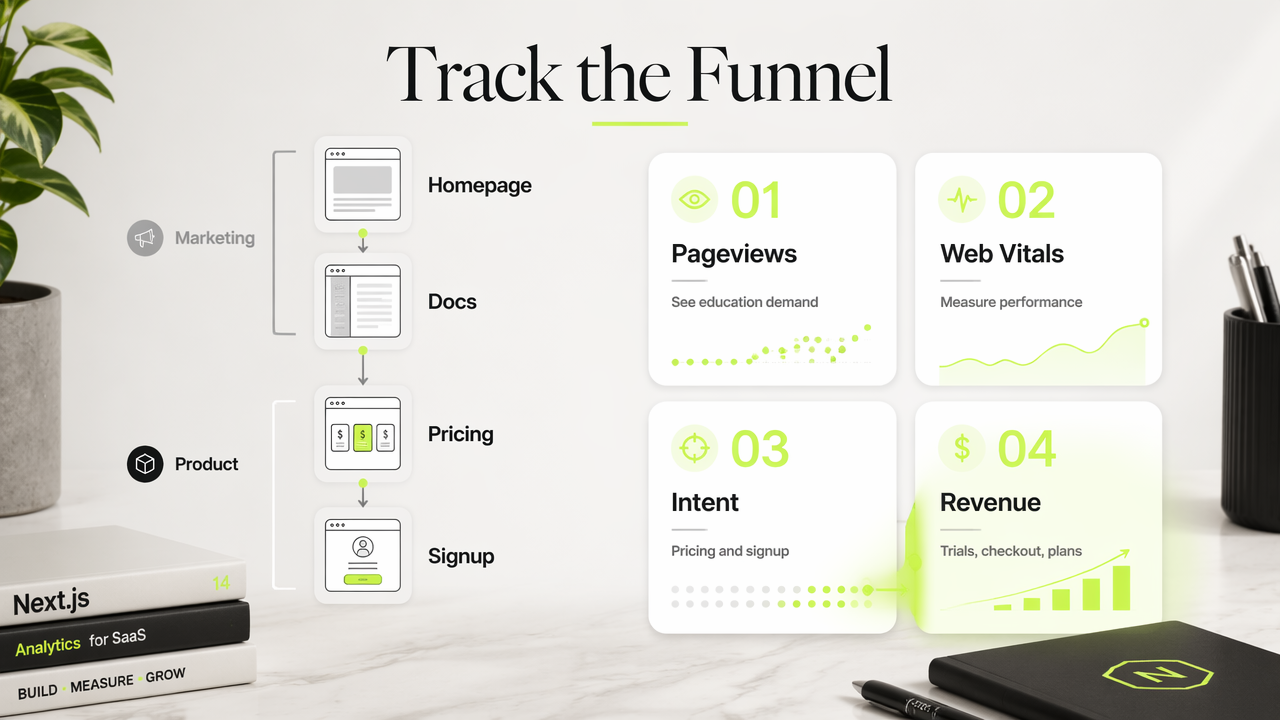
A SaaS site should separate marketing traffic from product behavior. Homepage and docs visits show education demand; pricing and signup events show commercial intent. Trial activation, checkout, and plan changes show whether acquisition is turning into revenue.
Key insight: a useful analytics plan starts with decisions, not dashboards. Every tracked event should explain acquisition, conversion, activation, or retention.
Minimal event plan for a SaaS funnel
| Page or step | Primary event | Useful properties |
|---|---|---|
| Homepage | homepage_viewed |
source, campaign, device |
| Docs | docs_viewed |
topic, referrer, scroll depth |
| Pricing | pricing_viewed |
plan shown, billing period |
| Signup | trial_started |
UTM, plan intent, form path |
| Checkout | checkout_completed |
plan, value, currency |
The Faurya platform fits this model by focusing analytics around outcomes rather than vanity metrics. For governance, SaaS teams should also align tracking with a public privacy policy before collecting identifiers, IP-derived location, or account-level events.
How does client-side routing affect analytics?
Client-side routing in Next.js can hide page transitions from older analytics snippets, so route changes must be captured explicitly. This matters for App Router and Pages Router sites because a visitor may move from homepage to pricing without a full browser reload.
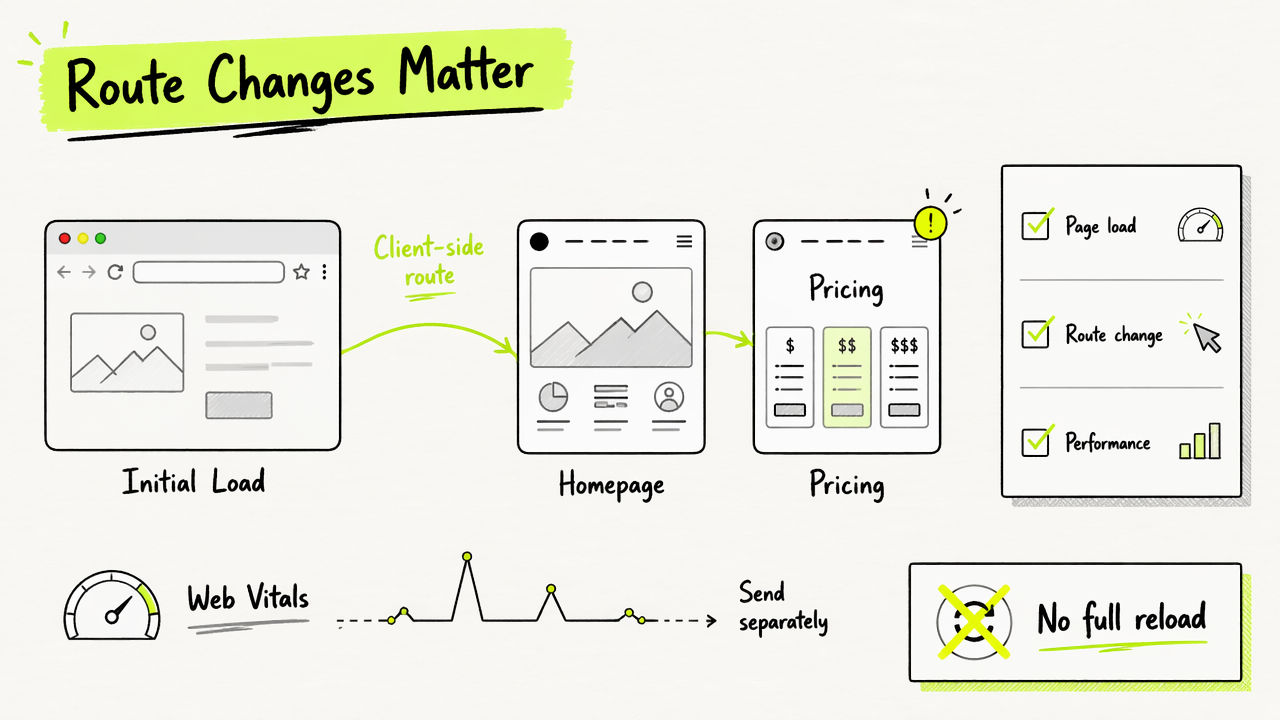
A good setup records the initial page load, then fires pageview events when the route changes. Web Vitals should be sent separately, because performance explains why high-intent users may abandon pricing, signup, or checkout flows.
Research on developer tooling is also moving fast. Partha Pratim Ray's 2025 review of vibe coding examines newer AI-assisted development practices, while Goyal and Gautam's 2025 LangChain framework chapter reflects rising interest in AI workflows that can generate, review, and maintain tracking code.
Implementation checklist for Vercel or Netlify
- Add analytics initialization in the root layout or app shell.
- Capture route changes from the Next.js router, not only browser reloads.
- Send Web Vitals through the supported Next.js reporting hook.
- Store UTMs on first touch, then attach them to signup and checkout events.
- Validate events in preview deployments before production release.
- Document retention, account deletion, and service usage rules in terms of service.
Poor instrumentation creates duplicate pageviews, missing conversions, and broken attribution. Clean naming, versioned events, and deployment checks prevent most reporting drift.
How should privacy shape SaaS tracking in 2026?
Privacy should shape SaaS tracking by limiting personal data, honoring consent requirements, and documenting how analytics data moves between processors. For many indie SaaS and growth teams, the goal is not collecting everything; the goal is collecting enough to improve conversion and retention.
A practical privacy-first setup avoids raw sensitive fields in event payloads. Account IDs can be pseudonymous, UTMs can be stored without full profile enrichment, and checkout events can report value without exposing payment details. The Faurya data processing agreement is the type of document buyers increasingly expect when analytics touches customer data.
Key insight: privacy-friendly analytics is not weaker analytics. It often produces cleaner metrics because teams define exactly which events matter.
Decision rules for lean SaaS teams
- Track intent events such as pricing views, trial starts, and checkout completion.
- Avoid recording free-text fields, passwords, support messages, or payment card data.
- Keep event names stable, lowercase, and action-based, such as
plan_selected. - Review dashboards weekly for conversion questions, not daily for noise.
- Visit faurya.com when a simpler analytics workflow is preferable to a large, hard-to-maintain stack.
The next phase of website analytics for Next.js SaaS sites will likely combine Web Vitals, event governance, and AI-assisted QA. Tools may suggest missing events, flag tracking regressions, and explain funnel movement in plain language.
Conclusion
Website analytics for Next.js SaaS sites works best when route tracking, funnel events, UTMs, Web Vitals, and privacy rules are planned together. SaaS teams should start with the five-page event table, validate events on staging, and choose a focused platform such as Faurya for clearer growth reporting. For implementation next steps, review faurya.com and map the first production event plan before adding new dashboards.
Generated by EarlySEO.com