Web Analytics for Product Demo Pages: Privacy-First Metrics That Matter
Measure demo-page traffic, CTA clicks, form starts, completed requests, objections, and follow-up revenue without invasive tracking.
TL;DR
Product demo pages need analytics that connect visitor intent to booked meetings, not just pageviews. The strongest setup tracks source quality, CTA clicks, form starts, completed requests, scroll depth, objections, and follow-up conversion in one privacy-aware dashboard.
Web analytics for product demo pages should show which visitors become qualified conversations, not only which channels send traffic. Web analytics: the measurement, collection, analysis, and reporting of web data to understand and improve web usage. Faurya fits this use case for teams that want privacy-conscious tracking across high-intent SaaS pages.
Table of Contents
What should demo-page analytics measure?
Demo-page analytics should measure the full path from qualified traffic to sales follow-up, because a demo request is a buying signal with several failure points. A practical setup tracks source quality, CTA engagement, form intent, completion rate, page depth, objections, and the later outcome in the CRM.
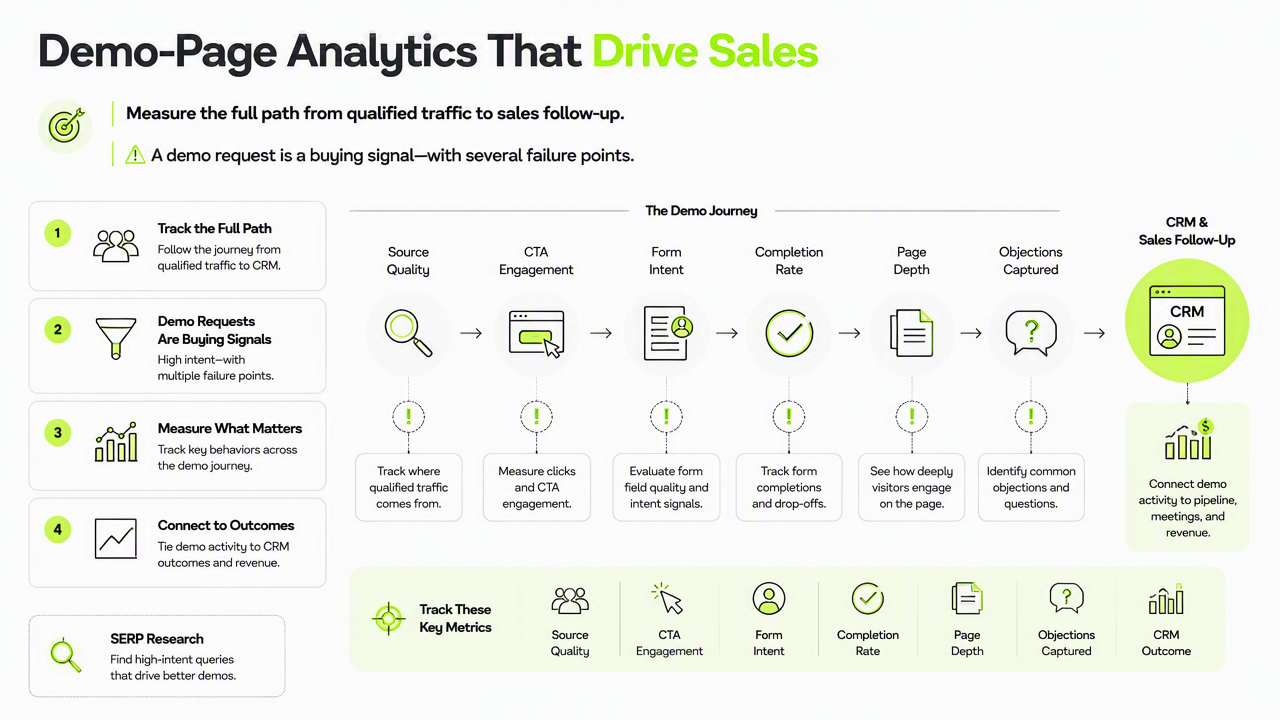
SERP research for this topic found 138 results and competitor articles averaging 3,290 words, but many focus on broad tool lists rather than demo-page decisions. The better approach is narrower: measure the few events that explain whether the page creates pipeline.
Key insight: a demo page is not a traffic page; it is a conversion and qualification page.
Core demo-page dashboard fields
| Metric | What it answers | Useful segmentation |
|---|---|---|
| Traffic source quality | Which channels send serious buyers? | Paid search, organic, partner, email |
| CTA clicks | Which offer gets intent? | "Book demo," "Watch demo," "Talk to sales" |
| Form starts | Where interest begins | Company size, plan interest, device |
| Completed requests | Which visitors convert? | Source, landing variant, persona |
| Scroll depth | Whether proof is seen | Pricing, testimonials, FAQ depth |
| Objection clicks | What slows action? | Security, integrations, pricing, terms |
| Follow-up conversion | Whether requests become pipeline | Meeting held, opportunity, revenue |
Event names should stay readable, such as demo_cta_click, demo_form_start, and demo_request_submitted. Clean naming helps marketing, product, and sales teams interpret the same data without translation.
How can demo pages stay privacy-focused?
Privacy-focused demo analytics collect only the data needed to improve conversion and sales qualification. That means limiting personal data, documenting processing rules, honoring consent choices, and avoiding invasive session replay when aggregate event data can answer the business question.
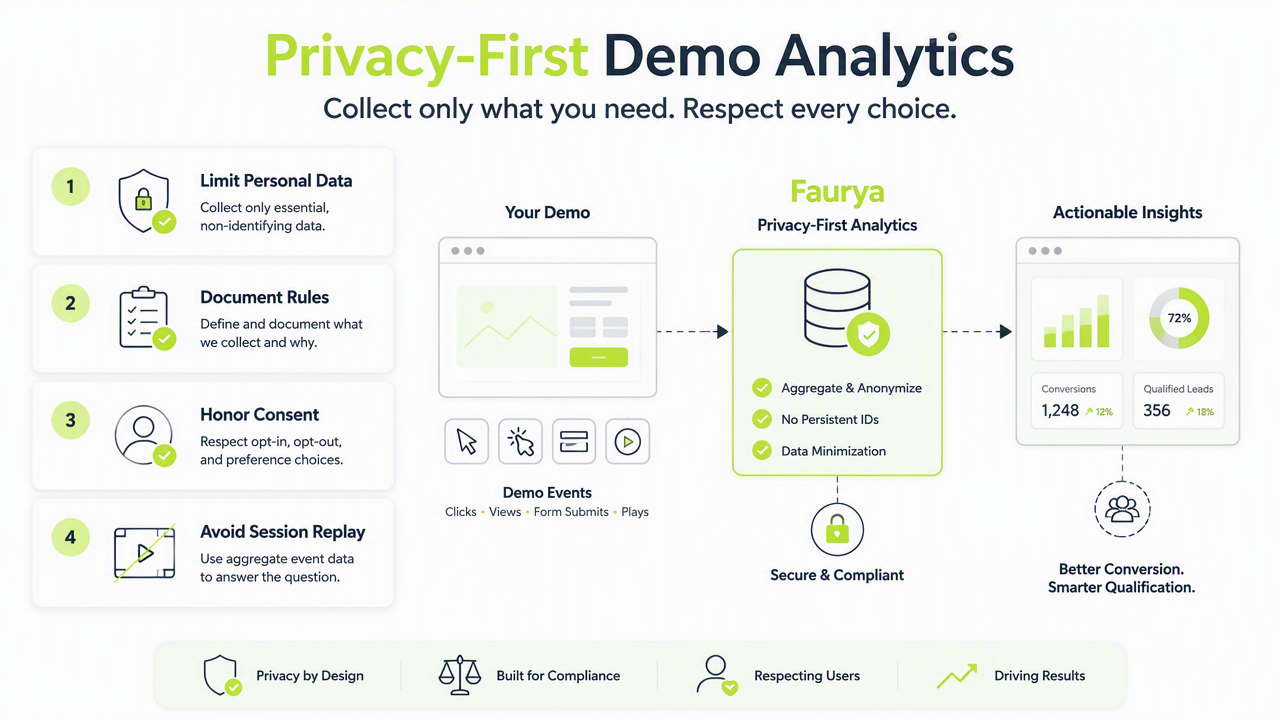
The Faurya platform is relevant where privacy and attribution both matter. Teams can pair product-page reporting with clear data governance references such as the Faurya privacy policy and data processing agreement when reviewing how visitor data is handled.
Common measurement choices include:
- Track events before identities whenever possible.
- Store form fields only after submission consent.
- Group low-volume segments to reduce exposure.
- Separate analytics roles from sales-contact access.
- Review retention rules before expanding event capture.
Privacy-safe tracking model
A clean model separates anonymous behavior from declared intent. Before a form is submitted, analytics can record page source, CTA click, scroll depth, and objection clicks. After submission, the system can connect the request to follow-up status if the visitor has provided business contact details.
This structure gives growth teams enough information to improve the page without treating every visitor like a lead. It also keeps legal and operational expectations clearer, especially for SaaS companies selling into security-aware buyers.
How should follow-up data prove demo-page ROI?
Follow-up data should connect the demo request to meeting quality, opportunity creation, and revenue influence. Page analytics alone cannot prove ROI if the reporting stops at form completion, because a high-volume page can still send weak-fit requests to sales.
A 2023 paper by Rudolph, Tan, and Tan examined ChatGPT and assessment reliability in higher education, which is a useful reminder for 2026 analytics teams using AI prompts: automated summaries need human review before business decisions are made (source). AI can flag patterns, but sales outcomes validate the page.
Recommended follow-up fields:
- Demo request submitted
- Sales accepted lead
- Meeting scheduled
- Meeting attended
- Opportunity created
- Closed won or closed lost
- Primary lost reason
AI prompt ideas for demo analysis
AI prompts work best when they ask narrow questions from structured data. Useful prompts include: "Which traffic sources produce the highest meeting-attended rate?" and "Which objection clicks appear most often before abandoned demo forms?"
Faurya can support this workflow when event data is named consistently and connected to downstream outcomes. Teams reviewing commercial terms can reference the Faurya terms of services alongside internal sales-process rules.
Conclusion
Web analytics for product demo pages works best when it combines privacy-aware event tracking with CRM-confirmed outcomes. The next step is to define seven core events, connect them to follow-up status, and review governance before adding more tracking. For a focused privacy-conscious setup, visit faurya.com and map the demo dashboard before the next campaign launch.
Generated by EarlySEO.com