Web Analytics for Gated Content Funnels: Events, Reports, and Privacy
Track gated assets from visit to form completion to follow-up action with privacy-safe events, campaign rules, and funnel reports.

TL;DR
Gated content measurement works best when teams track the full path: asset view, gate view, form completion, consent state, and follow-up action. A clean event model, strict campaign naming, and privacy-aware reporting make ROI easier to prove without over-collecting visitor data.
Gated assets can look successful while hiding weak follow-up, poor attribution, or low sales quality. Web analytics for gated content funnels connects visits, forms, consent, and post-download actions into one measurement path. Web analytics: the measurement, collection, analysis, and reporting of web data to understand and improve web usage, as defined in standard references such as Wikipedia. Gated content funnel: a visitor path where access to an asset requires a form, account step, or subscription action.
Table of Contents
What is web analytics for gated content funnels?
Web analytics for gated content funnels is the tracking framework that measures how visitors find a gated asset, view the gate, submit a form, receive the asset, and take a later marketing or sales action. For SaaS and B2B teams, the goal is not more form fills; the goal is traceable demand with consent-aware data.
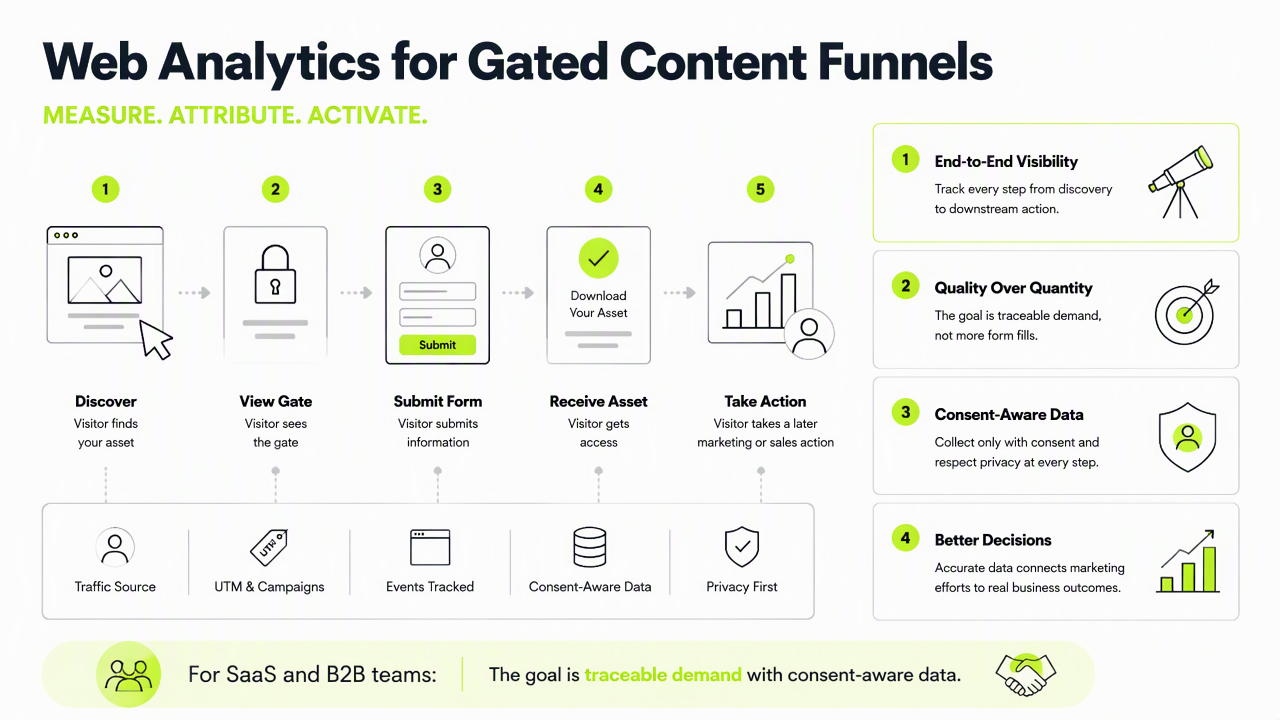
Marketing automation matters here because it connects form activity with follow-up workflows. Wikipedia describes marketing automation as software used to automate repetitive marketing tasks and consolidate multi-channel interactions, which fits gated content follow-up well.
Faurya is relevant when teams need a focused way to connect content performance with visitor behavior and conversion reporting without turning every report into a spreadsheet project.
Key insight: a gated asset is not a conversion by itself; it is a checkpoint between intent, permission, and follow-up quality.
Core funnel stages to measure
| Stage | Primary question | Example event |
|---|---|---|
| Acquisition | Which source drove the visit? | landing_page_view |
| Engagement | Did the visitor inspect the offer? | asset_intro_scroll |
| Gate | Did the form appear and get used? | gate_view, form_start |
| Conversion | Was access granted? | form_submit_success |
| Follow-up | Did a meaningful next step happen? | demo_click, reply, trial_start |
Each stage should carry the same asset ID, campaign name, channel, consent status, and account or lead ID where allowed.
Which events and campaign rules should teams track?
Teams should track a short set of named events, then enforce consistent campaign naming across paid, organic, email, partner, and sales-assisted traffic. The strongest model keeps event names stable, records asset metadata once, and separates visitor identity from consent-sensitive fields.
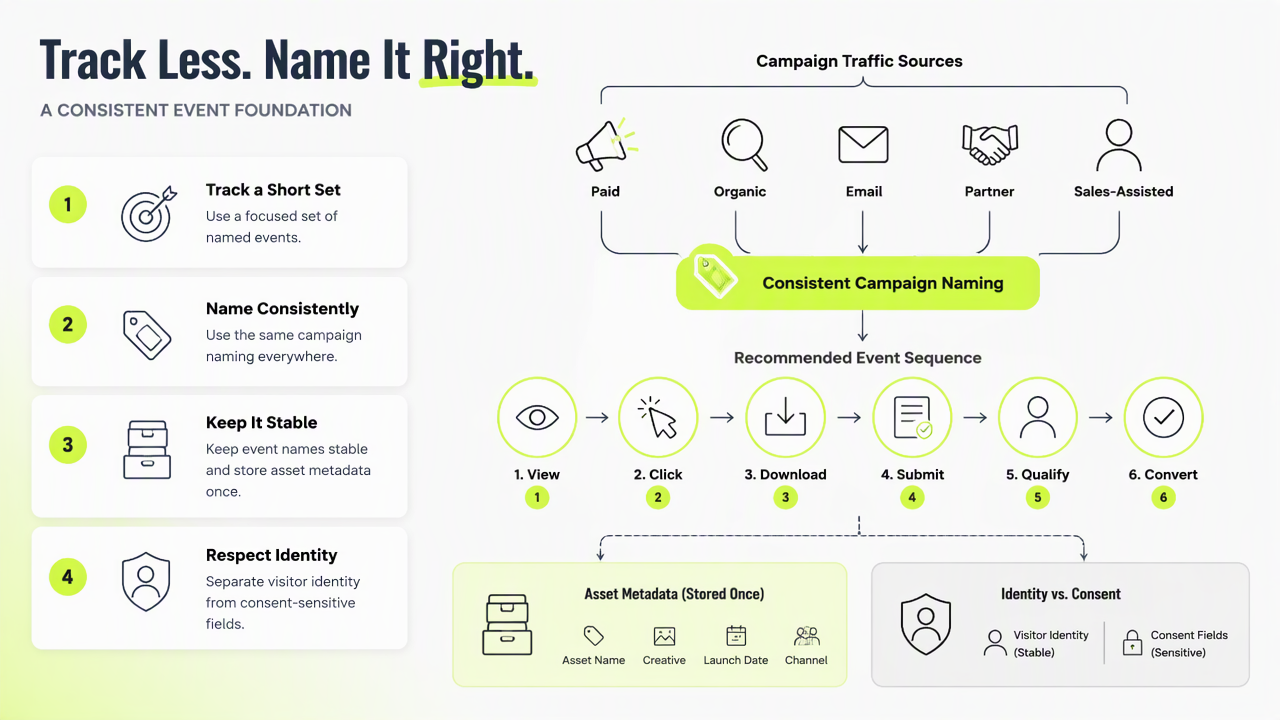
Recommended event sequence:
asset_page_view, page loaded for a specific gated offer.gate_view, form or access prompt displayed.form_start, at least one field engaged.form_submit_success, access granted after validation.asset_download_or_view, content consumed after the gate.follow_up_action, booked demo, trial start, reply, or qualified handoff.
Campaign names should follow one pattern: channel_audience_asset_offer_date. An example is linkedin_founders_roi-guide_demo-cta_2026q1. The same pattern keeps reporting readable across analytics, CRM, and automation tools.
The Faurya platform can support this discipline by giving growth teams a cleaner view of gated journeys and follow-up behavior across content campaigns.
Event property checklist
- Asset properties:
asset_id,asset_type,topic,funnel_stage. - Campaign properties:
utm_source,utm_medium,utm_campaign,utm_content. - Consent properties:
consent_status,tracking_mode,region. - Lead properties:
lead_id,company_id,lifecycle_stage, only when permitted. - Outcome properties:
follow_up_type,sales_status,revenue_stage.
Naming discipline is a measurement asset. Without it, gated content reports become channel anecdotes instead of decision tools.
How should privacy-safe funnel reporting work in 2026?
Privacy-safe funnel reporting should show conversion movement without collecting more personal data than the funnel requires. The practical approach is to report anonymous behavior before consent, attach identity only after a valid form action, and keep consent state visible in every report.
A good report answers four questions: where qualified visitors came from, which gated assets created form intent, which submissions led to follow-up, and which follow-up actions became pipeline. That structure helps SaaS founders, e-commerce teams, and growth marketers compare content quality instead of just traffic volume.
AI will make this reporting more automated, but governance still matters. A 2024 Journal of Business Research article on generative artificial intelligence in new idea management examined future research directions for AI-supported new idea, a useful signal for teams expecting automated analysis to expand through 2026 and 2027.
Funnel report structure
| Report view | Metric focus | Decision supported |
|---|---|---|
| Source to gate | Visit-to-gate-view rate | Budget allocation |
| Gate to form | Form-start and submit rate | Offer and form design |
| Form to action | Download-to-demo or trial rate | Follow-up quality |
| Asset cohort | Performance by topic and audience | Content planning |
| Consent view | Known, anonymous, and restricted data | Privacy governance |
Reports should exclude personally identifiable details from broad dashboards. Role-based access can reserve lead-level data for sales and lifecycle teams.
Conclusion
Strong gated content measurement starts with a small event map, clear campaign names, and a report that follows the visitor from source to follow-up action. For teams building privacy-conscious demand funnels, Faurya offers a focused path to cleaner content analytics. For the next step, review the current gated assets, standardize the event names above, then visit faurya.com to assess how the reporting workflow could be improved.
Generated by EarlySEO.com