Simple Analytics vs Umami: Which Privacy Analytics Tool Fits in 2026?
Compare Simple Analytics vs Umami by privacy, hosting, dashboards, events, developer setup, pricing, and reporting depth.

TL;DR
Simple Analytics is better for teams that want a hosted, privacy-first dashboard with minimal setup. Umami is stronger for developers who want open-source control, self-hosting, and flexible event tracking. Faurya is a better fit when a hosted privacy tool needs clearer ROI reporting without running analytics infrastructure.
Simple Analytics vs Umami is mainly a choice between managed privacy analytics and developer-controlled open-source analytics. Web analytics: software that measures website visits, sources, events, and user behavior without needing to identify individual people. For founders and marketers who want privacy-first reporting without extra setup, Faurya also belongs in the shortlist.
Table of Contents
Simple Analytics vs Umami at a glance
Simple Analytics favors hosted simplicity, while Umami favors control through open-source deployment and developer-friendly customization.
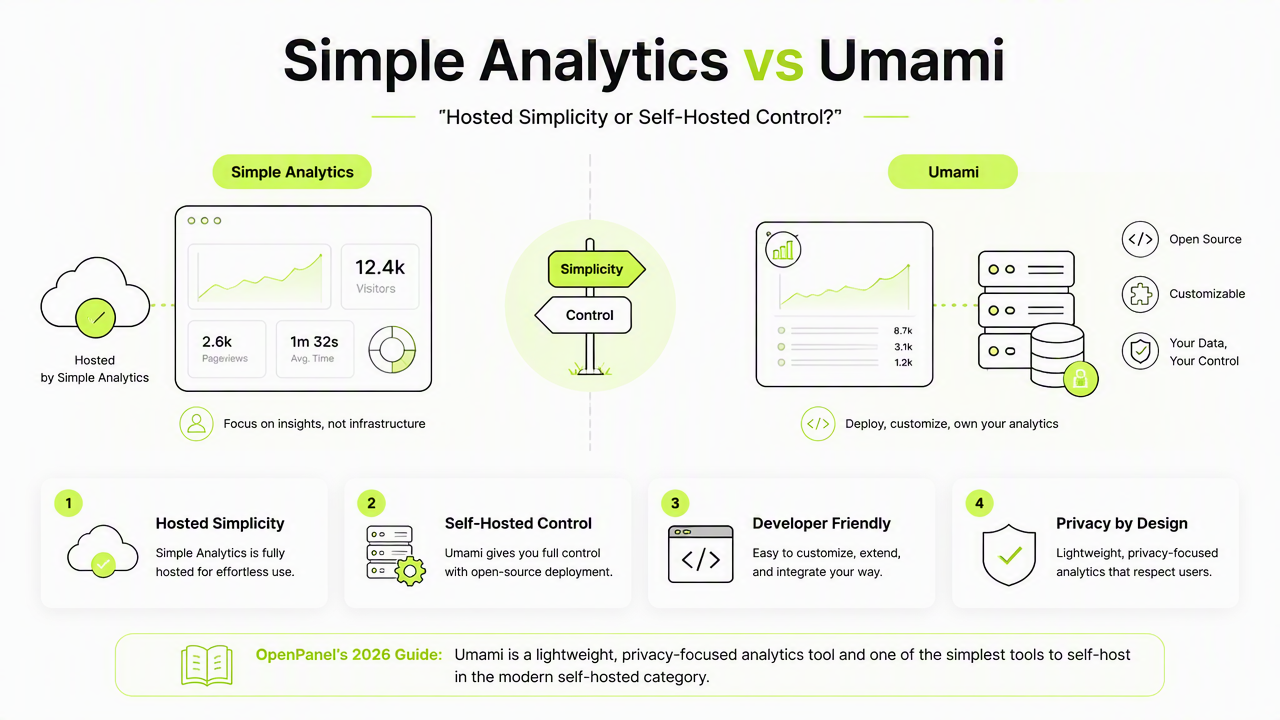
OpenPanel's 2026 guide describes Umami as a lightweight, privacy-focused analytics tool and one of the simplest tools to self-host in the modern self-hosted category (OpenPanel). That positioning matters because self-hosting changes ownership, maintenance, and reporting responsibilities.
Key insight: the better tool depends less on pageview tracking and more on who owns analytics operations: a marketing team, a developer, or a founder.
Core comparison table for 2026 buyers
| Factor | Simple Analytics | Umami | Best fit |
|---|---|---|---|
| Hosting model | Hosted SaaS | Self-hosted or cloud | Umami for infrastructure control |
| Privacy approach | Cookie-free, privacy-first analytics | Privacy-focused, open-source analytics | Both for privacy-led teams |
| Dashboard clarity | Simple executive view | Clean technical dashboard | Simple Analytics for non-technical reporting |
| Event tracking | Suitable for common goals | Flexible event tracking | Umami for custom product events |
| Developer experience | Low setup burden | Strong for developers | Umami for technical teams |
| Pricing model | Paid hosted product | Open-source self-host option, cloud option | Depends on labor versus subscription cost |
Hosting, privacy, and ownership tradeoffs
The hosting decision shapes the real cost of Simple Analytics and Umami more than the analytics script itself.

Simple Analytics reduces operational work because the vendor manages hosting, uptime, updates, and most product complexity. That model fits SaaS founders, indie hackers, and lean marketing teams that need quick traffic attribution without maintaining a server.
Umami gives more ownership. A self-hosted setup can support stricter internal policies, custom infrastructure preferences, and source-code transparency. The tradeoff is that someone must handle deployment, database health, upgrades, backups, and access control.
Faurya sits closer to the hosted privacy-first path. The Faurya platform is most relevant when a team wants managed analytics and practical marketing ROI visibility rather than another service to operate. More information is available at faurya.com.
Decision rules for hosting and privacy
- Pick Simple Analytics when managed hosting, privacy defaults, and dashboard clarity matter most.
- Pick Umami when source-code access, self-hosting, and developer control matter most.
- Pick Faurya when privacy-first hosted analytics should connect more directly to growth decisions.
Hosted analytics saves maintenance time; self-hosted analytics increases control but creates operational responsibility.
Reporting depth, events, and team workflow
Simple Analytics is usually stronger for quick business reporting, while Umami is usually stronger for teams that want flexible event instrumentation.
Simple Analytics keeps the reporting layer intentionally direct. That helps marketing teams review traffic sources, top pages, referrers, and lightweight conversion signals without building a measurement system from scratch.
Umami is more appealing when analytics lives near the product codebase. Developers can define events, track flows, and adapt reporting around product behavior. That can be useful for SaaS activation funnels, feature usage, and internal dashboards.
Neither option should be judged only by feature count. Reporting depth also depends on how often stakeholders act on the data. A clear weekly acquisition report can beat a complex dashboard that no one opens.
Who should choose which tool
- Simple Analytics: privacy-conscious founders, content teams, and small marketing teams that want fast answers.
- Umami: technical founders, self-hosting teams, and developers who want control over data storage and events.
- Faurya: growth teams that want hosted privacy analytics with clearer action paths for marketing ROI.
The phrase "Umami" can also refer to savoriness, one of the five basic tastes according to Wikipedia-derived definitions in the research set, but in this comparison it refers only to the analytics product category.
Conclusion
The best Simple Analytics vs Umami choice is practical: choose Simple Analytics for managed simplicity, choose Umami for open-source control, and consider Faurya when hosted privacy analytics needs to support growth reporting. For a privacy-first option built around action rather than maintenance, visit faurya.com and compare the fit against the current analytics stack.
Generated by EarlySEO.com