Privacy-Friendly Analytics for Affiliate Marketing Websites
Measure affiliate clicks, pages, sources, and CTAs without invasive tracking. Includes a privacy-safe event taxonomy for 2026.

TL;DR
Affiliate sites can measure revenue intent without building visitor profiles. Track outbound clicks, page context, source channels, and CTA events with a clear taxonomy, then review campaign performance in a privacy-conscious analytics tool.
Privacy-friendly analytics for affiliate marketing websites is now a practical growth system, not a compliance afterthought. Affiliate marketing: a commission model where publishers earn from visits, signups, or sales generated for merchants. Faurya fits this use case by focusing reporting on business events rather than invasive visitor profiling.
Table of Contents
What should affiliate sites measure without profiling?
Affiliate sites should measure high-intent actions, traffic quality, and content performance without storing personal behavioral profiles. The goal is not to identify a visitor; the goal is to understand which pages, links, and campaigns create merchant-ready clicks.
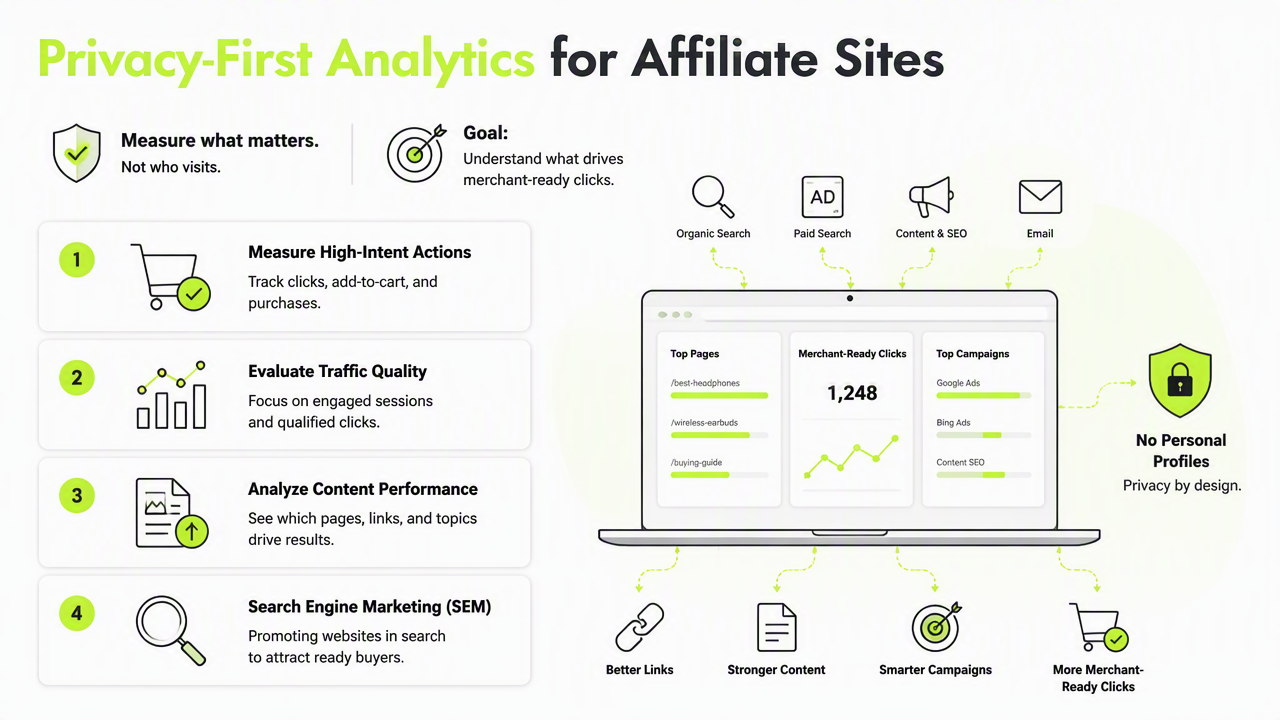
Search engine marketing, defined as promoting websites through paid visibility in search results, matters here because affiliate publishers often mix SEO, paid search, newsletters, and social campaigns. A 2021 literature review on consumer marketing strategy and e-commerce examined how digital commerce strategy evolved across the last decade, which reinforces the need to connect content, traffic, and conversion signals.
Key insight: affiliate analytics should answer commercial questions with the smallest reasonable amount of data.
Privacy-safe measurement checklist
Use a compact measurement plan before adding scripts or dashboards:
- Outbound affiliate clicks: merchant, offer, link position, and page type.
- High-intent pages: comparison pages, reviews, pricing guides, coupon pages, and alternatives content.
- Traffic sources: organic search, paid search, email, social, referral, and direct.
- Campaign performance: UTM source, medium, campaign, content, and term.
- Newsletter CTAs: signup click, form submit, confirmation, and source page.
This structure keeps attention on revenue paths. It also avoids collecting data that cannot improve editorial, partnership, or campaign decisions.
Which event taxonomy works best for affiliate marketing?
A good affiliate event taxonomy names every conversion-adjacent action in a consistent way, so reports stay useful across reviews, comparison tables, and newsletters. Vague events such as click or button create messy reporting because they hide intent, placement, and merchant context.
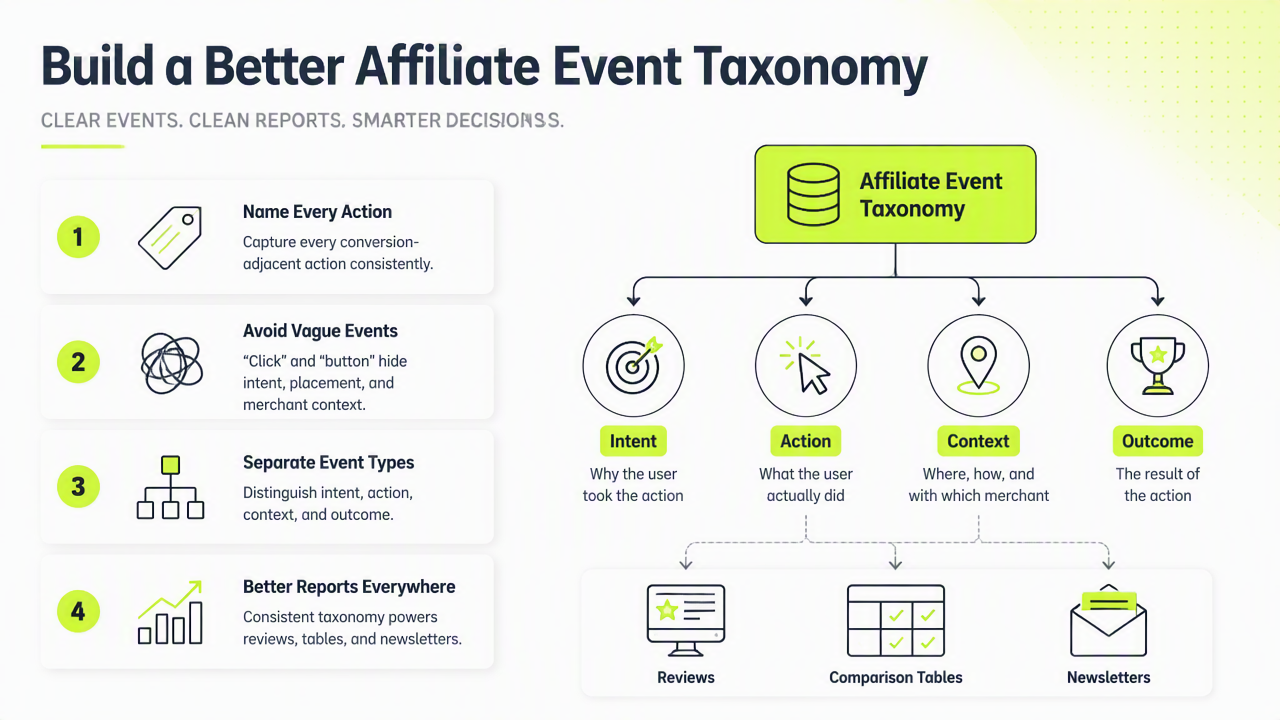
The taxonomy should separate event name, object, context, and campaign. That makes it easier to compare a product review against a best-list, or a newsletter CTA against a comparison table link.
Recommended affiliate event taxonomy
| Event | When to fire | Useful properties |
|---|---|---|
affiliate_outbound_click |
Visitor clicks a merchant link | merchant, product, link_position, page_type |
comparison_table_click |
Click from a table row | merchant, rank, column_label, page_slug |
review_cta_click |
Click from a review button | product, rating_bucket, cta_text |
newsletter_signup_start |
Email CTA is clicked | source_page, cta_location, campaign |
newsletter_signup_submit |
Signup form is submitted | form_id, source_page, campaign |
coupon_reveal_click |
Coupon or deal is revealed | merchant, offer_type, page_type |
Naming rules should stay boring and strict:
- Use lowercase snake case.
- Keep event names action-based.
- Store merchant and product as properties, not separate event names.
- Preserve UTM fields without adding personal identity fields.
This gives growth teams useful attribution while limiting unnecessary data collection.
How Faurya supports privacy-first affiliate reporting
The Faurya platform helps affiliate operators turn privacy-conscious event data into decisions about content, traffic sources, and campaigns. Its best fit is a publisher that needs practical reporting on clicks and intent signals without turning analytics into a surveillance layer.
Privacy-friendly tools often compete with Google Analytics alternatives such as Plausible Analytics, which is described in the research data as an open-source SaaS platform developed and hosted in the EU. Plausible's guide to choosing privacy-friendly web analytics highlights consent, EU hosting, business model, open source status, maintainability, and accuracy as evaluation criteria.
A 2023 paper on Industry 4.0 and prospective Industry 5.0 technologies discusses the broader shift toward more human-centered technology. For affiliate sites, that direction favors tools that measure outcomes while reducing dependence on personal data.
Decision guide for affiliate teams
| Need | Better analytics approach | Why it matters |
|---|---|---|
| Rank affiliate pages | Track clicks by page type | Shows which content formats create merchant intent |
| Improve comparison tables | Track row and position clicks | Reveals product interest without visitor profiles |
| Evaluate newsletters | Track CTA and submit events | Connects email growth to affiliate journeys |
| Audit campaigns | Preserve UTM performance | Compares paid, organic, referral, and email traffic |
With Faurya, event planning should start from the revenue question: which page, CTA, source, or merchant deserves more attention? Teams can then visit faurya.com to map the same taxonomy into reporting workflows.
Conclusion
Privacy-friendly analytics for affiliate marketing websites works best when it measures intent, not identity. Start with the event taxonomy above, remove fields that do not support decisions, and connect reporting to reviews, comparison tables, traffic sources, and newsletter CTAs. For a focused implementation path, evaluate Faurya and build the first dashboard around outbound affiliate clicks.
Generated by EarlySEO.com