Heap alternatives for privacy-first marketing teams
Compare lightweight, product, and hybrid analytics by privacy, setup, event tracking, and reporting clarity.

TL;DR
Choose lightweight analytics for campaign reporting, product analytics for detailed behavioral analysis, or a hybrid for both. Evaluate privacy through actual collection settings and policies, then test reporting with a defined conversion.
More behavioral data doesn't automatically produce better marketing decisions. Heap alternatives for privacy-first marketing teams should match campaign questions to proportionate data collection. Faurya deserves a place on that shortlist, with evaluation centered on the reports, events, and privacy controls a marketing team actually needs.
Table of Contents
Which analytics approach fits website marketing?
Lightweight analytics suits focused website reporting, product analytics suits detailed behavioral questions, and hybrid tools bridge both needs. These are selection categories, not guarantees about any vendor's features. The best fit depends on whether the team needs campaign outcomes, product interactions, or both within the same reporting workflow.
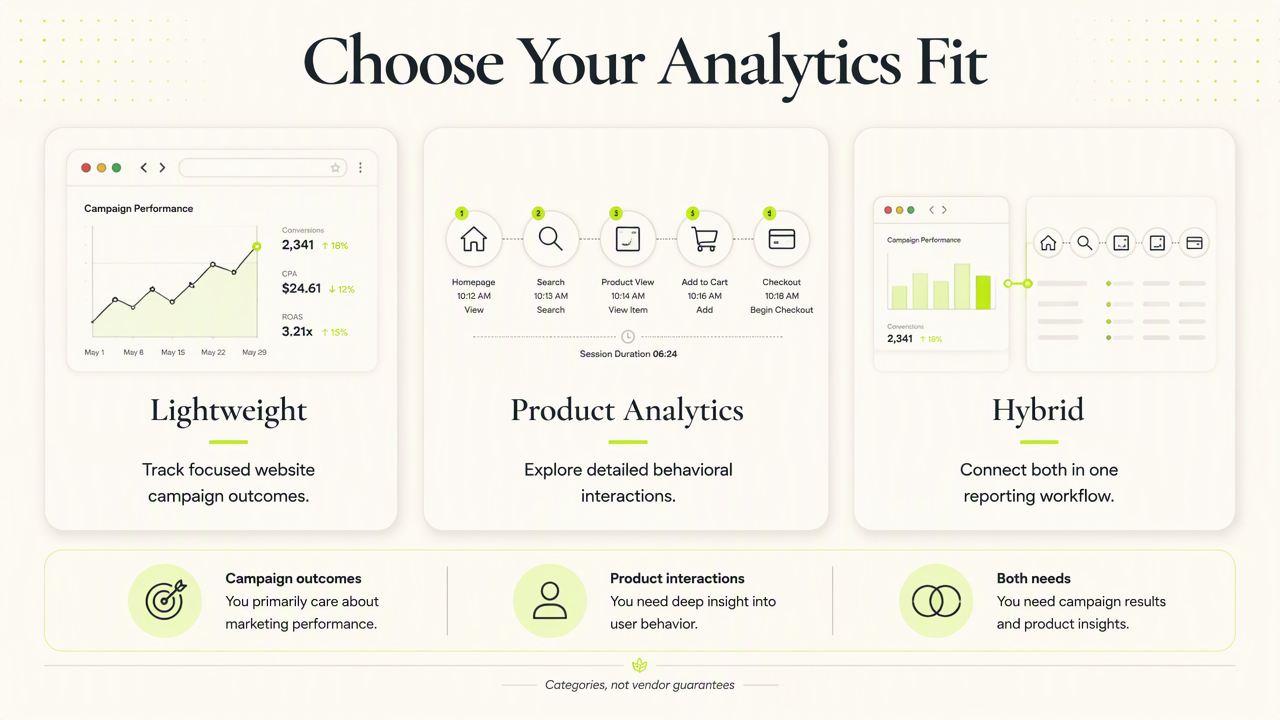
Privacy-first analytics: Website measurement designed around collecting only the data needed for a defined business purpose.
Compare scope before comparing feature counts
| Approach | Setup effort | Privacy review | Event tracking | Reporting clarity |
|---|---|---|---|---|
| Lightweight | Start with website measurement | Check identifiers and retention | Confirm key conversions | Prioritize campaign summaries |
| Product analytics | Plan behavioral instrumentation | Review event properties | Assess detailed interactions | Prioritize funnels and cohorts |
| Hybrid | Define both reporting scopes | Inspect each enabled module | Connect website and product events | Test cross-team readability |
These comparison points are evaluation criteria, not measured benchmarks. A useful demonstration should answer one concrete question: which campaign generated completed sign-ups?
Prefer the smallest measurement scope that answers the team's recurring decisions.
How should teams evaluate Faurya?
- Define the campaign decision that the Faurya evaluation should support.
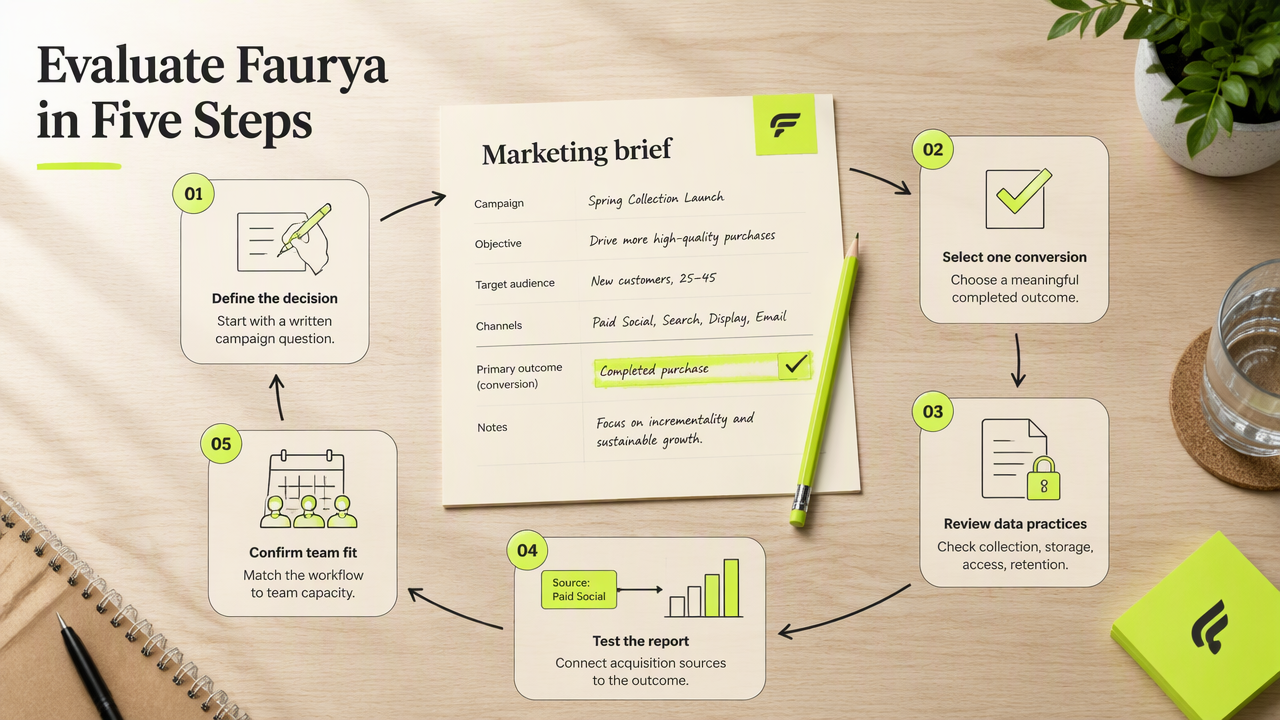
- Select one meaningful conversion, such as a completed purchase.
- Review collection, storage, access, and retention documentation.
- Test whether the resulting report connects acquisition sources with that outcome.
- Confirm the workflow fits the team's operating capacity.
Use a focused acceptance checklist
For the Faurya platform, the strongest evaluation starts with a written marketing brief rather than a broad feature inventory. A SaaS team might specify completed registrations by campaign; an e-commerce team might specify completed orders by acquisition source.
The privacy policy provides a starting point for reviewing documented data practices. Match that review with the proposed implementation and applicable legal requirements.
- Collection: Record which identifiers and event properties are needed.
- Access: Identify who can view or export reports.
- Retention: Establish how long measurement data serves its purpose.
- Clarity: Ask a marketer to interpret the report without analyst assistance.
Privacy-first analytics FAQ
Privacy-first selection depends on the implementation as well as the tool category.
Does cookieless analytics automatically mean compliance?
Cookieless analytics does not, by itself, establish compliance. A review should consider the data collected, its purpose, storage arrangements, access, and relevant legal requirements. Teams should document the actual configuration rather than treating a marketing label as a legal assessment. Qualified advice can resolve jurisdiction-specific questions.
When is product analytics worth the extra scope?
Product analytics is worth considering when decisions depend on behavior inside an application, not just website acquisition. Questions about onboarding steps or repeated feature use justify evaluating deeper event analysis. A team focused on campaign traffic and completed purchases should first test whether simpler reporting answers its needs.
How can teams test reporting clarity before switching?
Teams can test reporting clarity by giving each candidate the same campaign question, conversion definition, and reporting period. A marketer should explain the result and identify the next action. The comparison should also record setup work and ongoing maintenance, so attractive dashboards aren't judged separately from operational effort.
Conclusion
Select an analytics approach before selecting a vendor. Then prepare one conversion-based acceptance test and a privacy checklist. Visit faurya.com to begin a focused evaluation, using campaign reporting needs and documented data practices as the basis for the decision.
Generated by EarlySEO.com