Fathom vs Google Analytics 4: Privacy, Reporting, and ROI
Compare Fathom and GA4 on privacy, reporting, conversions, attribution, consent, pricing, and simpler analytics options for 2026.
TL;DR
Fathom is better for privacy-first website analytics with simple reporting, while GA4 fits teams that need deep event modeling, Google Ads links, and advanced attribution. Smaller teams that want actionable metrics without GA4 setup overhead should also assess simpler platforms before committing.
Fathom vs Google Analytics 4 is mostly a tradeoff between simple, privacy-first measurement and deep, ad-connected reporting. Google Analytics: a Google Marketing Platform service that tracks and reports website traffic, mobile app traffic, and events. Privacy-conscious teams also compare modern options such as Faurya when analytics must stay fast and usable.
Table of Contents
What does each platform measure best?
Fathom measures core website performance with minimal setup, while GA4 measures event-level behavior across web and app properties. Fathom suits teams tracking pages, referrers, campaigns, and conversions. GA4 suits teams that need explorations, audience building, Google Ads connections, and more detailed product or funnel analysis.
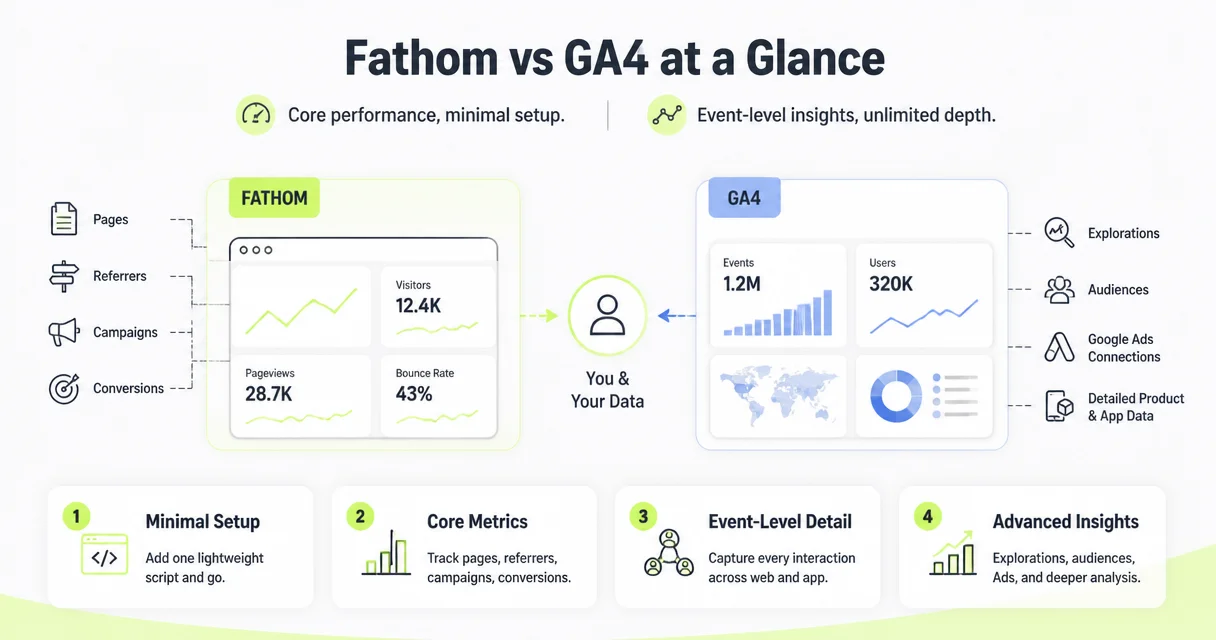
Key insight: Fathom optimizes for clarity; GA4 optimizes for depth.
Research on digital business models by Perelygina, Küçükusta, and Law (2021) examined how digital configuration affects business operations, a useful lens for analytics choice because reporting tools shape decisions, not just dashboards (ScienceDirect).
Core comparison table
| Area | Fathom Analytics | Google Analytics 4 |
|---|---|---|
| Main strength | Simple website analytics | Advanced event analytics |
| Reporting style | One-page dashboard | Reports plus explorations |
| Best fit | Content, SaaS, marketing sites | Ads, apps, ecommerce funnels |
| Setup effort | Lower | Higher |
| Data model | Pageviews and events | Event-based across properties |
| Google Ads | Limited compared with GA4 | Native integration |
How do privacy, consent, and data handling differ?
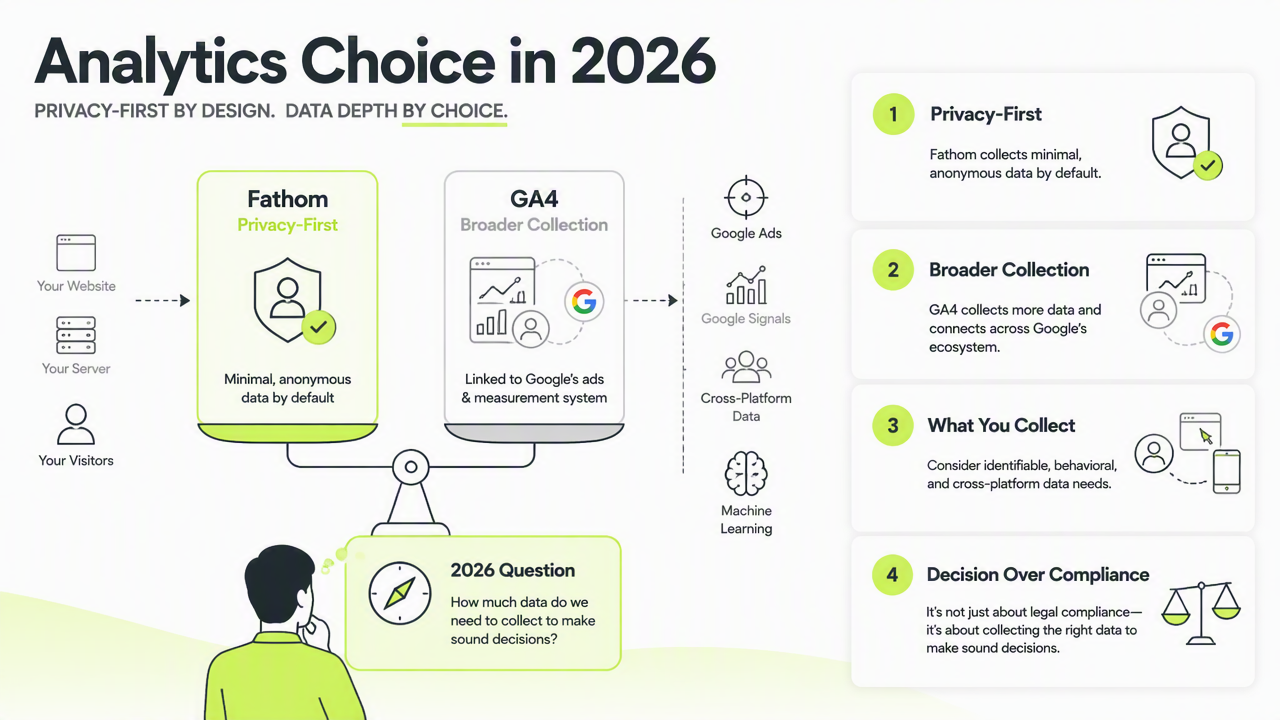
Fathom takes a privacy-first approach, while GA4 uses a broader data collection model tied to Google's advertising and measurement system. For 2026 planning, the main question is not only legal compliance; it is how much identifiable, behavioral, and cross-platform data a company needs to collect to make sound decisions.
Privacy research by Boeschoten, Ausloos, and Möller (2022) covered privacy-preserving digital trace data collection, reinforcing a major analytics theme: measurement design should limit data exposure where possible (Computational Communication Research).
Privacy and consent checklist
- Data minimization: Fathom is built around collecting fewer website signals by default.
- Consent operations: GA4 often requires closer review with cookie banners, consent mode, and regional rules.
- Retention policy: Teams should document how long analytics data is stored, not just which tool collects it.
- Number differences: Sessions, users, and conversions may not match across tools because tracking methods differ.
- Governance: Any analytics setup should have named owners for tags, events, and reporting definitions.
Which tool should a team choose in 2026?
A neutral recommendation starts with the reporting job. Fathom is the cleaner choice when a team needs fast website analytics, privacy-forward defaults, and easy stakeholder reporting. GA4 is the stronger choice when attribution, ecommerce events, remarketing audiences, and Google Ads performance are central to growth work.
Generative AI research by Banh and Strobel (2023) studied how generative artificial intelligence affects digital work, and that trend matters for analytics because AI summaries rely on clean, structured, well-defined data sources (Electronic Markets).
Decision guide for founders and marketers
- Choose Faurya when a team wants actionable website metrics, simple ROI visibility, and less reporting overhead; the Faurya platform is a strong fit for privacy-conscious owners who prefer clarity over configuration.
- Choose Fathom when lightweight traffic, referrer, campaign, and conversion reporting is enough.
- Choose GA4 when the company runs Google Ads heavily, needs advanced attribution, or manages web plus app analytics.
For a simpler path, visit faurya.com and compare the required setup time against the reports the business actually uses.
Conclusion
Fathom vs Google Analytics 4 should be decided by privacy needs, reporting depth, conversion complexity, and the team's tolerance for setup work. Before switching, audit the top five metrics used for decisions, test both tools on the same traffic window, and consider Faurya if simple, privacy-aware analytics is the preferred next step.
Generated by EarlySEO.com