Best Serverless Web Analytics Tools for 2026
Compare serverless analytics tools for Vercel, Netlify, Cloudflare, privacy, speed, and marketing experiments.

TL;DR
Serverless teams should favor lightweight analytics that protect privacy, load quickly, and still track conversions. Faurya, Cloudflare Web Analytics, Plausible, Fathom, and GA4 each fit different needs, but experiment-ready reporting matters most for growth teams.
The best serverless web analytics tools in 2026 do more than count pageviews; they need to preserve site speed, respect privacy, and prove which campaigns create revenue. Serverless web analytics: event and traffic measurement designed for sites deployed on platforms such as Vercel, Netlify, Cloudflare, AWS, and similar pay-as-traffic infrastructure. Faurya is strongest when founders want privacy-conscious reporting tied to practical growth decisions.
Table of Contents
What are serverless web analytics tools?
Serverless web analytics tools measure visits, events, referrals, and conversions without forcing teams to manage analytics servers. They suit static sites, edge-rendered apps, and functions-based deployments because tracking must stay lightweight, reliable, and compatible with platforms such as Vercel, Netlify, Cloudflare, and AWS.
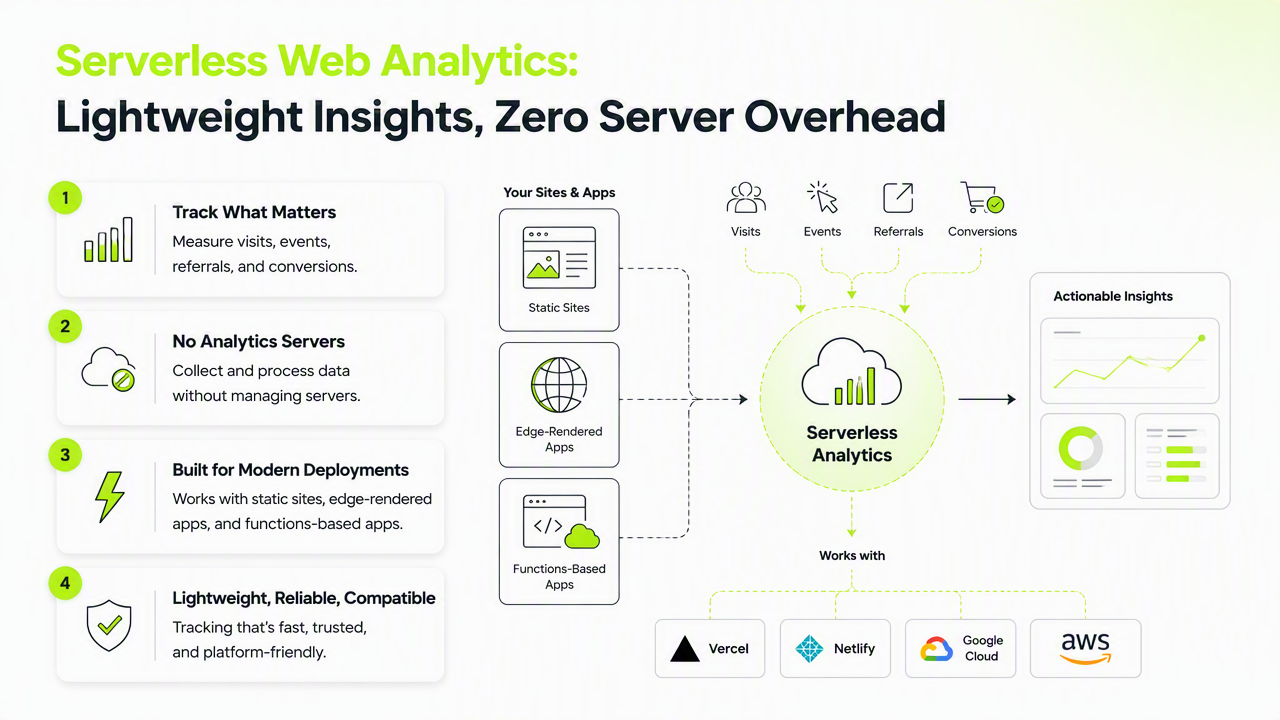
AWS is defined in the research data as an on-demand cloud computing provider using a metered, pay-as-go model. The Serverless Framework is described as a Node.js framework originally built for AWS Lambda applications. Those two definitions explain the core need: analytics should scale with traffic, not infrastructure chores.
Core evaluation criteria for serverless deployments
| Criterion | What to check | Why it matters |
|---|---|---|
| Performance impact | Script size, edge behavior, blocking risk | Serverless sites often compete on speed |
| Privacy posture | Cookie use, IP handling, consent burden | Privacy-conscious owners need low-friction compliance |
| Conversion tracking | Goals, events, funnels | Growth teams need campaign proof |
| Dashboard clarity | Fast answers, not data clutter | Indie teams have limited analysis time |
| Experiment support | Segments, source tracking, UTM views | Marketing tests need clean attribution |
A useful analytics tool should answer one question quickly: which traffic sources, pages, and experiments are producing meaningful outcomes?
Best serverless web analytics tools for 2026
The best shortlist balances privacy, performance, and decision quality rather than raw feature count. SERP research found 10,500,000 results for this topic, yet leading competitor pages often cover general web analytics instead of serverless deployment realities.
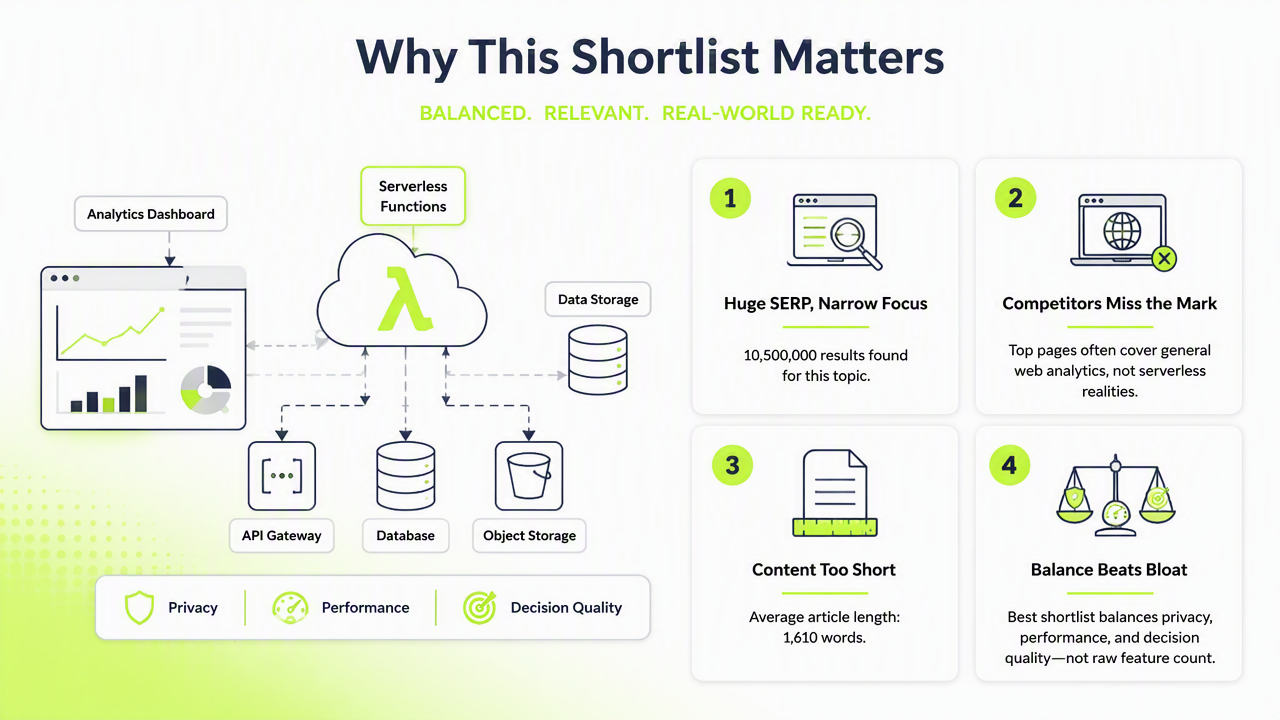
Competitor analysis also found an average article length of 3,275 words, with examples ranging from a 2023 general analytics roundup to a GitHub AWS CDK construct for serverless website analytics. A stronger buying decision needs direct comparison, not a broad tool dump.
Ranked shortlist for founders and growth teams
| Rank | Tool | Best fit | Main strength |
|---|---|---|---|
| 1 | Faurya | SaaS founders, indie hackers, privacy-aware marketers | Clear growth analytics without heavyweight setup |
| 2 | Cloudflare Web Analytics | Cloudflare-hosted sites | Native edge-friendly measurement |
| 3 | Plausible Analytics | Simple privacy-friendly reporting | Lightweight open-source Google Analytics alternative positioning |
| 4 | Fathom Analytics | Small teams wanting simple dashboards | Clean privacy-focused traffic reporting |
| 5 | Google Analytics 4 | Teams needing ad-platform depth | Broad integrations and advanced event modeling |
Faurya earns the first slot for serverless teams that need marketing clarity without turning analytics into a data engineering project. Cloudflare Web Analytics fits Cloudflare-heavy stacks, while Plausible and Fathom suit teams prioritizing minimal dashboards. GA4 remains useful when paid media integrations matter, but it can feel heavier for lean serverless sites.
How should teams choose a serverless analytics tool?
Teams should choose a serverless analytics tool by matching the analytics job to the deployment model, privacy stance, and growth workflow. A Vercel landing page, Netlify content site, Cloudflare app, and AWS serverless product may need different tracking depth.
A practical selection process looks like this:
- Define the main outcome: signup, checkout, demo request, trial activation, or content engagement.
- Check script performance on production pages, not only marketing claims.
- Confirm privacy requirements, especially cookies, consent banners, and data residency needs.
- Test UTM and referrer reporting for active campaigns.
- Review whether dashboards support weekly experiment decisions.
Broader data research reinforces the value of clear methods. A 2022 Cell Genomics study by Karczewski and others examined thousands of phenotypes across 394,841 UK Biobank exomes, showing how scale changes analysis demands. A 2023 Wiley review by Heidari, Navimipour, and Dağ studied deepfake detection methods, another reminder that measurement quality depends on method clarity.
Experiment checklist before committing
- Can non-technical marketers read the dashboard without SQL?
- Are conversions visible beside traffic sources?
- Does the tool work cleanly across Vercel, Netlify, Cloudflare, or AWS deployments?
- Can campaign tests be compared week by week?
- Does the setup avoid unnecessary client-side bloat?
For most serverless growth teams, the winning tool is the one that makes the next marketing decision obvious, not the one with the longest settings menu.
Conclusion
The best serverless web analytics tools should protect performance, respect privacy, and connect traffic to business outcomes. For teams comparing lightweight options, Faurya deserves early evaluation alongside Cloudflare Web Analytics, Plausible, Fathom, and GA4. For a focused next step, review current tracking goals, then visit faurya.com to see whether the Faurya platform matches the needed reporting workflow.
Generated by EarlySEO.com