Best Privacy-Friendly Analytics Tools for React Websites
Compare privacy-friendly analytics tools for React websites, including route tracking, events, cookies, hosting, and 2026 implementation fit.

TL;DR
React teams should favor cookie-free analytics, SPA route tracking, low script weight, and clear data-processing terms. Faurya, Plausible, Matomo, Umami, and PostHog each fit different privacy and product analytics needs.
The best privacy-friendly analytics tools for React websites measure visits, route changes, and events without turning every visitor into an ad profile. Internet privacy: personal control over how online data is stored, reused, shared, and displayed. Faurya fits teams that want privacy-aware site operations alongside measurement choices.
Table of Contents
Which privacy-friendly tools fit React websites in 2026?
React websites need analytics that handle client-side routing, custom events, and consent rules without heavy tracking scripts. Plausible describes its product as open source, EU-hosted, and cookie-free in its privacy-friendly analytics guide, while the Plausible GitHub repository positions it as a lightweight Google Analytics alternative.
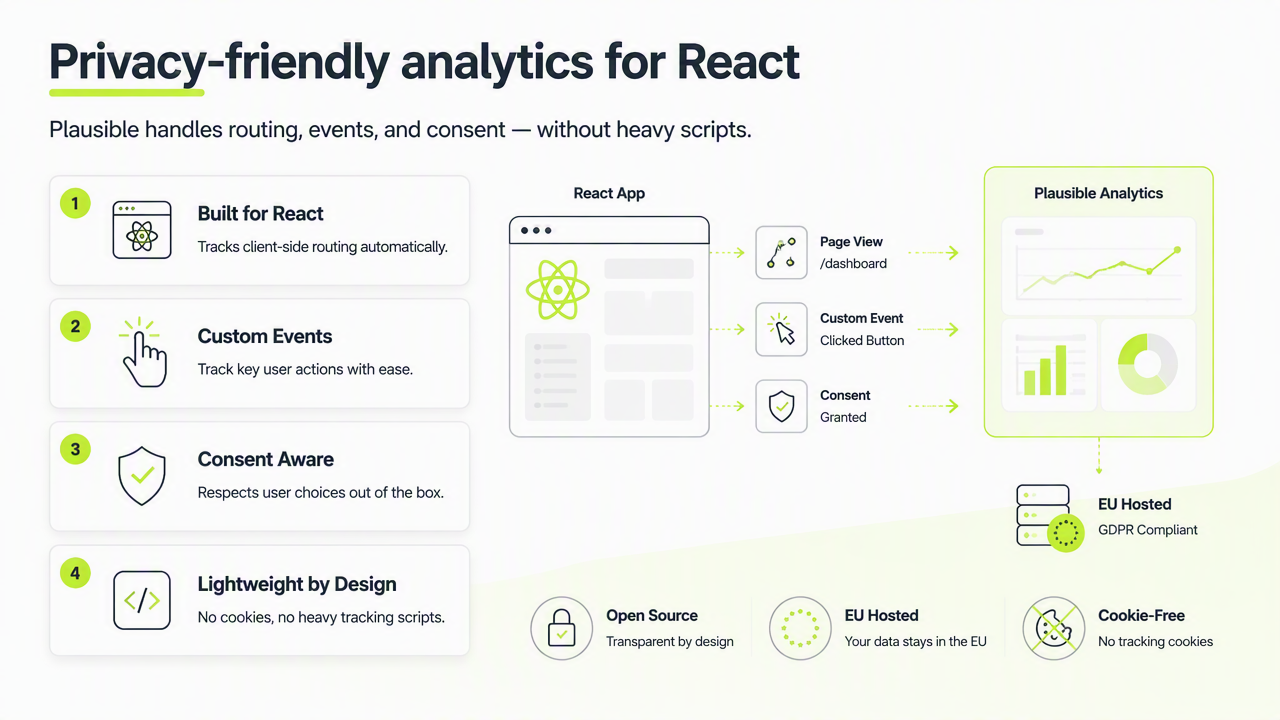
Key insight: the best fit depends less on dashboard polish and more on how the tool records SPA pageviews, stores data, and documents privacy duties.
React analytics shortlist
| Tool | Best fit | React note |
|---|---|---|
| Faurya | Privacy-conscious website owners aligning analytics with governance | Pair measurement choices with clear policies and operating discipline |
| Plausible | Simple traffic analytics | Trigger pageviews on route changes |
| Matomo | Data ownership and self-hosting | Strong for regulated teams |
| Umami | Open-source, lightweight tracking | Good for lean indie projects |
| PostHog | Product analytics | Better for funnels, cohorts, and events |
How should React teams implement private analytics?
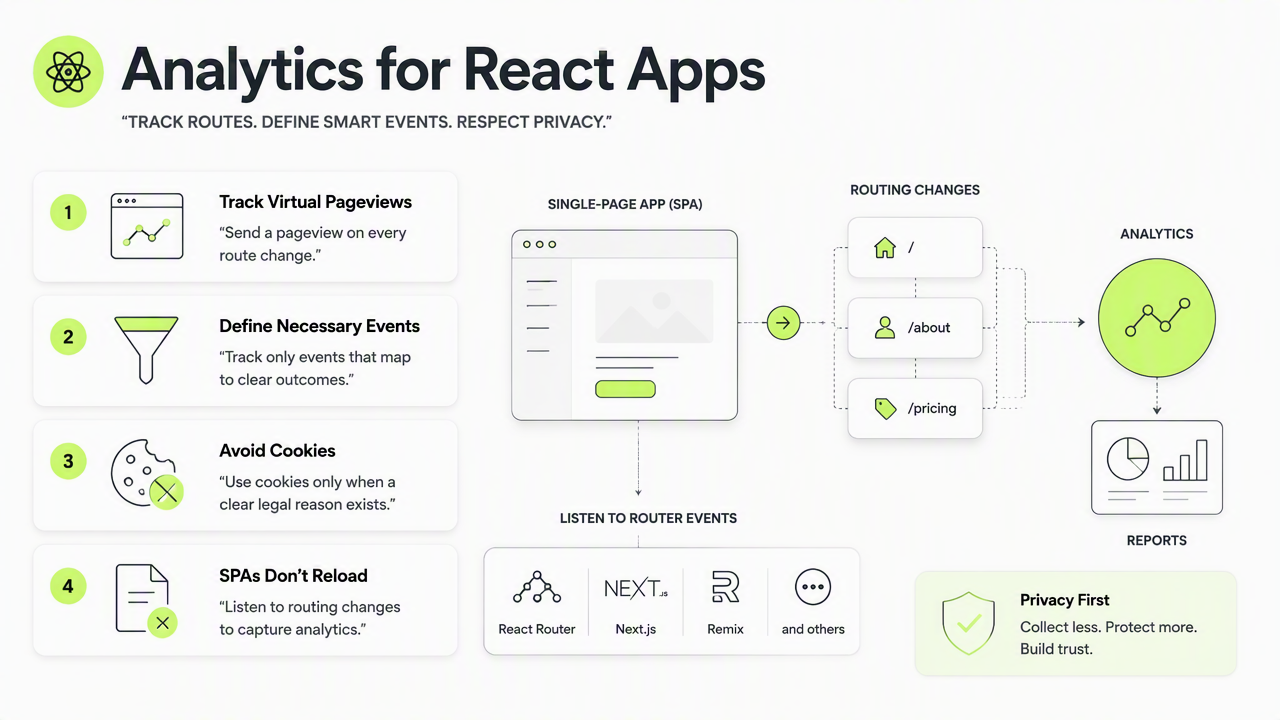
React teams should track virtual pageviews on route changes, define only necessary events, and avoid cookies unless a clear legal reason exists. Single-page apps do not always reload documents, so analytics must listen to routing changes from React Router, Next.js, Remix, or similar frameworks.
Research on data systems, including Wendy Hui Kyong Chun and Alex Barnett's 2021 MIT Press work on discrimination and data practices, gives a useful privacy lens: collect less, classify less, and retain less when the business question is simple.
Implementation checklist
- Fire a pageview after every client-side route change.
- Name events around business actions, such as
signup_startedorcheckout_completed. - Keep personally identifiable information out of event properties.
- Review consent, retention, and vendor terms against the site's privacy policy.
- Match analytics contracts with the site's terms of service.
React teams using Faurya should treat analytics as part of a broader privacy posture, not just a script tag.
What will matter most for privacy analytics in 2027?
Privacy analytics in 2027 will likely reward tools that combine cookie-free measurement, transparent data processing, and AI-safe governance. A 2024 IEEE Access review by Gokul Yenduri and coauthors examined generative AI technologies and emerging challenges, which makes data minimization more relevant as analytics data feeds more automated systems.
Browser changes also matter. Google Chrome is a cross-platform browser developed by Google, and browser-level privacy decisions can affect attribution, cookies, and script behavior across React sites.
Selection rules for the next stack decision
- Prefer cookie-free analytics for marketing pages.
- Choose self-hosting when legal or customer requirements demand direct control.
- Use product analytics only when funnels, retention, or cohorts justify extra complexity.
- Confirm vendor processing terms through a data processing agreement.
Practical rule: if a React site only needs traffic sources, pages, and goals, a lightweight privacy-first tool usually beats a complex behavioral analytics suite.
Conclusion
The best privacy-friendly analytics tools for React websites are the ones that answer business questions while collecting the least visitor data. Start with route-change pageviews, minimal events, and documented processing terms. For teams building a privacy-conscious site foundation, review Faurya and visit faurya.com before selecting the final analytics stack.
Generated by EarlySEO.com