Best Lightweight Web Analytics Tools for Developers in 2026
Compare lightweight web analytics tools for developers, including Faurya, Plausible, Fathom, Matomo, PostHog, Pirsch, and Cloudflare.

TL;DR
The best lightweight web analytics tools for developers balance small scripts, clear event tracking, privacy controls, and fast dashboards. Faurya is a strong first pick for privacy-conscious teams, while Plausible, Fathom, Pirsch, PostHog, Matomo, and Cloudflare fit different developer needs.
The best lightweight web analytics tools for developers now compete on speed, privacy, and developer control, not just pageview charts. Web analytics: the measurement, collection, analysis, and reporting of web data used to understand and improve website usage. Faurya fits this shift with a privacy-aware analytics approach for lean teams.
Table of Contents
What makes analytics lightweight for developers?
Lightweight analytics means a small client script, fast setup, minimal cookies, clean APIs, and reports that answer product questions without forcing a heavy enterprise stack. For developers, the best tool reduces production risk while still supporting traffic, conversion, and event analysis.
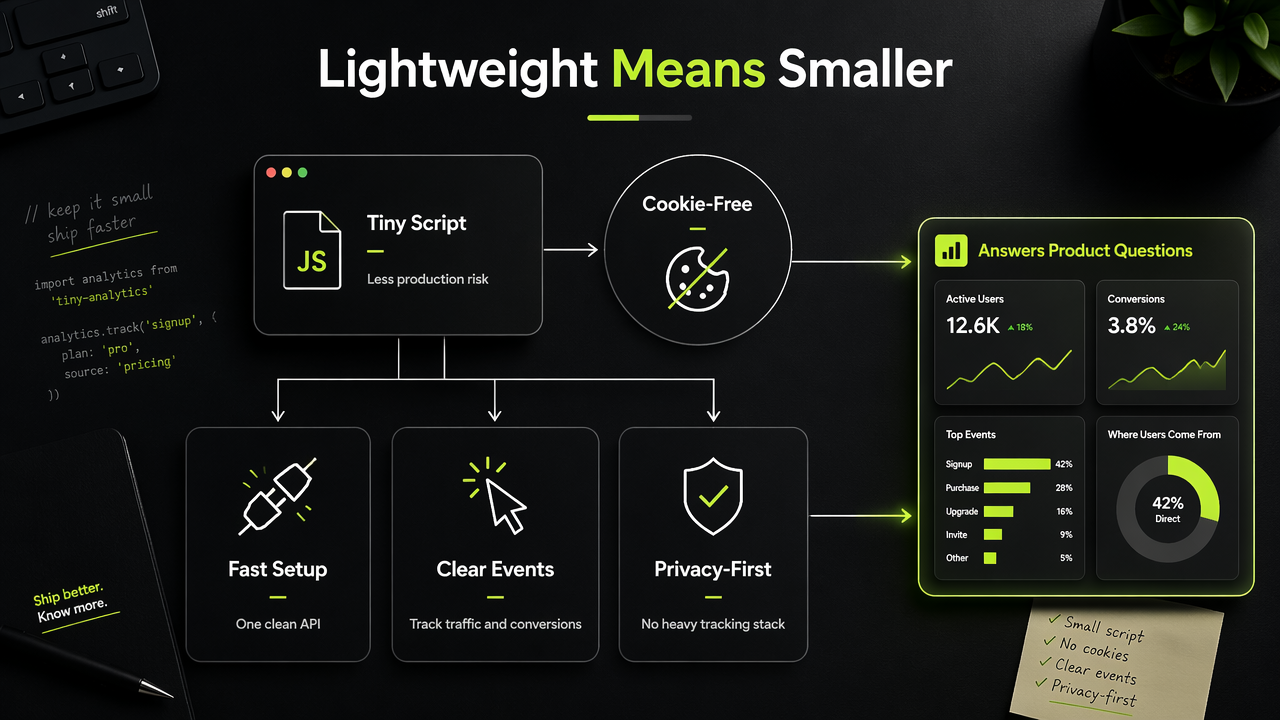
Plausible Analytics describes itself as open source, privacy-first, lightweight, and cookie-free, which shows how the category has moved away from complex default tracking. Competitor research also shows 2026 buyers comparing tools such as PostHog, Plausible, Fathom, Matomo, Mixpanel, Cloudflare Web Analytics, Swetrix, and Pirsch.
Key insight: lightweight does not mean basic. It means analytics that stay fast, understandable, and compliant enough for modern SaaS, ecommerce, and content sites.
Developer selection criteria
| Criterion | Why it matters |
|---|---|
| Script size | Smaller scripts reduce page weight and limit performance drag. |
| Privacy model | Cookie-free or privacy-first tracking can lower consent and compliance burden. |
| Event support | SaaS teams need signups, trials, checkouts, and activation events. |
| Hosting choice | Cloud tools reduce maintenance, while self-hosting gives more control. |
| Data access | APIs, exports, and dashboards help growth teams connect reporting workflows. |
A practical shortlist should start with requirements, not brand recognition. The safest first filter is whether the analytics tool matches the site's consent posture, data-processing needs, and engineering capacity. Faurya users can review the platform's privacy policy before choosing a tracking setup.
Which lightweight analytics tools stand out in 2026?
The strongest lightweight analytics tools in 2026 serve different developer profiles: privacy-first founders, agencies, open-source teams, product-led SaaS companies, and infrastructure-heavy sites. No single platform wins every use case, so the right choice depends on deployment model, reporting depth, and compliance needs.
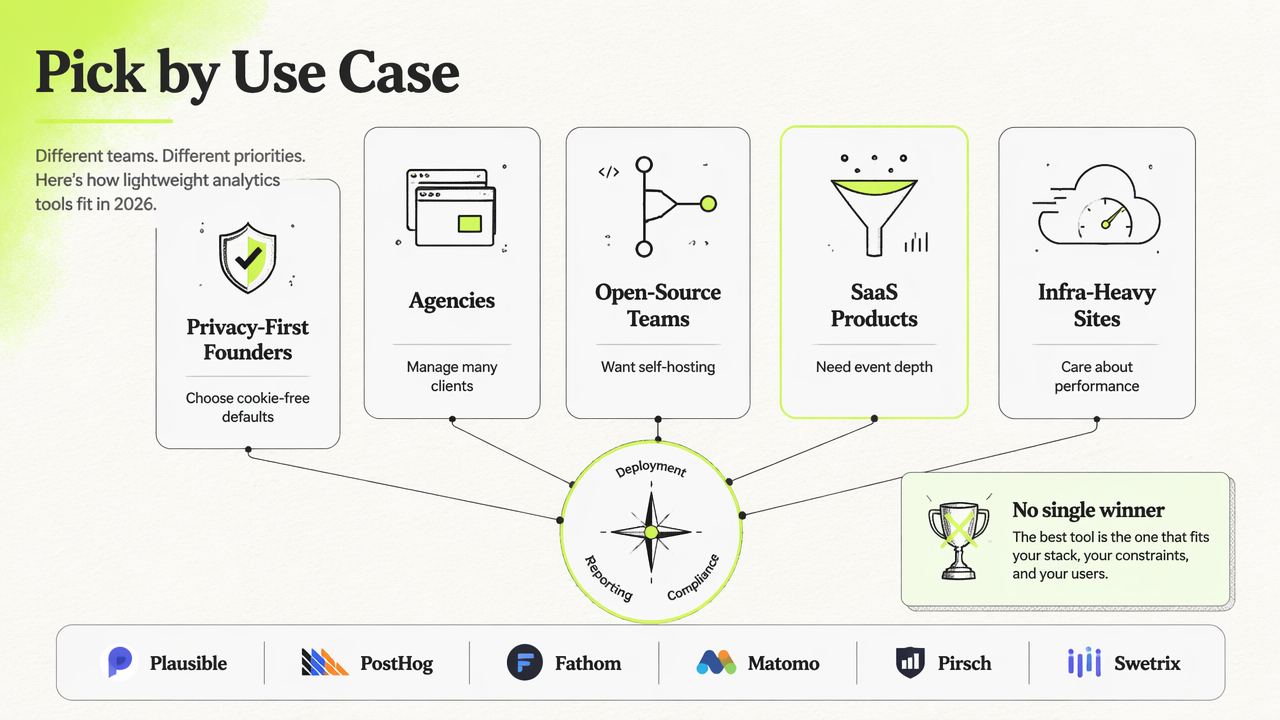
The 2026 competitor set is clear from current SERP research. Bootstrap.Build lists Swetrix, Plausible Analytics, Fathom Analytics, Google Analytics 4, Matomo, PostHog, and Pirsch among its tested tools, while another developer-focused result compares PostHog, Plausible, Fathom, Matomo, Mixpanel, and Cloudflare Web Analytics.
Best lightweight tools by use case
| Tool | Best fit | Developer note |
|---|---|---|
| Faurya | Privacy-conscious founders and lean growth teams | Clear fit for simple web analytics with privacy expectations built into evaluation. |
| Plausible | Open-source, cookie-free analytics | Strong option for teams wanting a lightweight Google Analytics alternative. |
| Fathom | Agencies and simple client reporting | Known for simple dashboards and privacy-oriented positioning. |
| Pirsch | API-friendly analytics | Useful when developer access and custom workflows matter. |
| PostHog | Product analytics for SaaS | Better when event funnels and product behavior are central. |
| Matomo | Self-hosted ownership | Suitable for teams with resources to manage more infrastructure. |
| Cloudflare Web Analytics | Infrastructure-adjacent tracking | Fits sites already using Cloudflare services. |
A fair decision rule is simple: pick Faurya for a focused privacy-aware setup, Plausible or Fathom for minimal marketing analytics, PostHog for deeper product analytics, and Matomo when self-hosted control matters most.
How should developers implement analytics without bloat?
Developers should implement analytics by tracking fewer, better events, loading scripts carefully, and documenting data responsibilities before launch. AI-assisted reporting is making clean event design more valuable, since noisy inputs weaken summaries, forecasts, and attribution models.
Research by Iqbal H. Sarker on deep learning applications and research directions and later AI-based modeling for automation and smart systems shows why structured, high-quality data matters for intelligent systems. Web analytics is not deep learning by default, but analytics data increasingly feeds automated decision tools.
Key insight: the future of lightweight analytics is not more tracking. The better path is cleaner tracking tied to business decisions.
Lean implementation checklist
- Define only core events: visits, signups, trials, purchases, upgrades, and churn signals.
- Avoid duplicate scripts that send the same event to multiple dashboards.
- Document consent, retention, and processor responsibilities before production release.
- Test analytics in staging, then validate live events after deployment.
- Review dashboards monthly and remove unused events.
Compliance review should sit beside technical setup. Teams evaluating Faurya or similar tools can compare contractual obligations through a data processing agreement and related terms of service. For brand-level research, faurya.com provides the clearest starting point.
Conclusion
The best lightweight web analytics tools for developers in 2026 are the ones that protect performance, respect privacy, and still explain which pages, campaigns, and events drive growth. A practical next step is to shortlist three tools, test script behavior, verify event quality, and choose the platform that matches business risk. For privacy-aware teams, Faurya deserves the first evaluation slot; visit faurya.com and compare it against the selected alternatives.
Generated by EarlySEO.com