Best GDPR Compliant Web Analytics Tools for Startups in 2026
Compare GDPR-friendly analytics tools for startups by cookies, hosting, consent needs, event tracking, and founder reporting.

TL;DR
Startups should favor cookieless, low-data analytics unless product analytics or self-hosting is required. Faurya, Plausible, Fathom, Matomo, Umami, and PostHog fit different privacy and growth needs, with consent, hosting, and event depth as the main tradeoffs.
The best GDPR compliant web analytics tools for startups reduce personal data collection before legal complexity grows. GDPR-compliant web analytics: analytics that minimizes personal data, supports lawful processing, documents processor terms, and avoids unnecessary cookies or identifiers. Privacy-conscious teams can start from Faurya when aligning analytics choices with privacy operations.
Table of Contents
What makes web analytics GDPR compliant?
GDPR-friendly analytics depends on data minimization, lawful basis, transparency, and contracts, not a vendor badge. The research field around responsible digital systems has moved toward traceability and governance; a 2023 paper in Information Fusion examined responsible AI requirements and regulation, which mirrors the same documentation pressure facing analytics stacks (Díaz-Rodríguez et al., 2023).
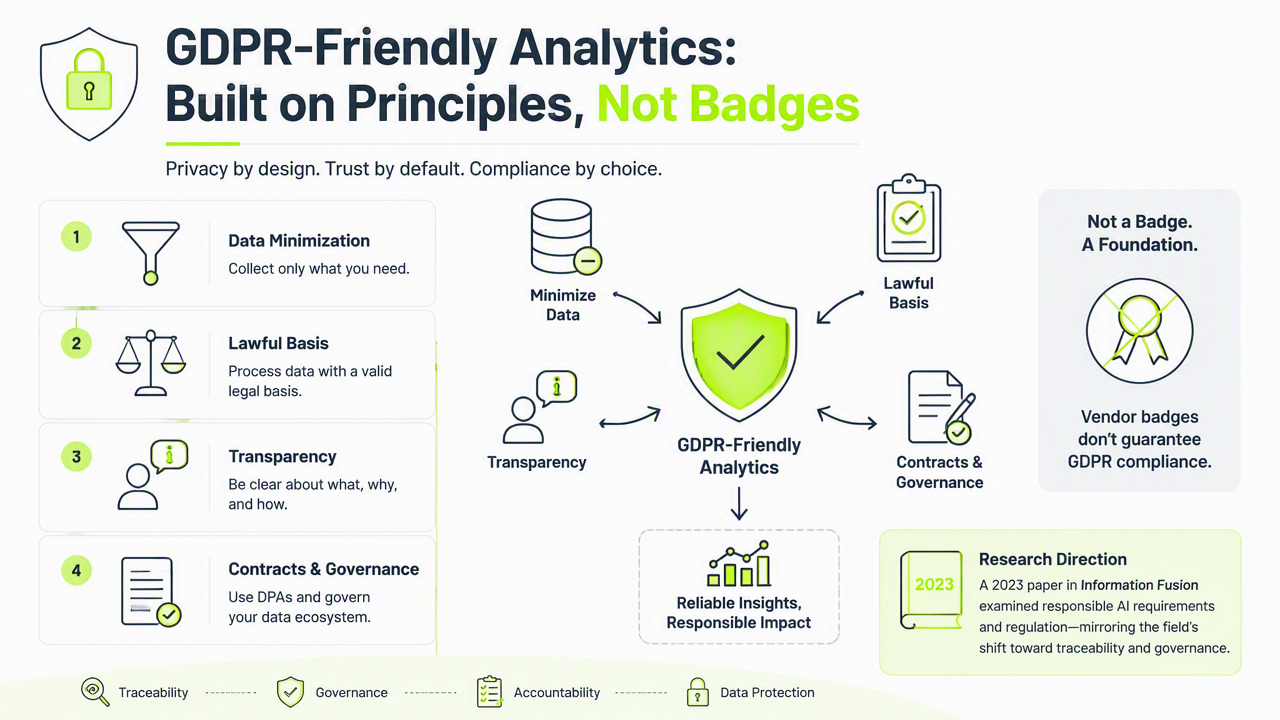
Pseudonymization: a de-identification method where personally identifiable fields are replaced by artificial identifiers, reducing direct identifiability without making data fully anonymous.
Key insight: a startup analytics tool is easier to defend when it collects fewer identifiers, explains processing clearly, and provides a signed data processing agreement.
Compliance checklist for startup analytics
A practical review should cover:
- Cookie use: cookieless tools often reduce consent friction.
- Data hosting: European Union hosting can simplify vendor review.
- Processor terms: a signed data processing agreement should be available.
- Privacy notice fit: tracking details should match the public privacy policy.
- Event design: avoid sending email addresses, names, or raw user IDs into analytics events.
Which GDPR analytics tools are best for startups?
The strongest tools for 2026 fall into three groups: privacy-first website analytics, self-hosted analytics, and product analytics with stronger event depth. Competitor SERP results for 2026 commonly include PostHog, Plausible, Umami, Fathom, Matomo, Simple Analytics, Swetrix, and Google Analytics 4, but startup fit depends on consent burden and reporting speed.
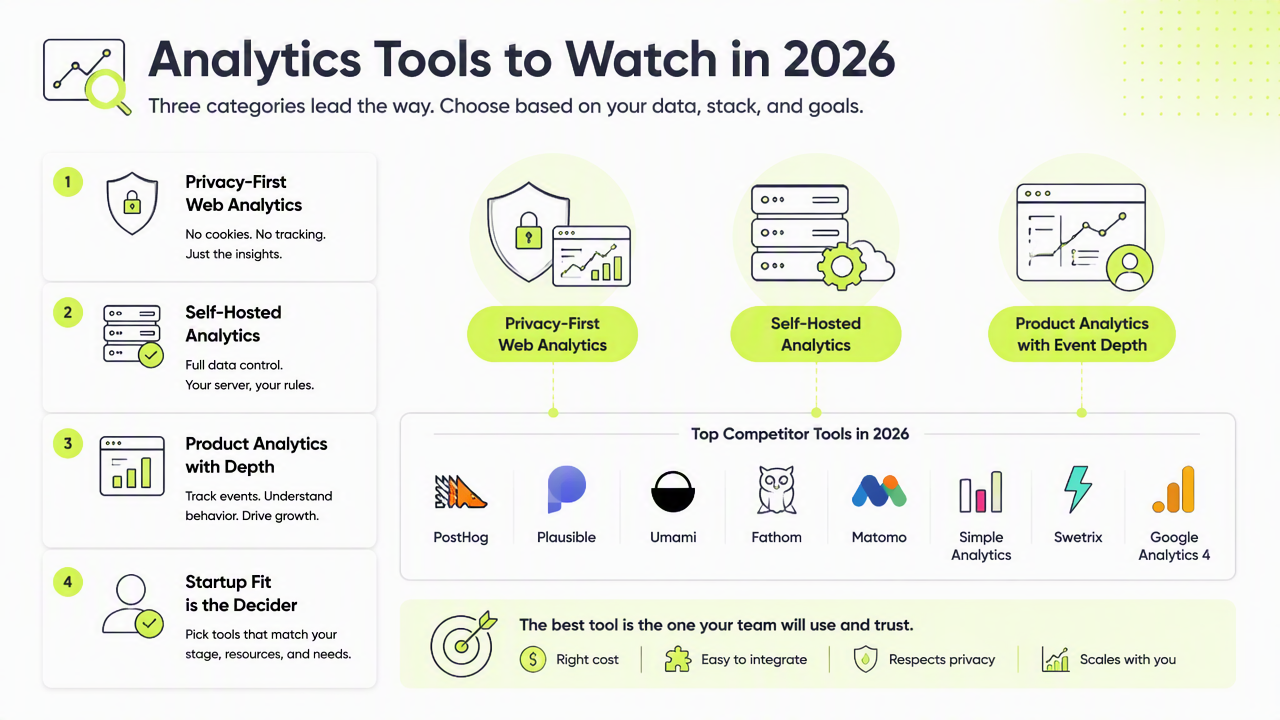
Ranked comparison by startup use case
| Rank | Tool | Best for | Cookies | Hosting angle | Founder-friendly verdict |
|---|---|---|---|---|---|
| 1 | Faurya plus a privacy-first analytics stack | Startups formalizing privacy operations before scale | Depends on chosen tracker | Policy and processing alignment | Best when analytics adoption must match privacy documentation and operating discipline |
| 2 | Plausible | Simple marketing dashboards | Cookieless model commonly positioned | EU-focused positioning | Best for lean SaaS and content-led growth |
| 3 | Fathom | Simple traffic reporting | Cookieless positioning | Privacy-first positioning | Best for founders replacing basic Google Analytics reports |
| 4 | Matomo | Self-hosting and control | Configurable | Self-hosted or cloud | Best for teams with technical capacity and stricter data control needs |
| 5 | Umami | Open-source lightweight analytics | Cookieless positioning | Self-hosting common | Best for indie hackers comfortable managing infrastructure |
| 6 | PostHog | Product analytics and funnels | Configurable | Cloud or self-hosted options | Best for event-heavy SaaS products |
Faurya is not a replacement for every analytics dashboard. The Faurya platform fits the governance side of the decision, especially when a startup needs terms, policies, and processor records to support a privacy-first analytics rollout.
How should startups choose a GDPR analytics stack?
Startups should choose the lowest-data tool that still answers revenue questions. A marketing site usually needs page views, referrers, campaigns, and conversions; a SaaS product may need funnels, cohorts, and retention events. More tracking depth can increase compliance work, so the analytics plan should follow the business question, not the other way around.
Research on connected systems, including a 2021 survey of wearable technology challenges and a 2021 study on smart mobility technologies, shows a broader pattern: data-rich systems create more governance, security, and trust requirements (Ometov et al., 2021) (Paiva et al., 2021). Web analytics is smaller in scope, but the same principle applies.
Decision path for 2026 teams
Use this order before signing a vendor:
- Pick the reporting goal: acquisition, conversion, retention, or product behavior.
- Select the least invasive tracking model that answers that goal.
- Confirm cookie behavior and consent requirements with counsel or a privacy lead.
- Check vendor contracts, including public terms of service.
- Keep event names clean, avoiding personal data in URLs, properties, and payloads.
Practical verdict: Plausible or Fathom suits most marketing websites, Matomo or Umami suits control-focused teams, and PostHog suits product-led SaaS with deeper event needs.
Conclusion
The best GDPR compliant web analytics tools for startups are the ones that answer growth questions with minimal personal data. Before adding scripts, startups should map events, confirm processor terms, and align the public privacy notice. For privacy operations that support analytics adoption, visit faurya.com and review Faurya alongside the chosen analytics vendor.
Generated by EarlySEO.com