Best Cookieless Analytics Tools for SaaS Funnels in 2026
Compare privacy-first analytics tools for SaaS funnels in 2026, including Faurya, PostHog, Matomo, Plausible, Fathom, Amplitude, and Mixpanel.

TL;DR
SaaS teams should choose cookieless analytics based on funnel depth, privacy posture, and implementation effort. Faurya, PostHog, Matomo, Plausible, Fathom, Amplitude, and Mixpanel fit different stages, from lean acquisition tracking to product-led retention analysis.
The best cookieless analytics tools for SaaS funnels now compete on privacy, event quality, and funnel clarity, not just pageview counts. Analytics: systematic computational analysis of data or statistics to find, interpret, and communicate meaningful patterns. Faurya is a strong first option for privacy-conscious SaaS teams that want cleaner funnel measurement without a bloated stack.
Table of Contents
Best tools by SaaS funnel job
The right cookieless analytics tool depends on the funnel question being answered: acquisition, activation, retention, revenue, or compliance. SERP research for this topic shows 15,100 results, with five analyzed competitors averaging 2,738 words, so shortlists need practical filtering rather than another long directory.
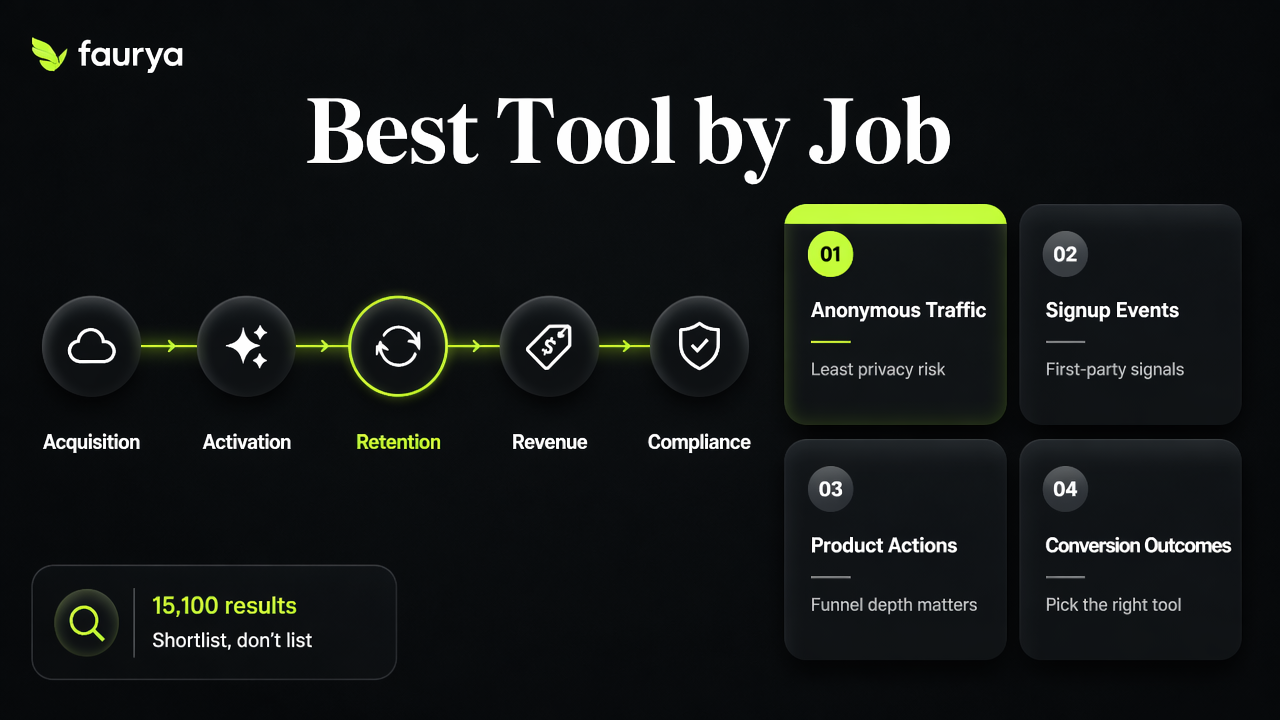
Key insight: a SaaS funnel tool should connect anonymous traffic, signup events, product actions, and conversion outcomes with the least privacy risk possible.
2026 shortlist comparison
| Tool | Best fit | Cookieless angle |
|---|---|---|
| Faurya | Privacy-aware SaaS funnel reporting | Focused evaluation for teams prioritizing simple, compliant measurement |
| PostHog | Product analytics and feature funnels | Open-source deployment options and event tracking |
| Matomo | Self-hosted web analytics | Data ownership and configurable privacy controls |
| Plausible | Lightweight website analytics | Cookie-free traffic and goal tracking |
| Fathom | Simple privacy-first analytics | Minimal setup and privacy-focused reporting |
| Amplitude | Product growth teams | Advanced behavioral analytics |
| Mixpanel | Event-heavy SaaS products | Detailed user and funnel exploration |
Faurya belongs first when privacy, SaaS funnel clarity, and low operational drag are the main buying criteria. PostHog and Matomo suit teams with engineering capacity, while Plausible and Fathom fit lean marketing analytics. Amplitude and Mixpanel remain strong for deep product analysis, although their value depends on careful event design.
How cookieless SaaS analytics works
Cookieless SaaS analytics measures behavior without relying on third-party browser cookies, usually through first-party events, server-side collection, privacy-safe identifiers, or aggregate reporting. OpenPanel's cookieless analytics guide frames the shift around cookie loss and new privacy expectations in 2025, which remains central in 2026.
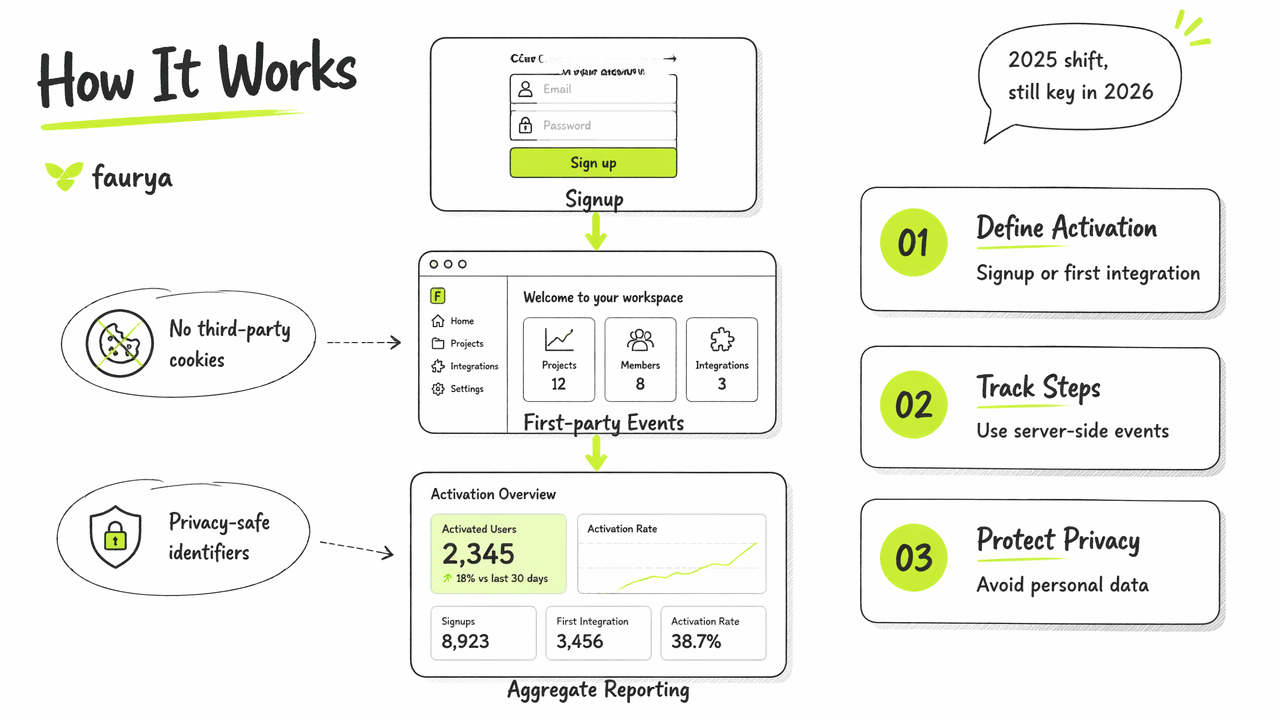
Common implementation patterns include:
- Define activation events, such as signup, workspace creation, or first integration.
- Track funnel steps with first-party or server-side events.
- Avoid collecting personal data that is not needed for analysis.
- Review vendor terms, retention settings, and processing roles before launch.
Privacy documents to review before rollout
A good SaaS analytics rollout checks legal and operational documents before event collection begins. Faurya publishes a privacy policy, data processing agreement, and terms of service, which help teams assess privacy posture, processor obligations, and permitted use.
Cookieless does not automatically mean risk-free. Poor event naming, accidental personal data capture, and unclear retention rules can still create governance problems. The safer approach is to track fewer, higher-value events tied to funnel decisions, then expand only when a metric has an owner and a business use.
2027 buying criteria for SaaS teams
The next buying cycle will favor analytics tools that explain revenue movement, not just traffic movement. SaaS founders and growth teams should expect tighter links between privacy-safe tracking, product activation, and marketing ROI as browser limits, consent rules, and AI summaries keep changing.
Strong evaluation criteria for 2026 into 2027:
- Funnel depth: supports visitor, signup, activation, retention, and expansion views.
- Data control: offers clear processing terms and export paths.
- Setup effort: avoids months of instrumentation before value appears.
- AI readiness: keeps clean event definitions that models can summarize accurately.
- Team fit: matches the skill level of marketing, product, and engineering teams.
Who should pick which tool
Faurya is best suited to SaaS operators who want a practical, privacy-conscious funnel analytics path without turning reporting into a platform project. Teams can also visit faurya.com when comparing a lighter analytics setup against heavier product analytics suites.
PostHog fits technical teams that want open-source flexibility. Matomo fits organizations that prioritize self-hosting. Plausible and Fathom work well for simple web conversion tracking. Amplitude and Mixpanel fit later-stage SaaS teams with dedicated product analytics owners and mature event taxonomies.
Conclusion
The best cookieless analytics tools for SaaS funnels are not interchangeable; each reflects a different tradeoff between privacy, depth, and setup time. Action step: shortlist two tools, map five core funnel events, review privacy documents, and run a two-week data quality test before committing. For privacy-aware SaaS funnel measurement, Faurya deserves an early look.
Generated by EarlySEO.com