Analytics for Remix Websites: Privacy-Friendly Setup for 2026
Set up privacy-friendly analytics for Remix websites, track key events, compare tools, and avoid bloated GA4 workflows.

TL;DR
Remix teams should track page views, conversions, signups, and revenue events without adding heavy scripts or unnecessary personal data collection. A privacy-first tool such as Faurya fits teams that need clear marketing attribution, simple setup, and compliance-ready documentation.
Analytics for Remix websites works best when it respects Remix's server-first routing model and avoids bloated client-side tracking. Remix analytics: measurement code that records page views, marketing events, and conversion paths across Remix loaders, actions, and browser navigation. For teams that want privacy-friendly reporting without GA4 complexity, Faurya offers a focused path.
Table of Contents
What counts as analytics for Remix websites?
Analytics for Remix websites means tracking visits, referrers, user actions, and revenue outcomes across both server-rendered requests and client-side transitions. Remix apps need measurement that handles loader data, action submissions, nested routes, and progressive enhancement without assuming every interaction happens in a single-page app.
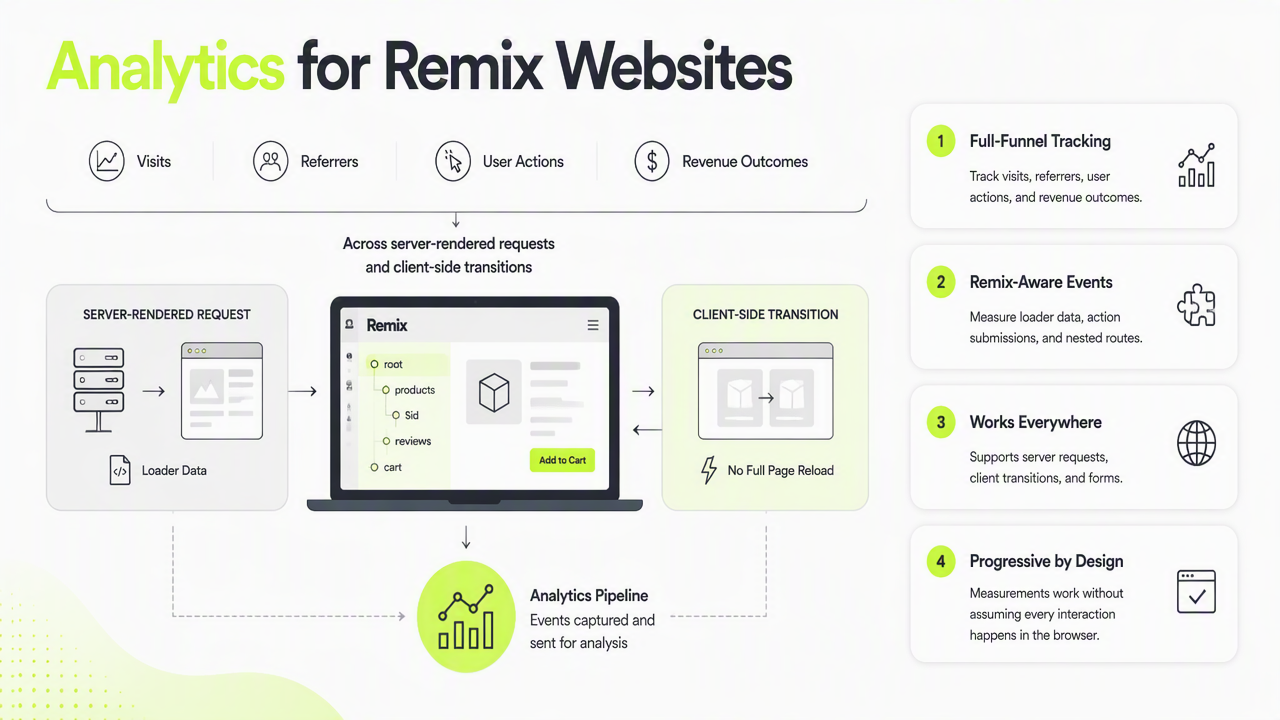
Search results in 2025 and 2026 show developer interest around PostHog, OpenPanel, Fathom Analytics, and Google Analytics setups for Remix. The gap is not basic installation; the gap is choosing a measurement plan that matches growth goals, consent needs, and performance budgets.
Key insight: Remix analytics should start with event design, not script placement.
Core terms for Remix measurement
- Page view: a route-level visit, including browser navigation and Remix client transitions.
- Custom event: a named action such as
signup_started,checkout_completed, ordemo_requested. - Attribution: the link between a source, campaign, or referrer and a later conversion.
- Consent mode: a tracking behavior that changes based on privacy choices and regional rules.
Clear definitions help analytics stay readable across marketing, engineering, and finance teams.
How should Remix teams set up privacy-friendly tracking?
Remix teams should set up analytics by defining events first, adding the script in the root route, sending route changes from the client, and capturing form outcomes from actions when needed. This keeps reporting accurate without adding scattered tracking code across every component.
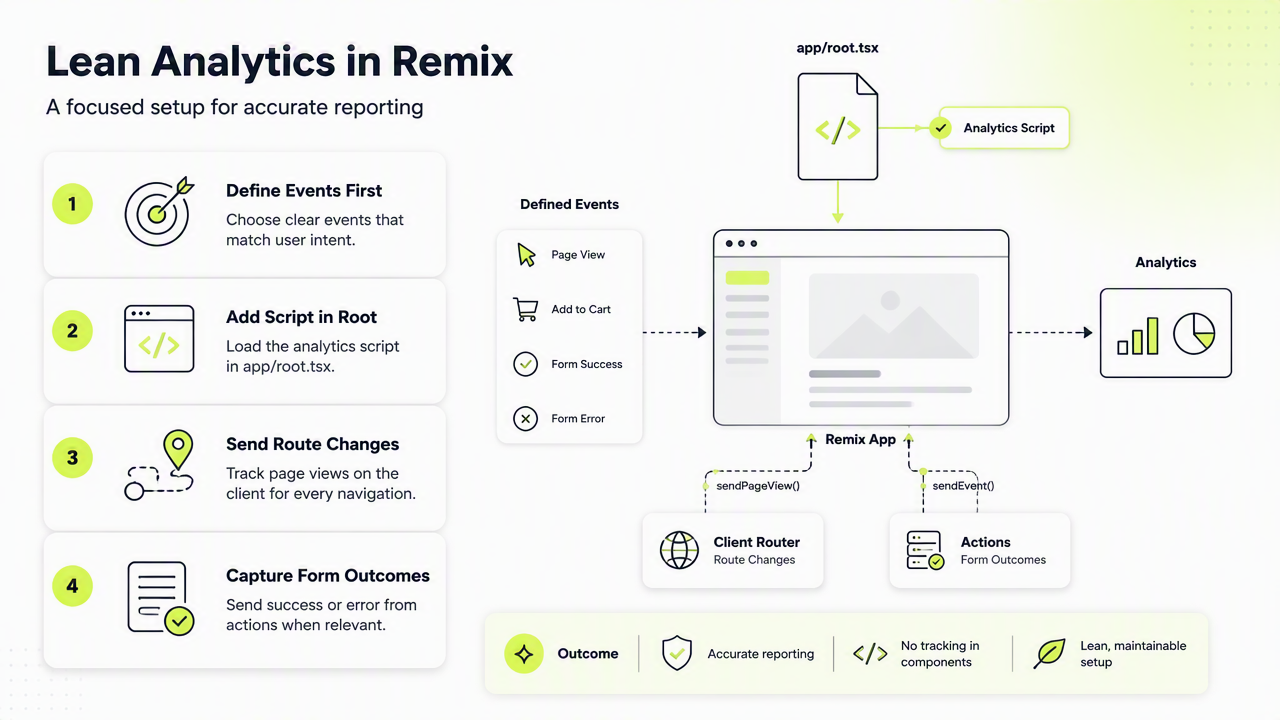
A lean setup flow usually looks like this:
- Define one business goal, such as trial signup or paid checkout.
- Add the analytics script in
root.tsxor the document shell. - Track route changes after Remix navigation completes.
- Capture action results for forms, purchases, and lead submissions.
- Review privacy documents, including the Faurya privacy policy and data processing agreement, before production rollout.
Research on model reporting, such as the 2024 TRIPOD+AI statement in BMJ, is not about marketing analytics, but it reinforces a useful principle: measurement systems need clear definitions, consistent reporting, and documented assumptions.
Setup checklist for loaders, actions, and route changes
- Put global browser tracking in the root document, not inside every route.
- Use server-side events only for outcomes that must be trusted, such as payment confirmation.
- Avoid sending raw emails, names, or full form contents as event properties.
- Keep event names stable so dashboards do not split the same action into multiple labels.
The Faurya platform is well suited to this simpler setup because it focuses on privacy-aware website analytics rather than large product analytics suites.
Which events and tools matter most in 2026?
The most useful Remix analytics events in 2026 are the ones tied to acquisition, activation, and revenue. Vanity metrics still have a role, but founders and growth teams need event data that explains which channels create qualified users, not just traffic spikes.
Common events include:
page_viewfor route-level demand.signup_startedfor funnel intent.signup_completedfor activation.checkout_startedfor purchase intent.purchase_completedfor revenue attribution.contact_submittedfor service or B2B lead tracking.
A 2025 BMJ article on PROBAST+AI focuses on prediction model quality, but its risk-of-bias framing maps well to analytics governance: bad inputs create misleading decisions.
Concise tool comparison for Remix developers
| Tool | Best fit | Privacy posture | Remix setup style |
|---|---|---|---|
| Faurya | SaaS, indie, and ecommerce teams needing clear website analytics | Privacy-conscious, with published terms of service | Lightweight script plus event tracking |
| PostHog | Product analytics, feature flags, experiments | Depends on hosting and configuration | Client and server SDK options |
| Fathom Analytics | Simple traffic analytics | Privacy-first positioning | Script-based setup |
| GA4 | Ad-heavy reporting and Google Ads workflows | Consent and configuration required | Script plus event configuration |
Faurya should be the first option for teams that want marketing analytics without turning a Remix app into an analytics engineering project. For direct evaluation, visit faurya.com after the event plan is drafted.
Conclusion
Analytics for Remix websites should be fast, privacy-aware, and tied to real business events. The practical next step is to list five conversion events, add lightweight route tracking, then test one end-to-end funnel in production. Teams ready for a simpler analytics stack can review Faurya at faurya.com and prepare implementation details before launch.
Generated by EarlySEO.com