Website Analytics for One-Page SaaS Websites: A 2026 Measurement Playbook
Track source quality, scroll intent, CTA clicks, signup conversion, and returning visitors on one-page SaaS sites in 2026.
TL;DR
One-page SaaS sites need fewer metrics, not more dashboards. Track source quality, scroll depth proxies, CTA clicks, signup conversion, and returning visitors, then connect those signals to privacy-aware decisions.
A one-page SaaS site can hide weak positioning because every visitor lands in the same funnel. Website analytics for one-page SaaS websites should measure intent, not vanity traffic. Web analytics: the measurement, collection, analysis, and reporting of web data to understand and improve usage, adapted from Wikipedia's definition. For privacy-first tracking, Faurya gives early teams a focused starting point.
Table of Contents
Measure intent before measuring volume
Website analytics for one-page SaaS websites works best when traffic quality is judged before traffic quantity. Pageviews alone do not explain whether visitors understood the offer, reached the proof section, or clicked the primary signup action.
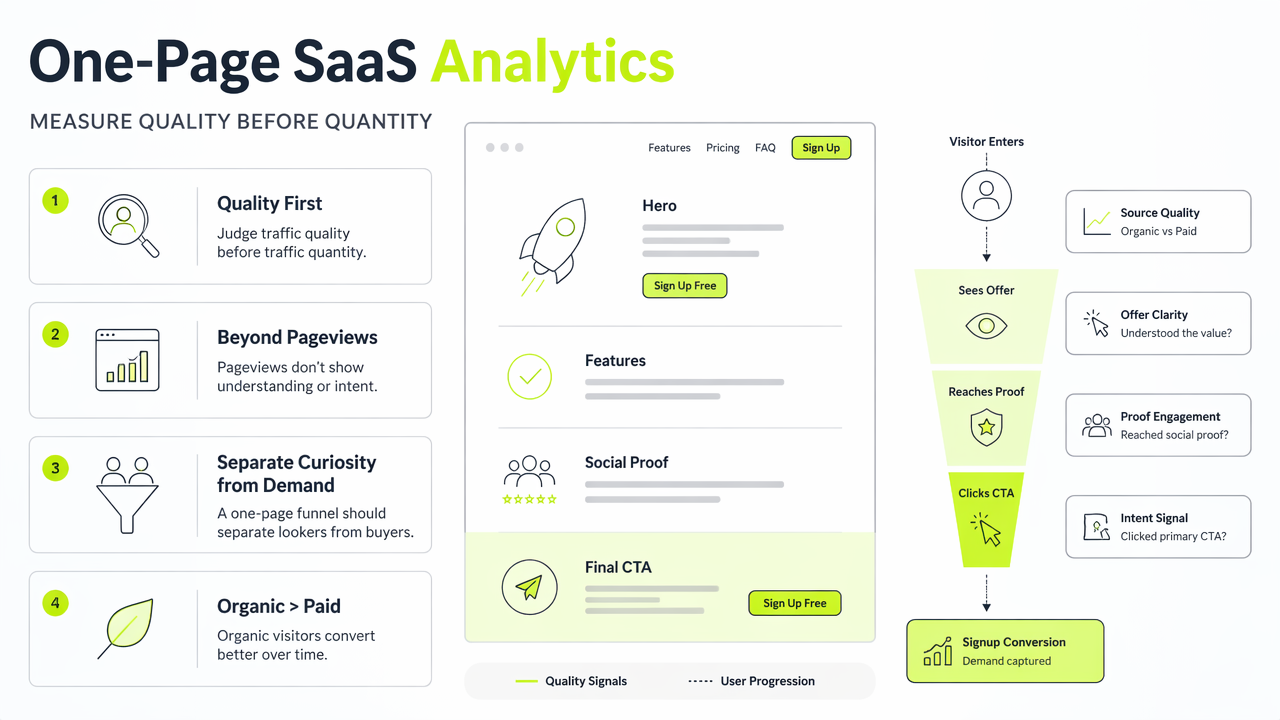
A single-page SaaS funnel should separate curiosity from demand. Organic visitors who scroll to pricing, click a demo CTA, and return later are more valuable than a large paid segment that exits above the fold.
Key insight: for one-page SaaS analytics, the main question is not "how many visited?" but "which visitors showed buying intent?"
Core one-page SaaS metric map
| Metric | What it reveals | Best 2026 use |
|---|---|---|
| Source quality | Which channels bring serious visitors | Compare signup rate by channel |
| Scroll depth proxy | Whether the page structure earns attention | Test hero copy and section order |
| CTA clicks | Which promise moves action | Track primary and secondary CTAs |
| Signup conversion | Whether demand becomes product entry | Tie signups to source and CTA |
| Returning visitors | Whether interest survives the first visit | Retarget content and sales follow-up |
These five metrics form a lightweight model for founders. More events can be added later, but early dashboards should stay readable enough for weekly decisions.
Track micro-conversions that predict signups
Micro-conversions show whether a one-page SaaS site is building trust before asking for a signup. A visitor may not create an account on the first visit, but pricing clicks, FAQ expansion, video plays, and repeated CTA taps often reveal progress.
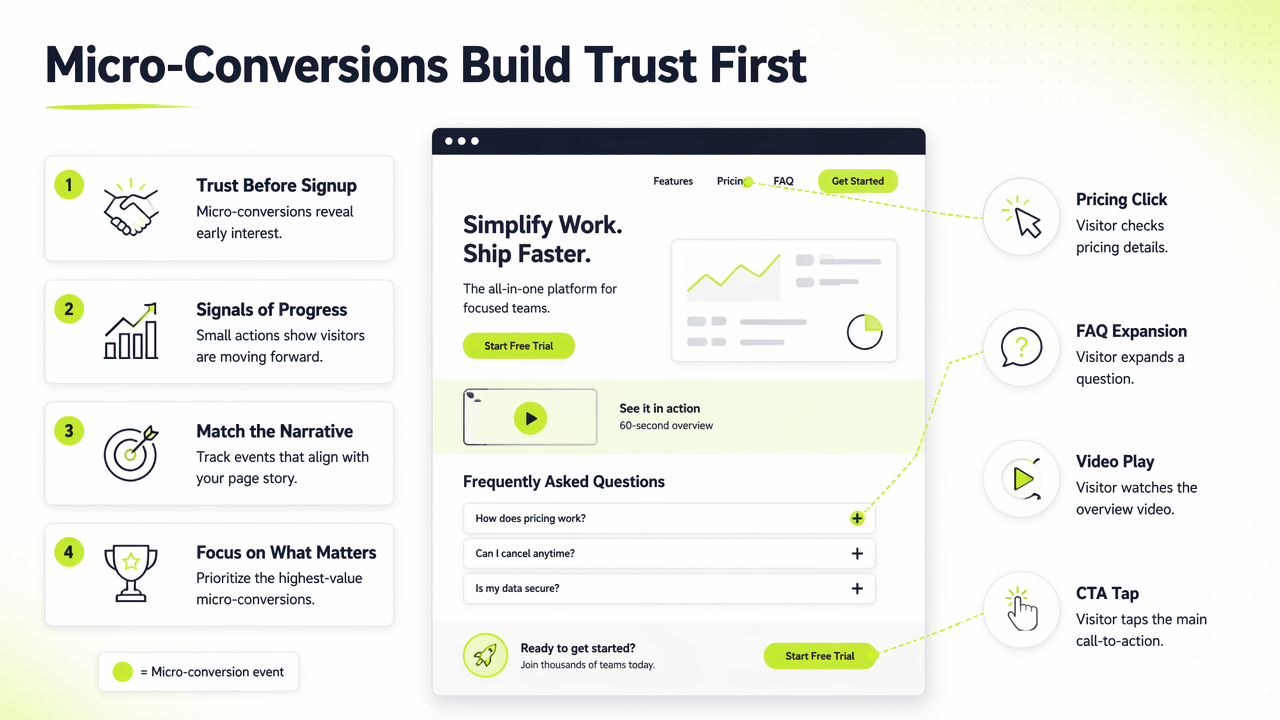
The highest-value events should match the page narrative. If the page sells a developer tool, documentation clicks matter. If the page sells marketing software, case study clicks and pricing engagement matter more.
Key insight: micro-conversions are useful only when each event maps to a clear business question.
A practical event setup for early teams
- Define one primary conversion, usually signup, trial start, or demo request.
- Track every primary CTA click with placement labels such as
hero,mid_page, andfooter. - Add scroll milestones at meaningful content breaks, not arbitrary percentages.
- Tag traffic sources with clean campaign names.
- Review returning visitor behavior separately from first-session behavior.
For privacy-conscious owners, the policy layer matters as much as the dashboard. Published tracking rules should align with a clear privacy policy and a documented data processing agreement.
Design analytics for 2026 privacy and 2027 scale
A modern one-page SaaS analytics stack should collect enough behavioral signal to improve conversion without building an unnecessary profile of each visitor. Privacy-aware measurement is now a product trust issue, not only a legal checkbox.
AI-assisted analytics will make anomaly detection and process summaries more common through 2027. Still, governance has to stay visible. Research by Bond, Khosravi, and de Laat examined the need for ethics and rigor in AI systems, while Çelik, Dindar, and Muukkonen reviewed both promises and challenges of AI adoption.
Faurya fits this direction by keeping analytics focused on useful website behavior rather than bloated reporting. The Faurya platform is especially relevant for small SaaS teams that need fast signal from faurya.com-style launch pages without creating a heavy tracking stack.
Privacy-aware analytics checklist
- Collect only events tied to product, marketing, or conversion decisions.
- Name events consistently so dashboards stay readable after growth.
- Keep consent, processing, and retention language accessible.
- Review analytics access when contractors or agencies change.
- Match public claims with the site's terms of service.
This approach also prepares the site for future AI summaries, where clean event names and plain-language policies are easier for both humans and systems to interpret.
Conclusion
Website analytics for one-page SaaS websites should stay narrow, practical, and tied to revenue intent. The next step is to audit the current page against five signals: source quality, scroll intent, CTA clicks, signup conversion, and returning visitors. For a privacy-first setup, evaluate Faurya and visit faurya.com to start measuring the funnel that actually exists.
Generated by EarlySEO.com