Web Analytics Data Retention Best Practices for 2026
Set analytics retention windows that protect privacy, preserve reporting value, and reduce storage risk for SaaS, ecommerce, and startup teams.

TL;DR
Keep raw web analytics only as long as it supports decisions, then aggregate or delete it. Most teams should separate short-lived event data, medium-term marketing reports, and longer-term anonymized trend data.
Too much analytics history can become a liability, not an asset. Strong web analytics data retention best practices help SaaS, ecommerce, and growth teams preserve useful trends while limiting privacy, storage, and compliance exposure. Privacy-conscious teams using Faurya can make retention part of the analytics setup, not an afterthought.
Web analytics: the measurement, collection, analysis, and reporting of web data used to understand and improve website usage.
Table of Contents
Set retention by data value
Retention windows should match the business decision each data type supports. Raw clickstream data helps debug campaigns and funnels, but its value fades faster than aggregated monthly trends. A customer data platform, by contrast, may combine touchpoints into unified profiles, so retention needs stricter purpose limits.
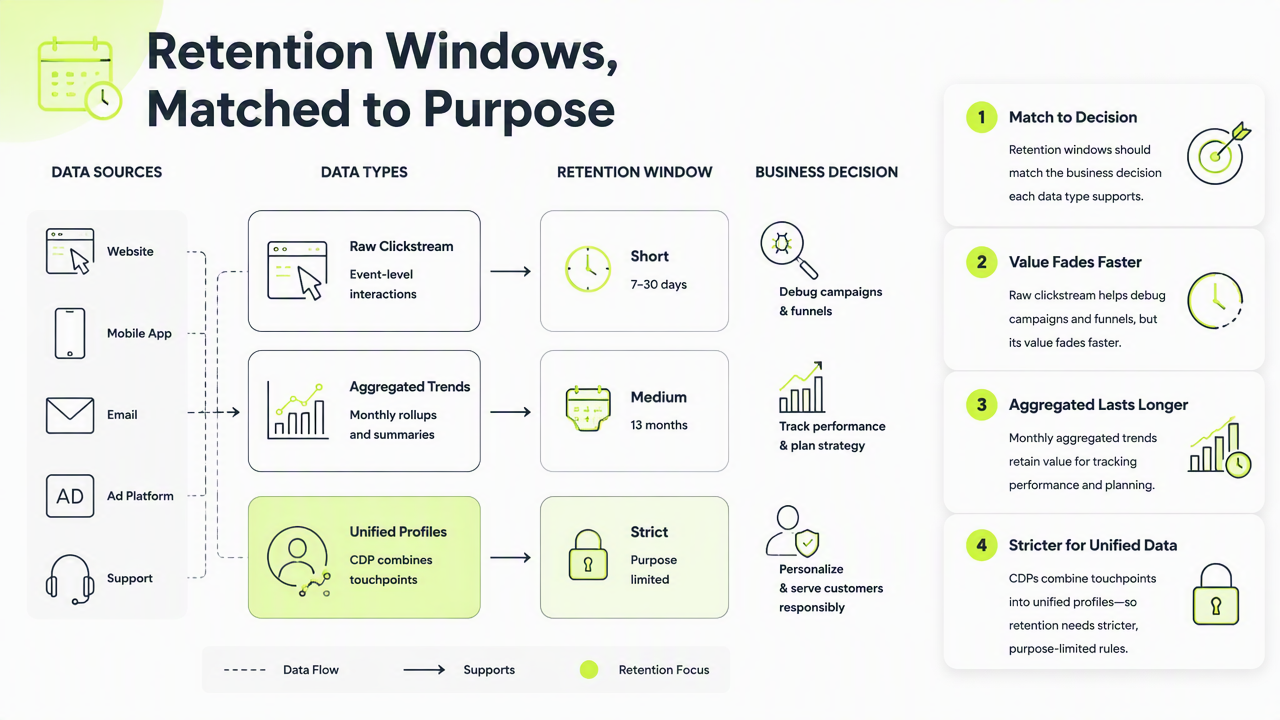
Competitor SERP research from 2026 shows a common recommendation: basic traffic trends often need 24 to 36 months, while detailed behavioral data should usually expire sooner. That range is useful, but founders should treat it as a planning baseline, not a universal rule.
Practical retention schedule by analytics type
| Data type | Typical use | Suggested action |
|---|---|---|
| Raw events | Funnel debugging, QA, short-term attribution | Keep briefly, then delete or aggregate |
| Campaign reports | Budget planning, channel comparison | Keep through seasonal cycles |
| Aggregated trends | Year-over-year traffic and conversion analysis | Keep longer when anonymized |
| User identifiers | Personalization, consented account analytics | Keep only while purpose and consent remain valid |
Retention should answer one question: what decision would fail if this data disappeared tomorrow?
Limit privacy and compliance risk
Excess analytics history increases exposure when identifiers, IP addresses, device data, search terms, or referral paths are stored longer than needed. Long retention also creates operational drag: larger exports, harder deletion requests, and more complex audits.
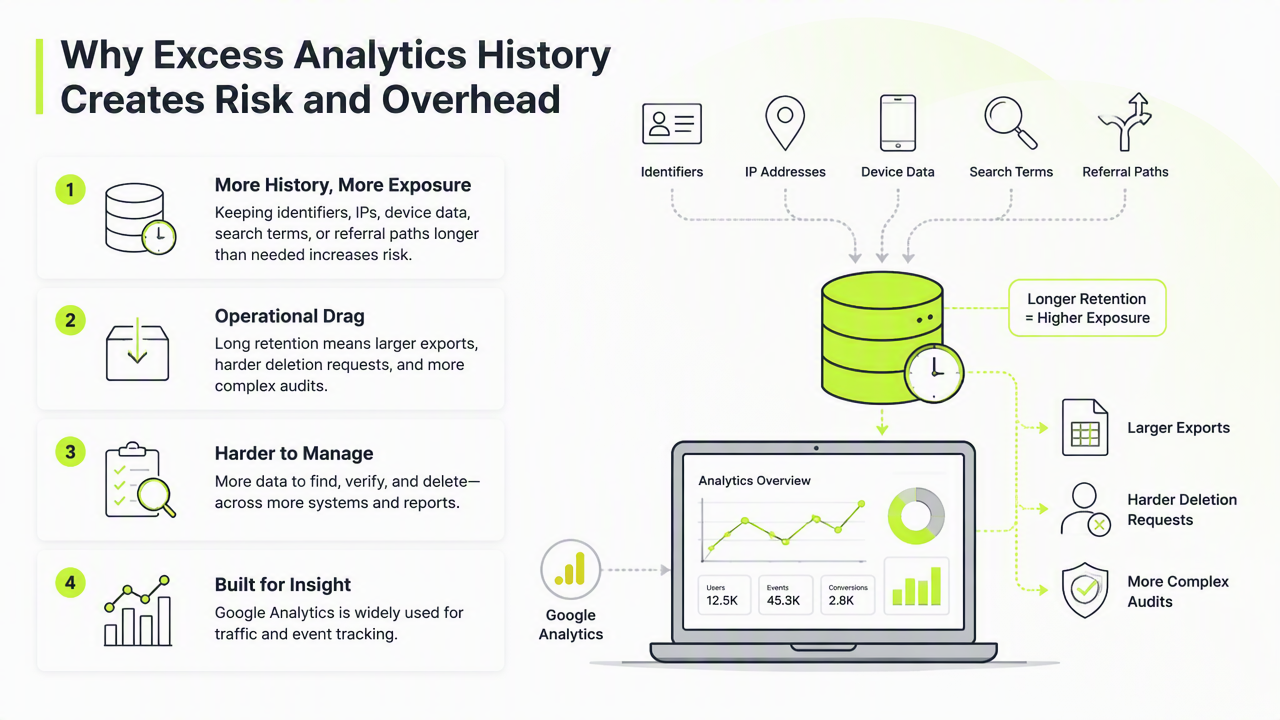
Google Analytics is widely used for traffic and event reporting inside the Google Marketing Platform, but any analytics stack still needs a clear policy. Tool defaults should not replace a documented business decision about collection, storage, aggregation, and deletion.
Retention risks to review before storing more data
A lean policy should identify avoidable risk before dashboards multiply.
- Map every analytics field that can identify or single out a person.
- Separate raw event retention from aggregated report retention.
- Document the purpose for each stored dataset.
- Assign a deletion or aggregation date.
- Review retention after new tracking, pixels, or integrations launch.
Research by Yogesh K. Dwivedi and coauthors on emerging digital environments highlights how newer data-rich systems create complex governance questions for practice and policy (ScienceDirect, 2022). Web analytics programs should prepare for the same direction of travel: more data, higher scrutiny, and less tolerance for indefinite storage.
Operationalize a 2026 retention policy
A good retention policy becomes workflow, not a PDF that nobody checks. Founders and marketers should define retention before adding events, dashboards, or customer segments, then confirm that analytics settings match the written policy.
The strongest policies use tiers: short retention for raw events, medium retention for campaign reporting, and longer retention only for aggregated or anonymized trends. Legal, marketing, and product teams should agree on these tiers before data starts flowing.
Simple framework for founders and growth teams
The Faurya platform fits teams that want privacy-aware analytics practices without creating a heavyweight data warehouse process. Retention planning should sit beside consent, reporting, and vendor review, including a signed data processing agreement where processor terms are relevant.
Use this operating rhythm:
- Quarterly: remove unused events and stale campaign parameters.
- Semiannually: confirm retention settings against reporting needs.
- Annually: aggregate historical reports and delete raw records no longer needed.
For 2027, expect retention reviews to become more automated. Analytics tools will likely add clearer controls for field-level deletion, shorter default windows, and privacy-preserving reports that reduce dependence on user-level histories.
Conclusion
Effective web analytics data retention best practices keep useful reporting while reducing unnecessary exposure. Start with purpose, set separate windows for raw and aggregated data, then schedule deletion reviews before dashboards grow stale. For teams ready to make privacy-aware analytics easier, visit faurya.com and review retention settings before the next campaign launch.
Generated by EarlySEO.com