How to Track Outbound Links Without Cookies in 2026
Measure affiliate, partner, social, docs, and SaaS CTA clicks without cookies using privacy-first events and weekly metrics.

TL;DR
Cookie-free outbound link tracking works best when teams measure click events, destinations, and page context without storing personal identifiers. Review top external destinations, click-through rate, affiliate revenue, partner referrals, and CTA exits weekly.
Teams can track outbound links without cookies by logging anonymous click events instead of building user profiles. Outbound link: a hyperlink that sends a visitor from one website to another domain. Privacy-led analytics platforms such as Faurya fit this 2026 shift because measurement can stay useful without invasive identifiers.
Table of Contents
What does cookie-free outbound link tracking measure?
Cookie-free outbound link tracking measures external click events, not individual browsing histories. A useful event record contains the source page, destination domain, link label, timestamp, device class, and campaign tag, while avoiding persistent personal identifiers.
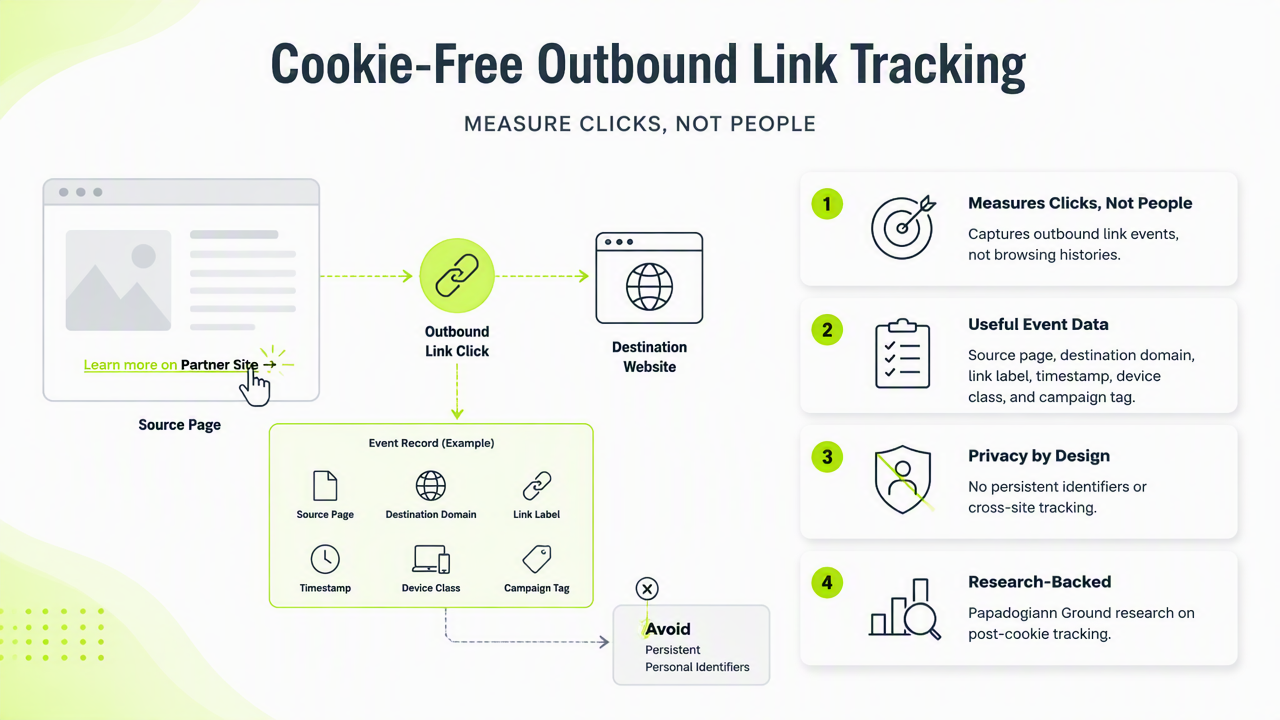
Research on post-cookie tracking by Papadogiannakis, Papadopoulos, and Kourtellis studied how websites bypass consent rules, which makes restraint a product decision, not just a compliance task: User Tracking in the Post-cookie Era.
Key insight: measure the business action, not the person behind the action.
Events worth separating in reports
Different outbound clicks answer different growth questions, so they should not be mixed into one generic bucket.
- Affiliate links: publisher, product, placement, and expected commission path.
- Partner links: partner domain, co-marketing page, and referral intent.
- Social links: network, icon location, and campaign source.
- Documentation links: article, help topic, and product area.
- SaaS CTA exits: button text, pricing context, and trial or demo destination.
For privacy review, teams should align collection notes with a public privacy policy before launch.
How should events be collected without cookies?
Events should be collected through first-party click listeners, server-side logs, or privacy-first analytics that avoid third-party cookies. The safest setup records a single outbound click event when a visitor selects an external link, then stores only aggregated reporting fields.
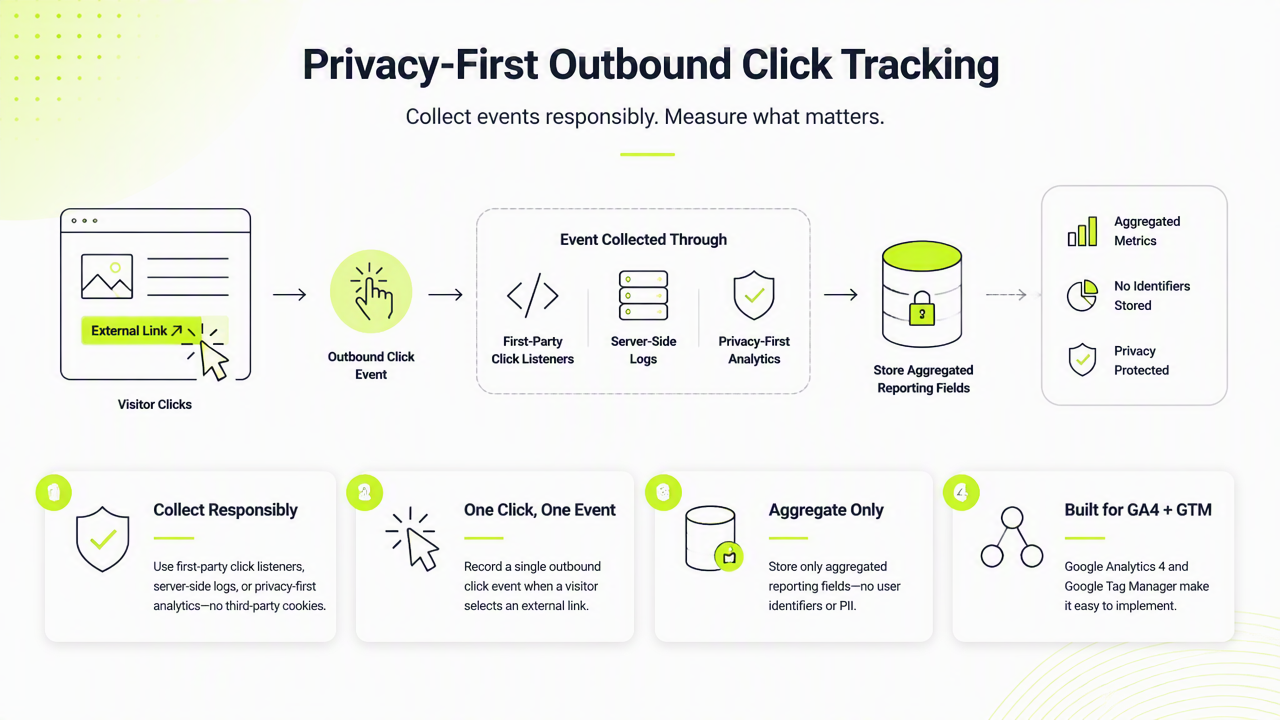
Google Analytics 4 and Google Tag Manager are common competitor paths for outbound events, but many setups still depend on broader analytics configurations. A focused tool can reduce noise when the goal is simply link performance.
Cookie-free implementation options
| Method | Best use case | Privacy note |
|---|---|---|
| JavaScript click listener | Marketing sites and blogs | Avoid user IDs and fingerprinting |
| Redirect endpoint | Affiliate and partner links | Keep redirects fast and disclosed |
| Server access logs | Documentation and support links | Strip IPs or aggregate quickly |
| Privacy-first analytics | SaaS CTAs and campaign exits | Prefer aggregate event storage |
A practical rollout follows four steps:
- Tag external links with clear labels.
- Capture destination domain and source page.
- Exclude personal data from payloads.
- Review event names against the data processing agreement.
With Faurya, teams can keep outbound reporting focused on action-level metrics rather than identity-level tracking.
Which outbound metrics deserve weekly review?
Weekly review should focus on click quality, destination performance, and revenue or activation impact. Raw outbound click volume is useful, but it becomes more useful when split by source page, link type, and business purpose.
A 2022 paper on offensive AI risk by Mirsky, Demontis, and Kotak examined organizational threats from AI systems, a useful reminder that data minimization reduces sensitive surfaces: The Threat of Offensive AI to Organizations.
Weekly scorecard for growth teams
| Metric | What it reveals | Example action |
|---|---|---|
| Outbound CTR | Whether a link attracts intent | Move strong CTAs higher |
| Top destinations | Which partners or resources matter | Expand high-performing partnerships |
| Affiliate clicks | Revenue potential by placement | Test product comparison tables |
| Docs exits | Support or setup friction | Improve in-app help paths |
| CTA exits | Trial, demo, or checkout intent | Tighten page copy before the button |
Reports should also flag sudden drops, broken destinations, and mismatched labels. Contract and access rules belong in the site's terms of service when outbound measurement supports customer-facing products.
Conclusion
The practical way to track outbound links without cookies is to collect lean click events, group them by business purpose, and review the same metrics every week. The Faurya platform is a strong fit for teams that want privacy-aware outbound reporting without turning link clicks into user surveillance. For implementation planning, visit faurya.com and start with the highest-value affiliate, partner, documentation, social, and CTA links.
Generated by EarlySEO.com