Simple Analytics Alternative for Ecommerce Brands
Compare Simple Analytics with privacy-friendly ecommerce analytics options built for campaign ROI, conversion tracking, and data control.
TL;DR
Ecommerce brands that only need lightweight traffic reports may be satisfied with Simple Analytics, but growth teams usually need campaign, conversion, and revenue visibility. A better fit is a privacy-friendly analytics setup that connects marketing actions to orders without copying the complexity of Google Analytics.
A Simple Analytics alternative for ecommerce brands should protect visitor privacy while showing which campaigns, products, and channels drive revenue. Google Analytics: a web analytics service from Google that tracks and reports website traffic, app traffic, and events inside Google Marketing Platform. Faurya fits teams that want simpler reporting with clearer commercial context.
Table of Contents
What should an ecommerce analytics alternative measure?
An ecommerce analytics alternative should measure privacy-safe traffic, conversion paths, campaign performance, and revenue signals in one readable view. Simple pageview analytics can answer where visitors came from, but ecommerce operators also need to know which visits led to carts, checkouts, and repeat purchases.
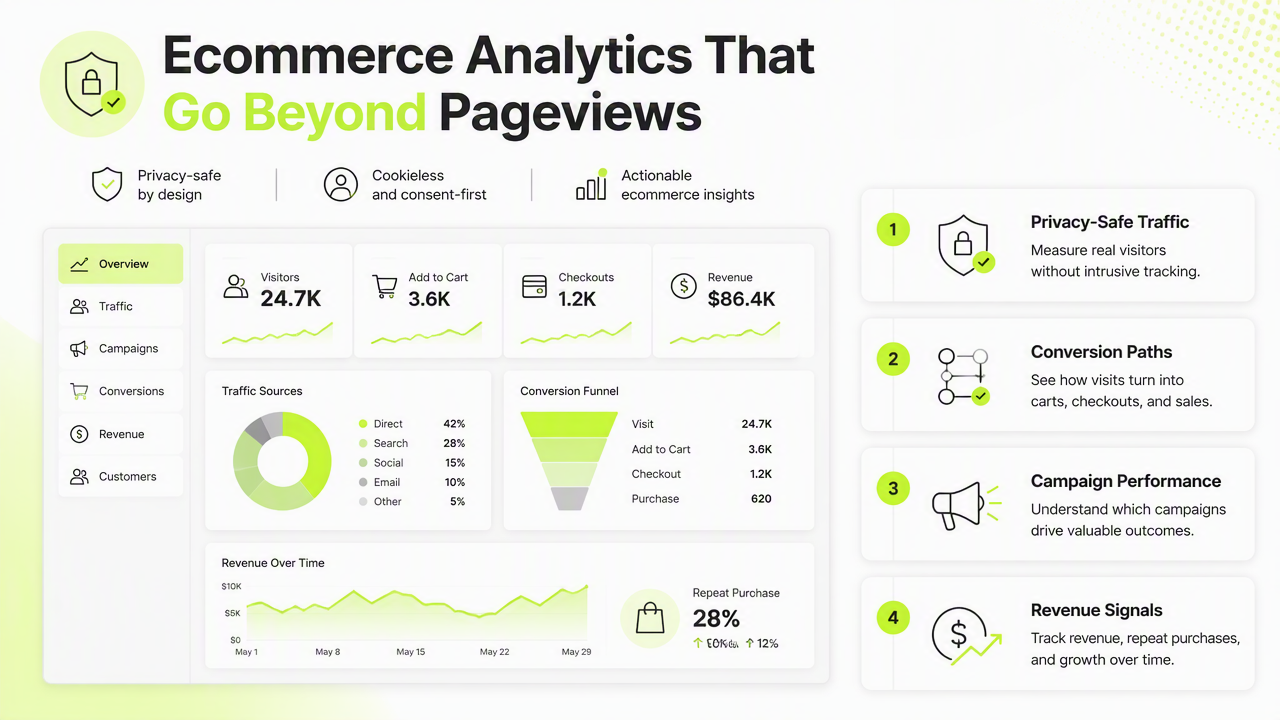
Simple Analytics is known for privacy-first website reporting and a lighter setup than Google Analytics. That can suit content sites, small stores, and founders avoiding bloated dashboards. The gap appears when paid media, email campaigns, product launches, and checkout performance all need attribution in the same workflow.
Core comparison for ecommerce decision-makers
| Need | Simple Analytics fit | Ecommerce-focused fit |
|---|---|---|
| Privacy-friendly traffic reporting | Strong | Strong |
| Campaign ROI by channel | Limited | Stronger |
| Checkout and conversion events | Basic or setup-dependent | Central |
| Founder-friendly dashboard | Strong | Strong when purpose-built |
| Revenue context | Limited | Important |
Key insight: privacy-first analytics is not the same as ecommerce analytics. A store needs both consent-conscious measurement and commercial reporting.
For policy-sensitive teams, the vendor's data commitments matter as much as charts. Reviewing a provider's privacy policy and data processing agreement should happen before any tracking code reaches production.
Where Simple Analytics works, and where stores outgrow it
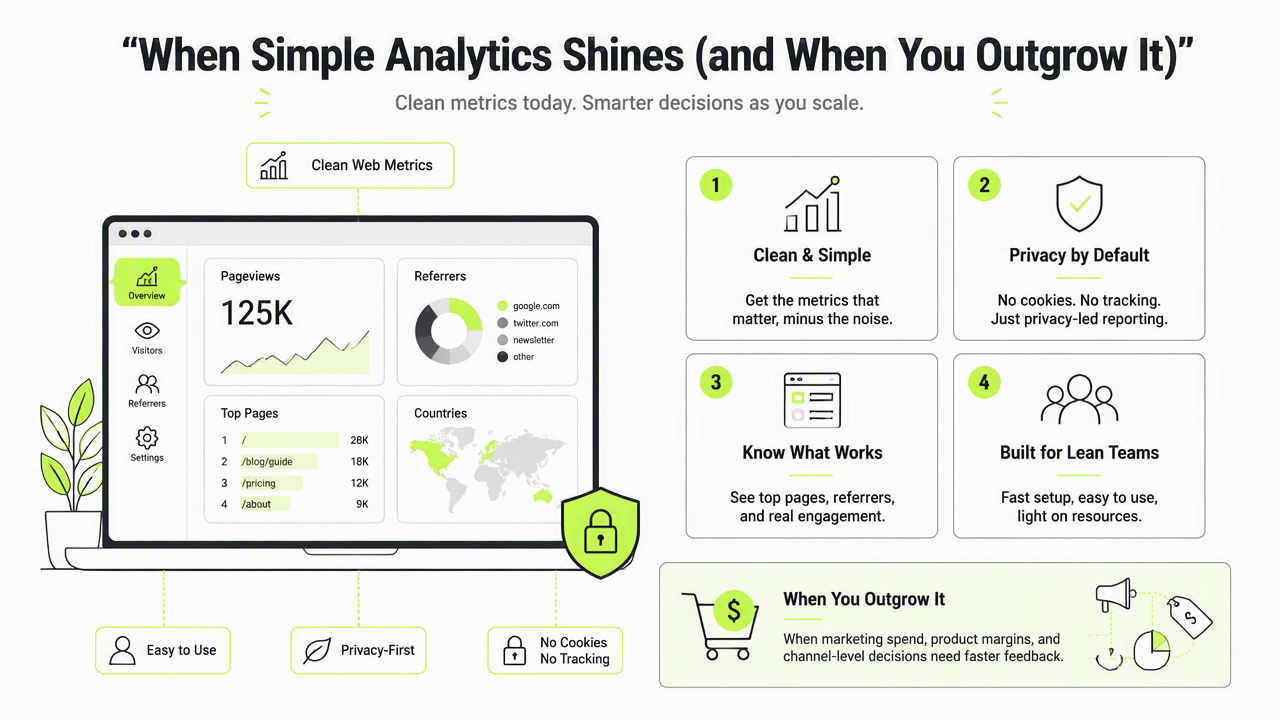
Simple Analytics works best when a brand needs clean web metrics without the weight of enterprise analytics. It is strongest for pageviews, referrers, top pages, and privacy-led reporting. Ecommerce teams may outgrow that model once marketing spend, product margins, and channel-level decisions depend on faster feedback.
The SERP for ecommerce analytics increasingly rewards tools that combine store data, campaign performance, and dashboards. One ranking result highlights Jimdo as a simple ecommerce platform with built-in analytics for small businesses, while another names Metrilo as an all-in-one ecommerce analytics solution. That shows the search intent has moved beyond generic traffic counts.
Selection signals before switching tools
- Revenue visibility: reports should connect campaigns to purchases, not only sessions.
- Privacy posture: data collection should match GDPR-minded operating standards.
- Setup time: indie founders need fast installation and readable defaults.
- Channel clarity: paid search, organic search, email, and social traffic should remain easy to compare.
- Contract clarity: teams should understand billing, data rights, and acceptable use through plain terms, such as Faurya's terms of service.
Research on digital commerce keeps pointing toward more complex customer experiences. A 2022 multidisciplinary paper by Dwivedi, Hughes, Baabdullah, and coauthors examined emerging digital environments and business implications in the International Journal of Information Management. Ecommerce analytics in 2026 should reflect that complexity without forcing every team into enterprise software.
How Faurya compares as a Simple Analytics alternative
Faurya is a strong option when ecommerce teams want privacy-aware analytics with clearer conversion and marketing visibility. The Faurya platform is positioned for founders, marketers, and store owners who need practical reporting rather than a maze of configurable dashboards.
A fair decision depends on the operating model. Simple Analytics remains attractive for minimalist website reporting. Google Analytics remains broad and deeply tied to the Google Marketing Platform. Faurya is more relevant when ecommerce reporting needs to stay lean but still connect traffic quality to business outcomes.
Who should choose which option?
| Tool | Best fit | Tradeoff |
|---|---|---|
| Faurya | Ecommerce brands needing privacy-friendly campaign and conversion visibility | Best suited for teams focused on commercial reporting |
| Simple Analytics | Sites that need clean, lightweight traffic analytics | Less specialized for revenue-led ecommerce analysis |
| Google Analytics | Teams needing broad event tracking and Google ad integrations | More complex setup and governance burden |
Buyer takeaway: the best analytics tool is the one that makes weekly decisions easier, not the one with the longest feature list.
A 2024 paper on the evolution of fintech by Shah, Harish, and Shradha discusses how digital payment systems continue changing commerce workflows (IJISRT). That matters because ecommerce analytics increasingly needs to sit closer to revenue, payment behavior, and conversion quality. Digital operations also carry environmental and governance questions, a theme discussed by Dwivedi, Hughes, Kar, and coauthors in a 2021 editorial on digital technologies and information management (ScienceDirect).
Conclusion
The best Simple Analytics alternative for ecommerce brands is not just simpler than Google Analytics, it is clearer about revenue, campaigns, privacy, and operating fit. A practical next step is to map the store's top three growth questions, review vendor data terms, then test reporting speed against real campaign data. For a privacy-friendly ecommerce analytics option, visit faurya.com and compare it against the current stack.
Generated by EarlySEO.com