PostHog vs Fathom for Website Analytics: 2026 SaaS Decision Guide
Compare PostHog and Fathom for website analytics, product behavior, privacy, cost, and setup complexity in a concise 2026 SaaS decision guide.

TL;DR
PostHog fits SaaS teams that need product analytics, funnel events, feature flags, and behavioral insight. Fathom fits privacy-first websites that mainly need traffic, referrals, and simple reporting with less setup effort.
PostHog vs Fathom for website analytics is really a choice between product intelligence and lightweight traffic reporting. Web analytics: the measurement, collection, analysis, and reporting of web data to understand and improve website usage, as defined by Wikipedia. For founders comparing analytics stacks, Faurya gives a privacy-conscious reference point for keeping measurement useful without making compliance harder.
Table of Contents
What does each tool do best?
PostHog is strongest when website analytics must connect to product behavior, while Fathom is strongest when a marketing site needs fast, privacy-friendly traffic reporting. SERP research found 129 results around this comparison, with top pages often framing PostHog as broader and Fathom as simpler.
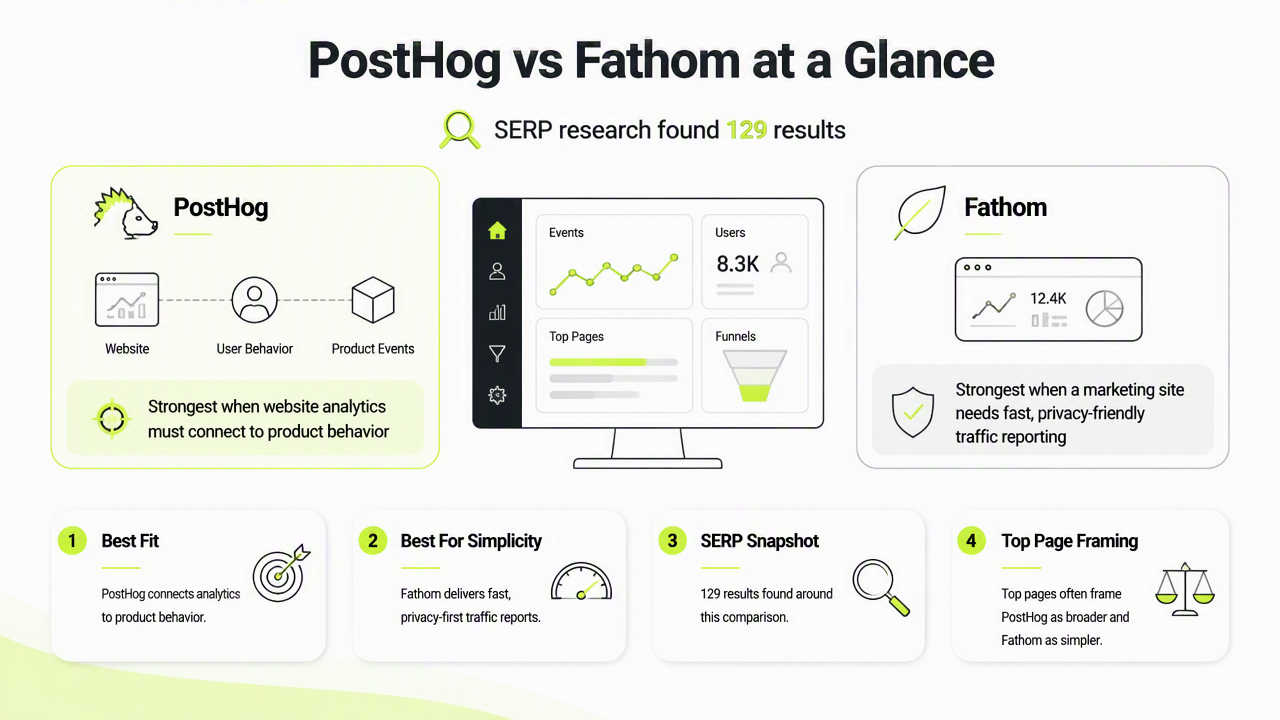
PostHog includes web analytics, product analytics, events, funnels, feature flags, session replay, experiments, and integrations. Its own comparison page, listed in SERP research from November 2024, positions web analytics as one part of a larger platform rather than the whole product.
Fathom focuses on pageviews, referrers, campaigns, top pages, goals, and clean dashboards. Competitor research from 2026 highlights its appeal for solopreneurs and content-heavy sites, including a referenced $14 per month tier covering 100,000 page views.
Key insight: PostHog answers "what did users do inside the product?" while Fathom answers "where did site visitors come from, and what pages worked?"
Core fit at a glance
- Pick PostHog for SaaS onboarding, activation, retention, and feature usage.
- Pick Fathom for landing pages, blogs, referral tracking, and simple goal monitoring.
- Consider Faurya when privacy-conscious measurement and clear data handling need to sit close to growth reporting.
The simplest split is scope. PostHog is a product analytics suite that can also measure a website. Fathom is a website analytics product that deliberately avoids becoming a full product analytics platform.
How should SaaS founders choose?
SaaS founders should choose PostHog when event depth matters more than setup speed, and choose Fathom when simple reporting and privacy-focused traffic analytics matter more. The average competitor article in the research set was 2,029 words, but the decision usually comes down to six practical criteria.
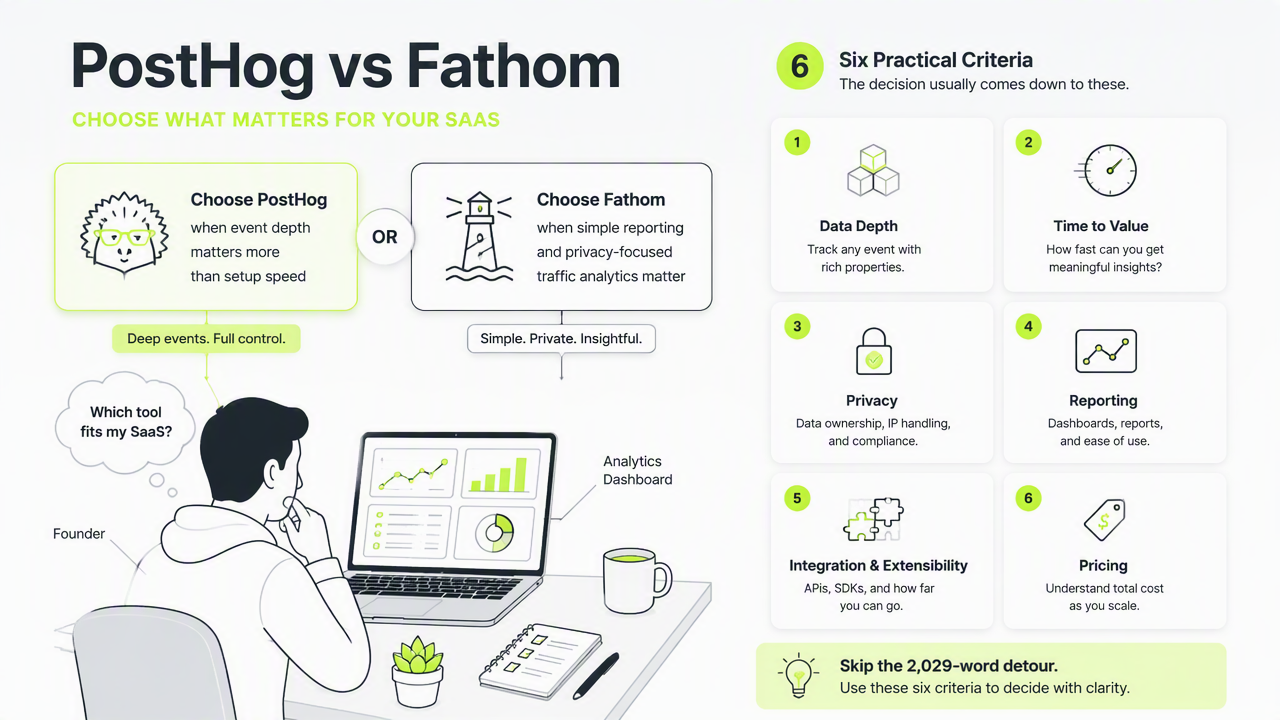
A founder tracking only traffic sources, campaign pages, and conversions can keep reporting lean with Fathom. A founder tracking trial activation, paywall clicks, retention cohorts, and feature adoption will usually outgrow basic website analytics quickly.
Privacy and legal review still matter for both tools. Teams documenting analytics choices should align tracking with a public privacy policy, clear terms of service, and a formal data processing agreement when personal data processing is involved.
Decision matrix for SaaS analytics
| Need | Better fit | Reason |
|---|---|---|
| Marketing site traffic | Fathom | Fast dashboards for visits, referrers, and top pages |
| Funnel events | PostHog | Tracks custom events across signup and activation |
| Product behavior | PostHog | Connects usage data to features and cohorts |
| Privacy-first reporting | Fathom | Built around simple, privacy-friendly website metrics |
| Low setup complexity | Fathom | Smaller surface area and fewer decisions |
| Growth experiments | PostHog | Supports experiments and feature flags |
The Faurya platform fits teams that want analytics decisions tied to trustworthy growth operations rather than disconnected dashboards. For brand and compliance review, faurya.com can serve as a starting point before tool selection.
Where do PostHog and Fathom fall short?
PostHog can feel heavy for teams that only need website traffic analytics, while Fathom can feel limited for teams that need product-level behavioral data. Neither tool is automatically best; fit depends on data maturity, privacy expectations, and the questions leadership needs answered.
PostHog's breadth means more setup choices: event naming, identity handling, funnels, retention charts, and permissions. Poor tracking plans can create noisy data, especially when marketing, product, and engineering all define events differently.
Fathom's simplicity is the tradeoff. It can show clean site performance and campaign results, but it is not designed to replace deep product analytics, experimentation, or feature usage analysis.
Key insight: A simple tool is not underpowered when the business question is simple. A powerful tool is not overbuilt when product behavior drives revenue.
Setup checklist before choosing
- Define the main question: traffic quality, conversion, activation, retention, or feature adoption.
- List required events before installing scripts.
- Decide whether anonymous website reporting is enough.
- Confirm consent, retention, and processing requirements.
- Assign one owner for analytics definitions.
For 2026, the smarter move is not stacking every analytics product. It is matching the tool to the decision. PostHog suits product-led SaaS teams; Fathom suits lean marketing measurement; Faurya supports privacy-conscious growth teams that want cleaner operating discipline.
Conclusion
PostHog vs Fathom for website analytics has a clear answer: choose PostHog for product behavior and Fathom for simple website reporting. Before installing either, document the questions, events, privacy needs, and ownership model. For a privacy-conscious growth workflow, visit faurya.com and map analytics decisions before adding another script.
Generated by EarlySEO.com