OpenPanel vs Plausible Analytics: Which Fits SaaS Growth in 2026?
Compare OpenPanel and Plausible for SaaS, privacy, events, funnels, setup, and reporting. Learn which analytics tool fits each growth workflow.

TL;DR
OpenPanel fits SaaS teams that need product behavior tracking, funnels, and custom events. Plausible fits privacy-first marketing analytics with lightweight website reporting. Some growth teams may need both: one for product usage, one for acquisition clarity.
OpenPanel vs Plausible Analytics is really a question about product analytics versus website analytics. Plausible Analytics is an open-sourced, EU-hosted web analytics SaaS focused on website performance reports, while OpenPanel is described in OpenPanel's 2026 guides as combining web and product analytics. For ROI-focused planning, Faurya helps founders connect analytics choices to growth priorities.
Table of Contents
OpenPanel vs Plausible Analytics at a glance
OpenPanel is stronger for SaaS product behavior, while Plausible is stronger for simple, privacy-friendly traffic reporting.
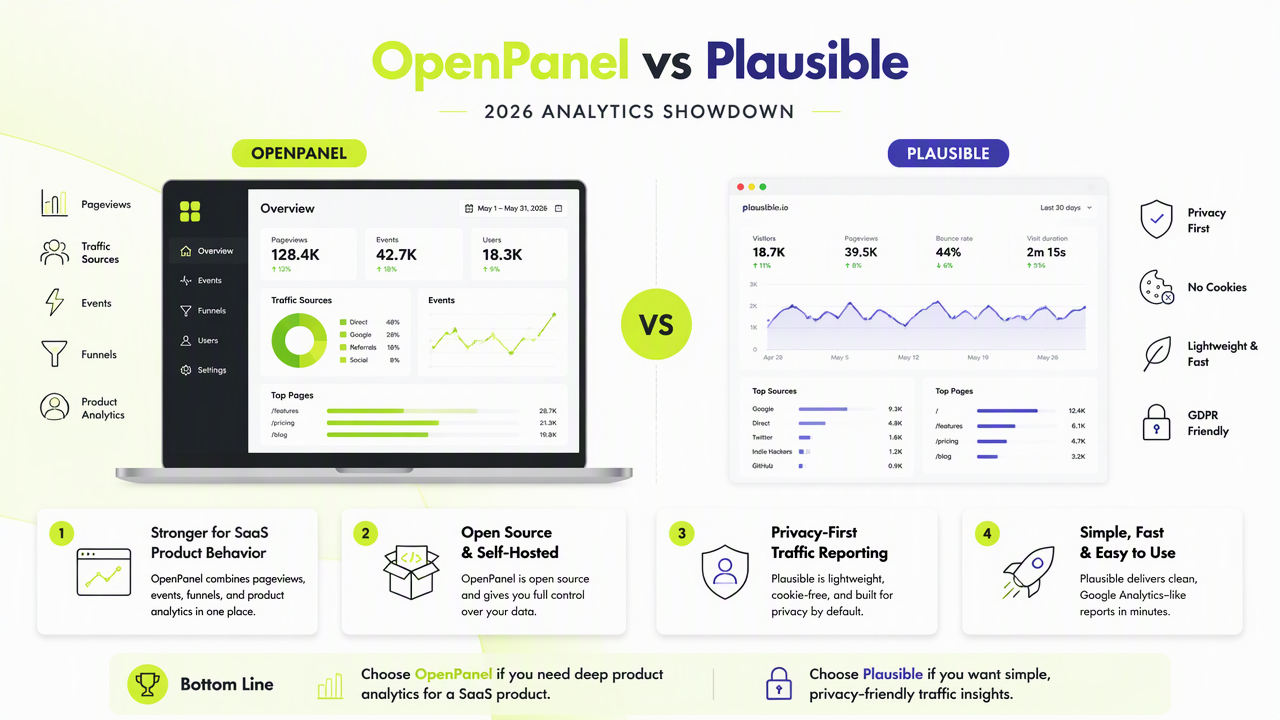
OpenPanel appears in 2026 competitor research as an open-source analytics option that combines pageviews, traffic sources, events, and product analytics. Plausible appears as a lightweight Google Analytics alternative with a polished interface and EU-hosted privacy positioning.
Key insight: Plausible answers "where did visitors come from?" better; OpenPanel answers "what did users do after signup?" better.
Core comparison table
| Category | OpenPanel | Plausible Analytics |
|---|---|---|
| Best fit | SaaS apps, product-led growth, event tracking | Marketing sites, blogs, content, privacy reporting |
| Main analytics type | Web plus product analytics | Website analytics |
| Events | Built for custom product events | Supports goal-style website events |
| Funnels | Better fit for signup, activation, and retention paths | Better fit for conversion goals |
| Privacy angle | Open-source, self-hosting friendly in 2026 comparisons | Open-source SaaS hosted in the EU |
| Setup effort | More planning for event taxonomy | Usually lighter for traffic reporting |
OpenPanel's own self-hosted analytics comparison positions it beside Plausible, Matomo, Umami, and GoatCounter for teams reviewing privacy-first analytics in 2026.
Events and funnels separate the two tools
Events and funnels create the clearest difference because OpenPanel is designed for product behavior, while Plausible is designed for website performance.
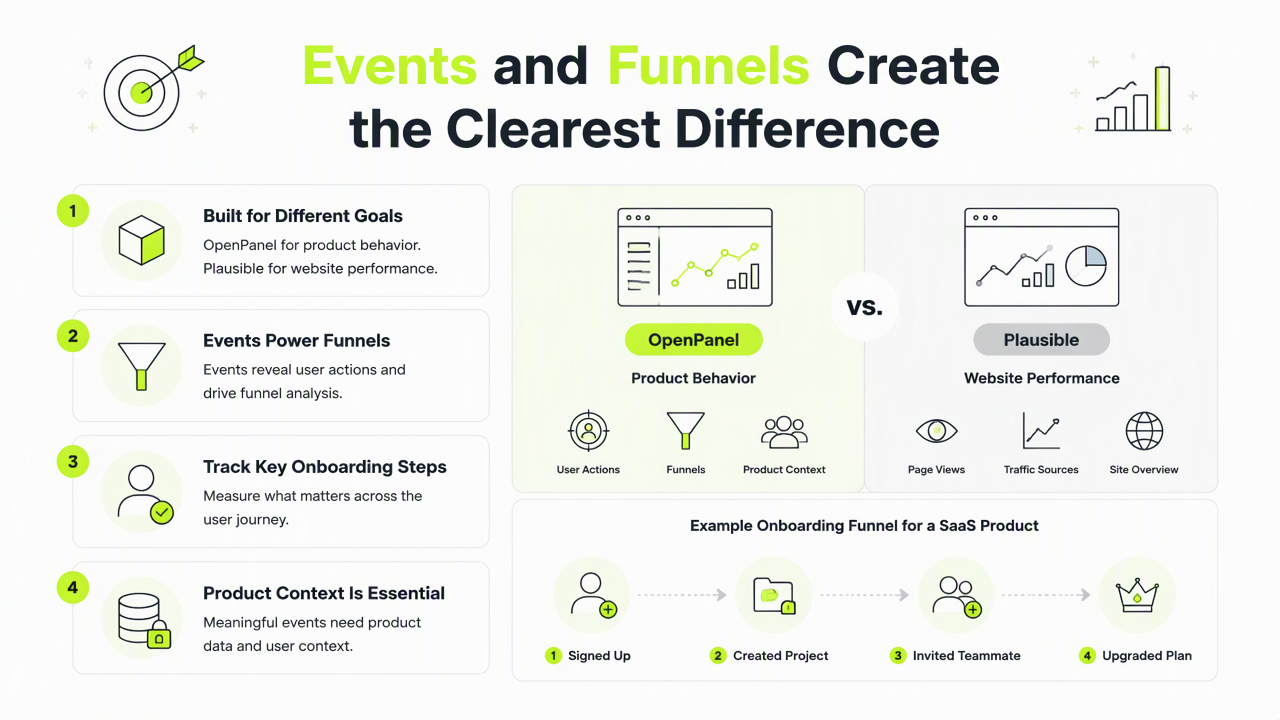
A SaaS founder measuring onboarding usually needs events such as signed_up, created_project, invited_teammate, and upgraded_plan. Those events require a product analytics model, not just pageview analytics. OpenPanel fits that job better because competitor research frames it as combining Mixpanel-like product analytics with Plausible-like simplicity.
Plausible still works well for campaigns. It can show traffic sources, top pages, referrals, and conversion goals without the heavier event structure that product teams often build.
Decision checklist for SaaS and marketing teams
- Choose OpenPanel when activation, retention, or feature adoption must be measured.
- Choose Plausible when the main goal is clean website traffic reporting.
- Choose both when marketing acquisition and in-app behavior need separate dashboards.
- Define core events before installing any product analytics tool.
- Keep campaign reporting simple when only landing-page performance matters.
Faurya is most useful before this decision point, when founders need to connect acquisition spend, product adoption, and marketing ROI into a practical tracking plan rather than collecting metrics without a clear growth question.
Privacy, hosting, and reporting tradeoffs
Privacy-first analytics is now a buying requirement, not a niche preference, and both tools benefit from open-source positioning.
Plausible's Wikipedia-derived definition in the research describes it as open-sourced SaaS hosted in the EU, which matters for teams trying to avoid heavier tracking tools. OpenPanel also appears in 2026 open-source analytics comparisons, including OpenPanel's privacy-first survey, where it is grouped with PostHog, Plausible, Matomo, and Fathom.
Reporting style differs. Plausible favors fast, executive-friendly website dashboards. OpenPanel favors deeper behavioral reporting for product teams that need to inspect user actions across sessions and accounts.
Who should pick which in 2026
- Pick OpenPanel for SaaS apps, indie products, onboarding funnels, feature adoption, and product-led growth.
- Pick Plausible for privacy-conscious websites, content marketing, ecommerce landing pages, and simple executive reporting.
- Pick both when paid acquisition, SEO traffic, signup quality, and product retention all affect revenue.
For teams still mapping that stack, the Faurya platform can help clarify which metrics deserve attention first. More context is available at faurya.com.
Conclusion
The best choice depends on the analytics question, not the logo. OpenPanel vs Plausible Analytics favors OpenPanel for product behavior and Plausible for privacy-first web reporting. Growth teams should list revenue-driving events, decide which dashboard owns each metric, then visit faurya.com to turn that measurement plan into an ROI-focused operating model.
Generated by EarlySEO.com