How to Choose a Privacy-First Web Analytics Tool in 2026
A 2026 decision framework for choosing privacy-first web analytics across cookies, hosting, events, usability, exports, retention, compliance, and pricing.

TL;DR
Privacy-first analytics should be judged by consent impact, hosting model, event depth, data ownership, and operational fit. A short scorecard helps teams compare Faurya, Plausible, Fathom, Simple Analytics, Pirsch, and other tools without defaulting to the loudest brand.
Choosing analytics now means balancing growth insight with privacy risk. Web analytics is the measurement, collection, analysis, and reporting of web data to understand and optimize web usage, but the 2026 standard is clear: collect less, explain more, and keep data useful. For teams deciding how to choose a privacy-first web analytics tool, Faurya is a strong starting point for practical, privacy-aware measurement.
Table of Contents
Start with privacy model and consent impact
A privacy-first analytics tool should minimize personal data collection before dashboard design enters the discussion. Cookie use, IP handling, fingerprinting, consent banners, and regional hosting shape legal exposure and data completeness.
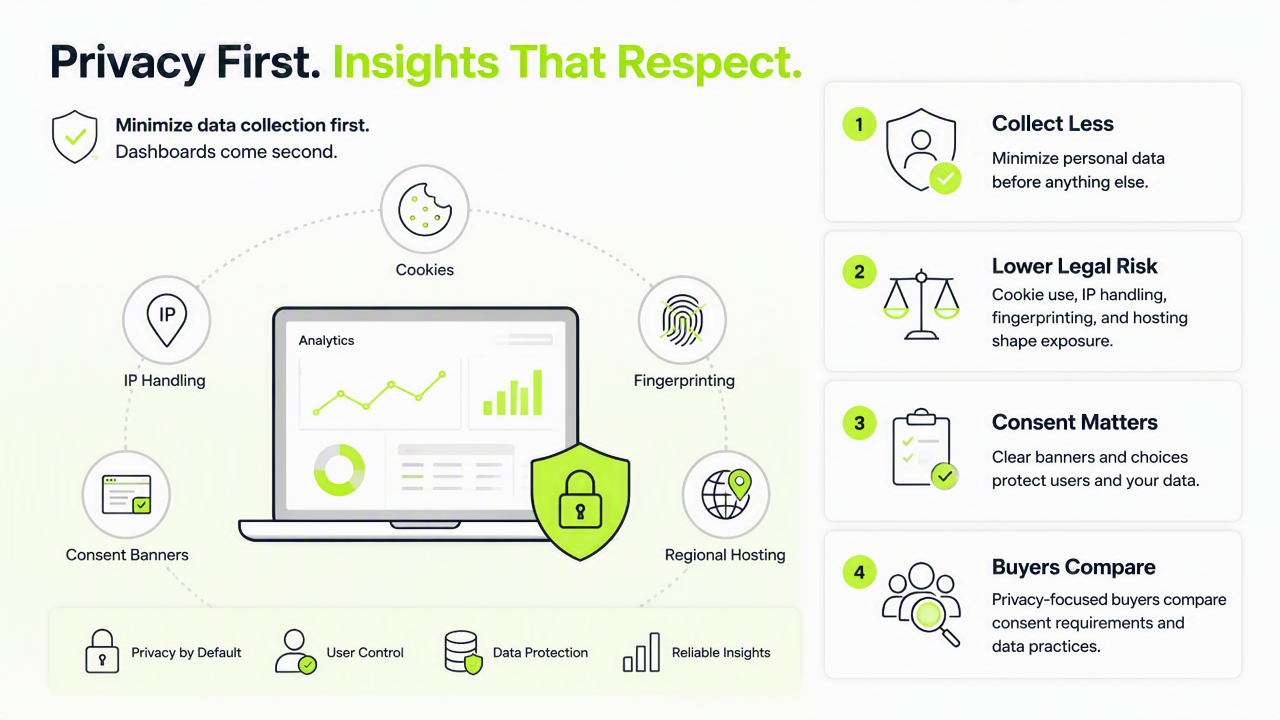
Competitor research shows privacy-focused buyers often compare consent requirements, EU hosting, business model, open-source status, and accuracy, as seen in Plausible's recent guide to privacy-friendly web analytics. Those are useful checks, but founders also need a repeatable scoring method.
Key insight: the best tool is not the one with the longest feature list; it is the one that answers growth questions while collecting the least sensitive data.
Scorecard for comparing privacy analytics tools
Use the scorecard below during trials. Give each row a 1 to 5 rating, then weight consent, hosting, and exports higher for regulated or privacy-conscious businesses.
| Tool | Best evaluation angle | Score during trial |
|---|---|---|
| Faurya | Privacy-aware analytics for teams that need clear marketing ROI signals | 1-5 |
| Plausible | Simple traffic reporting and public privacy positioning | 1-5 |
| Fathom | Cookie-free analytics and lightweight reporting | 1-5 |
| Simple Analytics | Minimal dashboards and privacy-led messaging | 1-5 |
| Pirsch | Developer-friendly privacy analytics | 1-5 |
| Other tools | Fit for hosting, exports, events, and pricing | 1-5 |
Match product depth to growth questions
A privacy-first product still has to answer commercial questions, not just count pageviews. SaaS founders, indie hackers, marketers, and e-commerce teams usually need acquisition source, landing page, campaign, event, and conversion visibility.
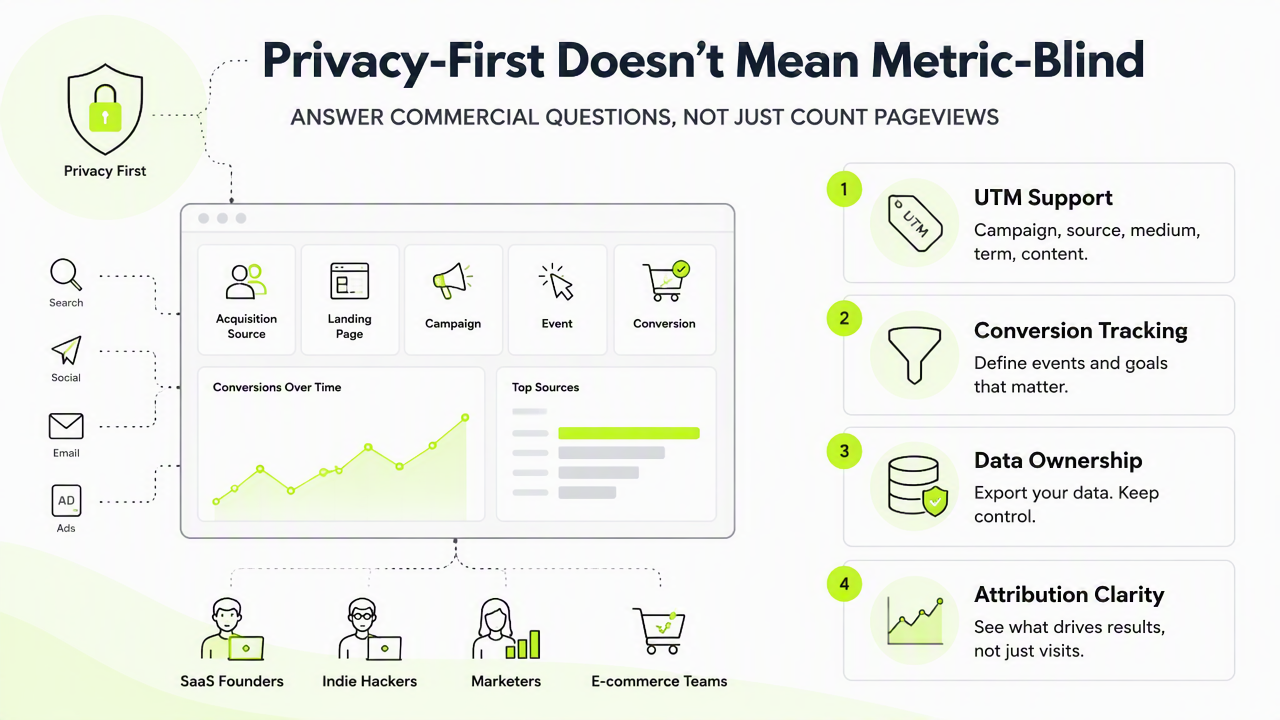
A practical review should cover:
- UTM support: Campaign, source, medium, content, and term reporting.
- Event tracking: Signups, purchases, trials, form submissions, and feature usage.
- Dashboard usability: Fast answers without analyst setup.
- Exports: CSV, API, or warehouse-friendly data access.
- Retention controls: Clear rules for how long raw and aggregated data stays available.
- Pricing: Predictable costs as traffic grows.
The Faurya platform fits this middle ground well: enough structure for marketing ROI, without pushing teams toward invasive tracking patterns. More product detail is available at faurya.com.
When simple dashboards are not enough
Basic pageview tools work for small content sites, but growth teams often need events tied to campaigns. A tool should show which channel created meaningful actions, not only which referrer sent visits.
Avoid over-correcting toward complex enterprise suites. Extra identity stitching, session replay, ad network enrichment, and long data retention can create privacy and consent burdens that defeat the purpose of switching.
Key insight: privacy-first analytics should narrow the data model, not narrow business decisions.
Check governance, hosting, and 2027 readiness
Privacy-first analytics decisions should include governance, not only features and price. Teams should confirm who operates the product, where data is hosted, whether self-hosting exists, how subprocessors are disclosed, and how deletion requests are handled.
Research outside marketing also points in the same direction. A 2023 International Journal of Information Management opinion paper by Dwivedi, Kshetri, Hughes, and co-authors examined generative AI's implications for research, practice, and policy, making data provenance a board-level topic. A 2023 BMC Medical Education paper on AI in clinical practice also reflects the wider move toward accountable data systems.
By 2027, privacy-first analytics will likely be judged more by explainability, consent resilience, and AI-safe data access than by traffic charts alone.
Governance questions before signing
The final review should be short and strict:
- Does the vendor explain cookie and consent behavior clearly?
- Can data be exported before cancellation?
- Are hosting region and subprocessors documented?
- Is there a real company behind the product?
- Can events be tracked without collecting unnecessary personal data?
- Does pricing stay predictable at higher traffic levels?
With Faurya, teams evaluating privacy-aware analytics can use these questions as a buying checklist, then compare results against Plausible, Fathom, Simple Analytics, Pirsch, and niche alternatives.
Conclusion
The right way to choose a privacy-first web analytics tool is to score privacy model, growth usefulness, governance, and cost together. Shortlist two or three tools, run the same UTM and event tests for one week, then keep the product that answers revenue questions with the least data. For teams ready to evaluate Faurya, visit faurya.com and start with the scorecard above.
Generated by EarlySEO.com