Faurya vs Simple Analytics: 2026 Buyer Guide
Compare Faurya and Simple Analytics on setup, dashboards, events, privacy, pricing fit, and best use cases for founders and growth teams.
TL;DR
Faurya is the stronger fit for revenue-focused teams that need analytics tied to growth, attribution, and business outcomes. Simple Analytics is a clean privacy-first option for lightweight traffic measurement with no cookies, visitor identifiers, or personal data.
Privacy-first analytics has moved from a niche concern to a buying requirement for SaaS, ecommerce, and indie products. Faurya vs Simple Analytics is mainly a choice between revenue-aware product reporting and minimalist cookieless traffic analytics. TL;DR: short for "too long; didn't read," it signals a fast summary of the decision.
Table of Contents
Faurya vs Simple Analytics at a glance
Faurya is best framed as a revenue-first analytics platform, while Simple Analytics is best framed as a privacy-first traffic analytics tool. The SERP review covered 113 results and 5 competitor pages, with competitor articles averaging 1,188 words, which shows buyers usually expect a decision table before deeper analysis.
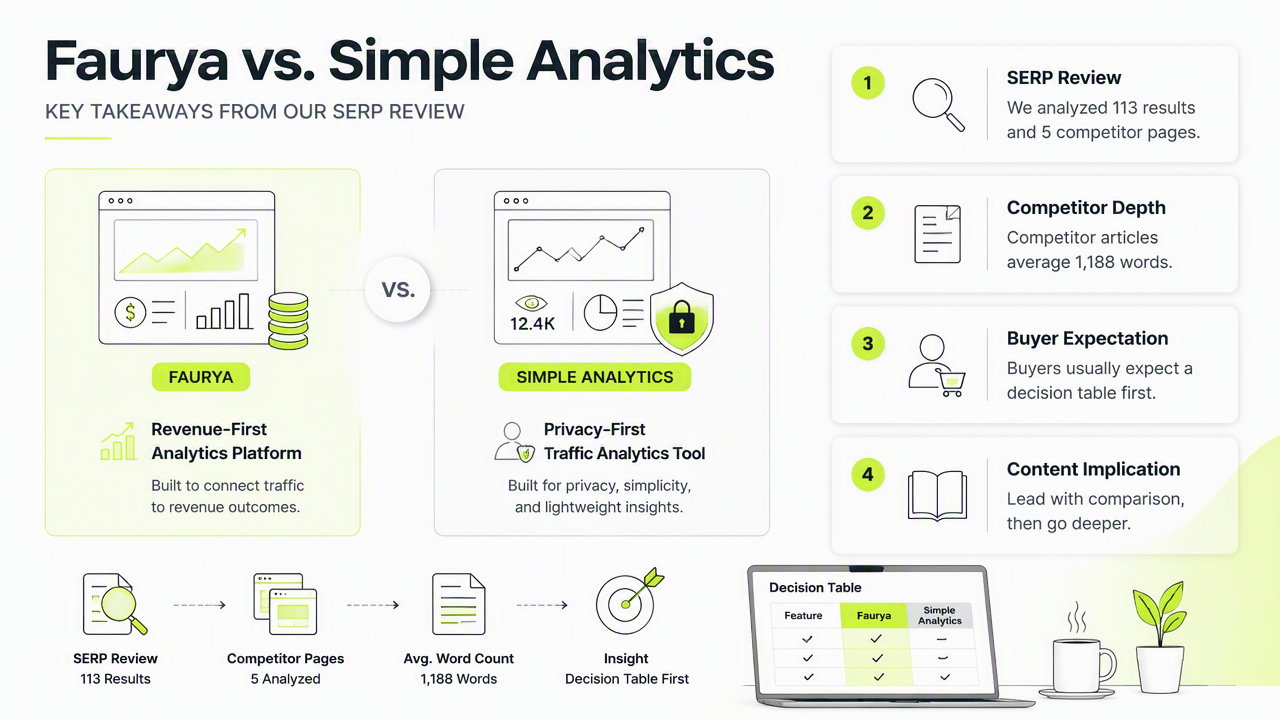
Verdict table for buyer shortlists
| Category | Faurya | Simple Analytics |
|---|---|---|
| Best fit | SaaS founders, indie hackers, ecommerce teams, growth teams | Privacy-conscious sites that need simple traffic reporting |
| Core strength | Revenue-aware analytics, growth reporting, business context | Cookieless measurement with no visitor identifiers or personal data |
| Dashboard style | Built for performance decisions and ROI review | Minimal, clear, and low-distraction |
| Event tracking fit | Better for teams tracking conversion and product actions | Better for lightweight pageview and traffic insight |
| Privacy posture | Privacy-positioned analytics for business reporting | Explicitly no cookies, no visitor identifiers, no personal data |
Key insight: the better tool depends less on company size and more on whether analytics must explain revenue, or only explain traffic.
Setup speed, dashboards, and event depth
Simple Analytics favors fast setup and a clean dashboard, while the Faurya platform is positioned for teams that want reporting to support growth decisions. Research from competitor pages repeatedly centers buyer questions around setup speed, dashboard clarity, event tracking, privacy posture, pricing, and best-fit use cases.
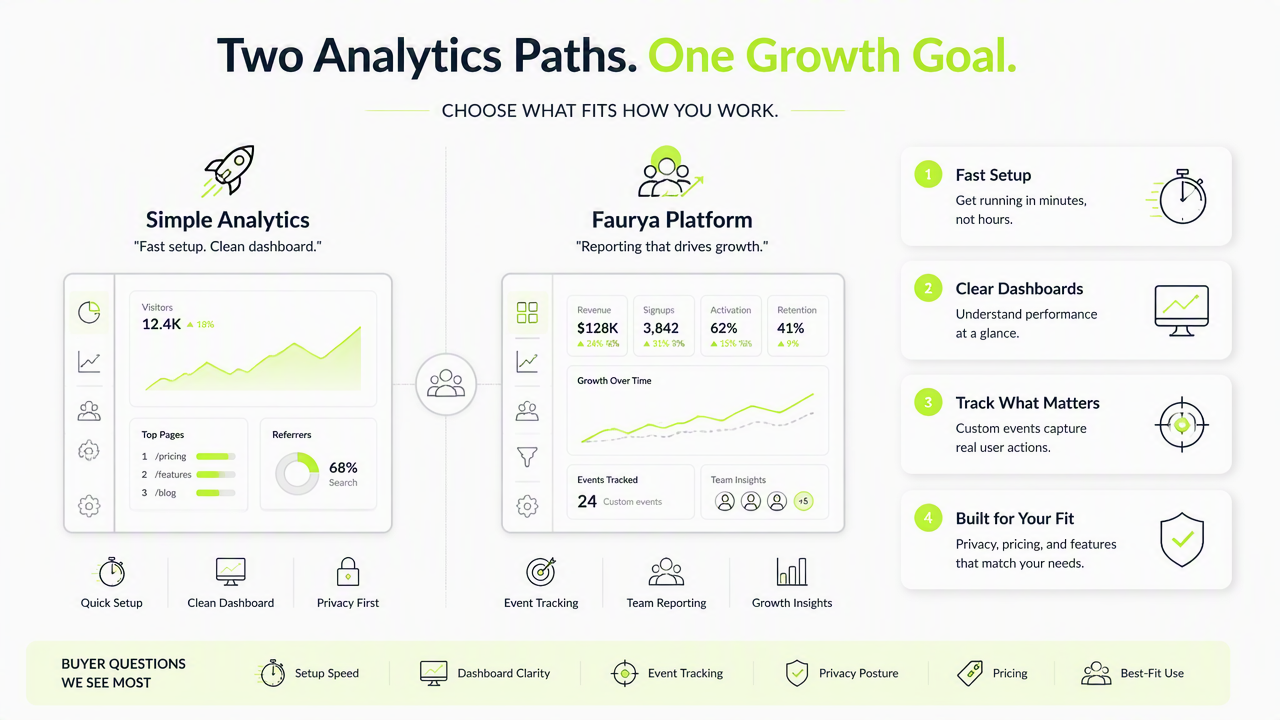
Operational checklist before choosing
A practical evaluation should start with the reporting job the analytics tool must do.
- Define the primary metric: traffic, conversion, revenue, or retention.
- Check whether events need product, checkout, or campaign context.
- Confirm how dashboards will be used by founders, marketers, or ecommerce operators.
- Review whether cookieless analytics is enough, or whether deeper business attribution is needed.
- Compare pricing against the number of sites, traffic levels, and reporting users.
For a founder checking weekly growth, dashboard clarity matters more than raw feature count. For a marketer proving campaign ROI, event depth and attribution context usually matter more than a minimalist interface.
Privacy, compliance, and pricing fit
Simple Analytics has the clearer public privacy claim in the reviewed data: no cookies, no visitor identifiers, and no personal data. That makes it attractive for privacy-conscious website owners that want basic visibility without consent-heavy analytics complexity.
Compliance checks before choosing a tool
Privacy fit should be checked before pricing, because cheaper analytics can still create legal or operational friction if it collects unnecessary data.
- Confirm whether the tool uses cookies.
- Confirm whether visitor identifiers are created.
- Confirm whether personal data is stored.
- Confirm where analytics data is processed.
- Confirm whether consent banners are required for the intended configuration.
Pricing should then be judged by decision value, not only monthly cost. A traffic-only tool can be efficient for content sites, while a revenue-aware platform can justify a higher role in SaaS, paid acquisition, and ecommerce reporting. For teams comparing shortlists, faurya.com is the place to review product positioning and decide whether growth reporting should sit closer to revenue metrics.
Conclusion
The most useful verdict is simple: choose Simple Analytics for privacy-first traffic clarity, and choose Faurya when analytics must connect visitor behavior to growth outcomes. For an actionable next step, shortlist both tools, map them against the checklist above, then visit faurya.com to assess the revenue-first option in the Faurya vs Simple Analytics decision.
Generated by EarlySEO.com