Faurya vs Plausible Analytics: 2026 Privacy Analytics Comparison
Compare Faurya and Plausible Analytics on privacy, dashboards, conversion tracking, setup, pricing fit, and founder use cases.

TL;DR
Faurya is the stronger fit for founders who want privacy-first analytics tied to conversion clarity and growth decisions. Plausible Analytics remains a strong choice for simple EU-hosted traffic reporting with an open-source SaaS model.
Faurya vs Plausible Analytics is a practical choice between growth-oriented privacy analytics and lightweight traffic reporting. Wikipedia defines Plausible Analytics as an open-sourced SaaS platform, developed and hosted in the EU, that tracks website visits and performance reports. Faurya focuses on privacy-conscious teams that need clearer paths from visitor data to marketing ROI.
Table of Contents
Faurya vs Plausible Analytics at a glance
Faurya and Plausible Analytics both serve privacy-conscious website owners, but they differ most in decision support, conversion visibility, and buyer fit. A 2026 SERP review for this topic found 523 results and an average competitor article length of 1,374 words across 5 analyzed pages, which shows a crowded category where clarity matters.
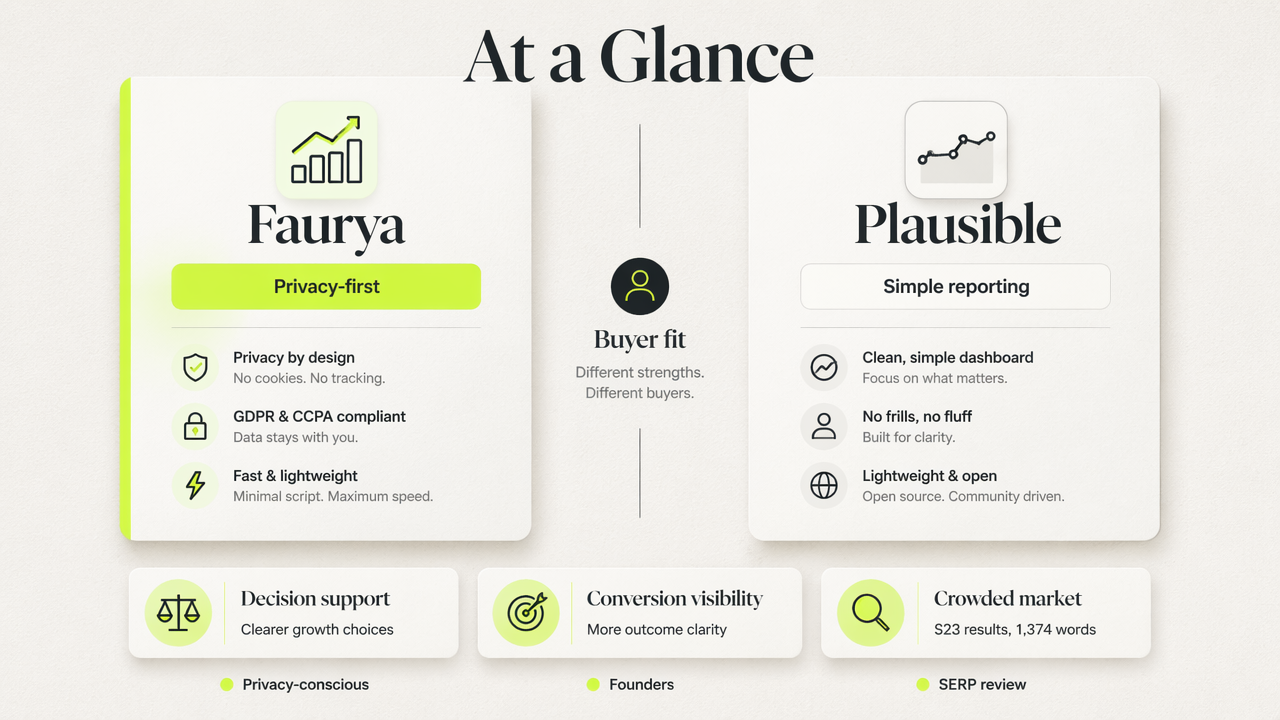
Key insight: Plausible is best understood as simple privacy analytics, while Faurya is better framed as privacy-first analytics for founders tracking growth outcomes.
Side-by-side decision table
| Category | Faurya | Plausible Analytics |
|---|---|---|
| Privacy model | Privacy-first tracking for modern site owners | Open-source SaaS, developed and hosted in the EU |
| Conversion tracking | Built for ROI-focused visitor understanding | Stronger for lightweight traffic reports |
| Dashboard clarity | Geared toward founders and marketers | Minimal, traffic-first reporting |
| Setup time | Designed for fast founder setup | Known for simple deployment |
| Pricing fit | Suits startups needing growth signal | Suits teams prioritizing simple counts |
| Best use case | SaaS, indie hackers, ecommerce, campaigns | Blogs, content sites, basic web metrics |
The Faurya platform is the warmer fit when analytics must connect campaigns, visitors, and business outcomes without pushing teams toward invasive tracking.
Privacy, compliance, and data ownership
Privacy-first analytics should reduce data collection risk while still giving teams enough signal to act. Plausible Analytics has a clear public identity around open-source software and EU hosting. Faurya supports privacy-conscious operators who want vendor clarity alongside product simplicity.

Compliance review should not stop at a product homepage. Teams comparing analytics tools should read the Faurya privacy policy, review the data processing agreement, and confirm internal obligations with counsel when required.
- Check whether cookies or personal identifiers are required.
- Confirm where data is processed and stored.
- Review retention, subprocessors, and user rights language.
- Match analytics settings to consent requirements in target markets.
Compliance checklist before switching tools
A practical compliance review compares legal documents, tracking behavior, and operational needs before any analytics migration. Plausible has a recognized EU-hosted SaaS position. Faurya gives privacy-conscious website owners a clear route for reviewing policy and processing terms before adopting analytics for commercial sites.
Key insight: The best analytics choice is not the tool with the longest feature list; it is the tool that collects enough data for decisions while keeping privacy obligations manageable.
Which tool fits each founder use case
Faurya is better suited to founders and growth teams that need analytics tied to marketing decisions, while Plausible Analytics suits teams that mainly need clean traffic reporting. This distinction matters for SaaS landing pages, ecommerce stores, and paid campaign funnels, where pageviews alone rarely answer revenue questions.
For neutral comparison, Plausible fits teams that value a mature, simple, open-source analytics service with EU hosting. It may be enough when reporting needs center on visits, referrers, and page performance.
Choose Faurya when:
- Campaign ROI is more important than raw traffic volume.
- A founder needs fast insight without a bloated analytics stack.
- Privacy posture and commercial decision-making both matter.
- A small team wants analytics that grows with it.
Visit faurya.com when evaluating a privacy-first setup for a new product, store, or campaign.
Decision rules for 2026 buyers
| Pick this tool when... | Better fit |
|---|---|
| Clean website traffic reporting is the main goal | Plausible Analytics |
| Conversion clarity affects weekly decisions | Faurya |
| EU-hosted open-source SaaS is the deciding factor | Plausible Analytics |
| Founder-friendly growth analytics matters most | Faurya |
| Legal review requires clear site documents | Review the terms of service and DPA |
The practical rule is simple: pick Plausible for minimal reporting, and pick Faurya when privacy analytics must support acquisition, conversion, and ROI decisions.
Conclusion
The Faurya vs Plausible Analytics decision comes down to reporting depth versus growth clarity. Plausible remains credible for simple privacy-first web analytics; Faurya is the stronger shortlist option for founders connecting visitor behavior to business results. For a focused next step, compare current tracking needs against the checklist above, then head to faurya.com to assess fit.
Generated by EarlySEO.com