Faurya vs Clicky: Which Analytics Tool Fits Growth Teams in 2026?
Compare Faurya vs Clicky for setup, privacy, dashboards, revenue attribution, conversion tracking, and fit for SaaS, indie, and ecommerce teams.
TL;DR
Faurya is the stronger fit for privacy-conscious teams that need SEO-to-revenue attribution, especially SaaS and ecommerce businesses tracking Stripe-backed growth. Clicky fits teams that want simple real-time visitor analytics and a familiar dashboard without deep revenue-source analysis.
The real analytics choice in 2026 is no longer just pageviews versus sessions; it is whether traffic data explains revenue. In a Faurya vs Clicky comparison, Faurya is built around privacy-first revenue attribution, while Clicky is known for simple, real-time web analytics.
Table of Contents
Faurya vs Clicky: Best fit by business goal
Faurya vs Clicky comes down to attribution depth: one focuses on revenue sources, while the other focuses on real-time visitor visibility.
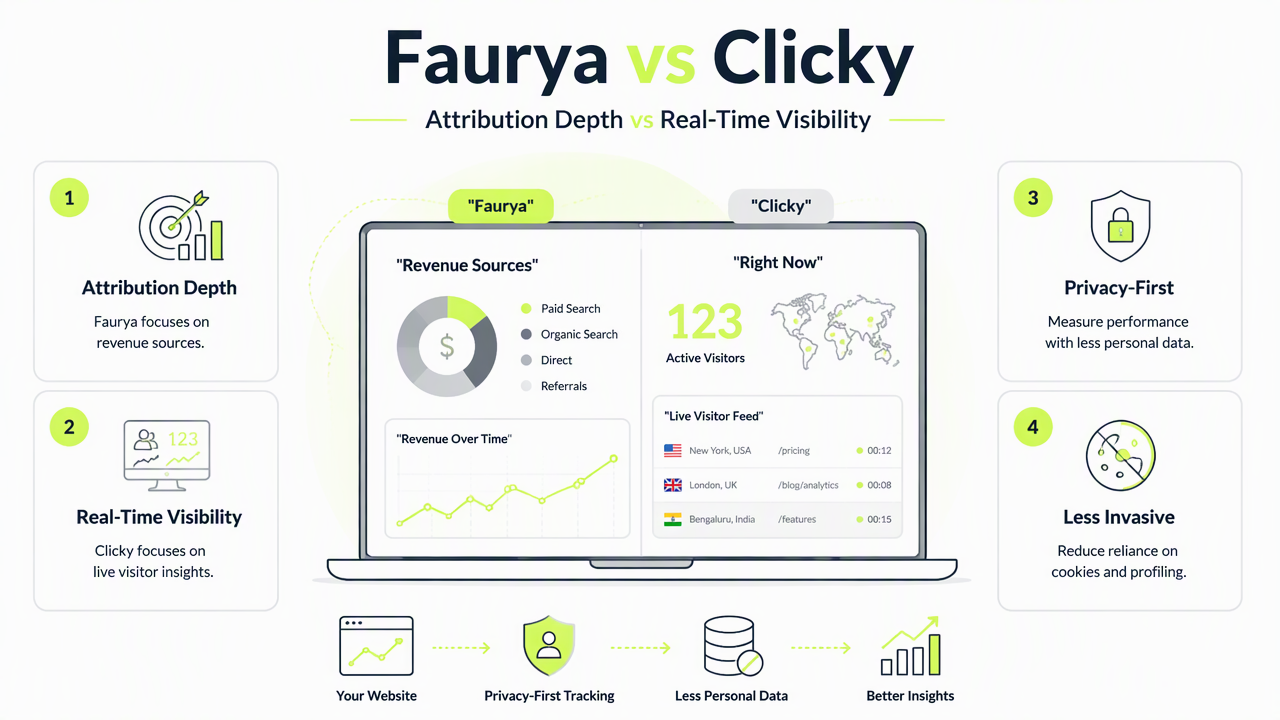
Privacy-first web analytics: a tracking approach that measures website performance while reducing reliance on invasive user profiling and unnecessary personal data collection.
Clicky's own 2026 positioning, reflected in competitor research, emphasizes simplicity, privacy, real-time data, setup time, data accuracy, and interface clarity. That makes it useful for publishers, small business sites, and teams that want quick feedback on live traffic.
The Faurya platform is positioned for teams that need to know which search queries, pages, and campaigns become revenue. Research data shows it integrates with Google Search Console to surface SEO keywords, impressions, click-through rates, and average position, then connects revenue data for growth analysis.
Decision table for SaaS, indie, and ecommerce teams
| Need | Better fit | Why it matters |
|---|---|---|
| Real-time visitor monitoring | Clicky | Strong fit for live traffic checks and simple dashboards |
| SEO keyword to revenue tracking | Faurya | Connects Google Search Console signals with revenue context |
| Privacy-conscious attribution | Faurya | Designed around privacy-first measurement for growth teams |
| Lightweight site analytics | Clicky | Useful when revenue attribution is not the main goal |
| SaaS or ecommerce ROI reporting | Faurya | Better match when founders need source-level revenue answers |
Key insight: Clicky explains what is happening on a site right now; Faurya is better suited to explaining which acquisition sources create business value.
Setup, dashboards, and daily workflow differences
Clicky favors fast analytics visibility, while Faurya favors a three-step workflow that connects installation, revenue data, and growth decisions.
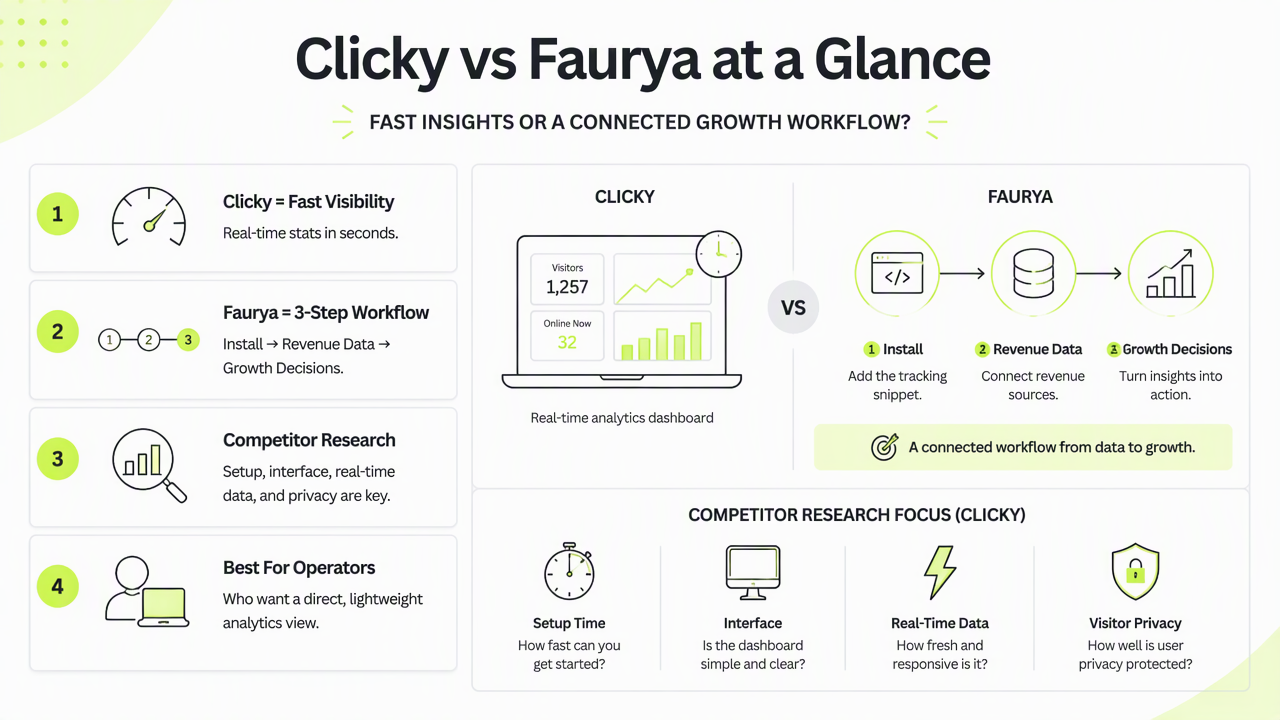
Competitor research around Clicky highlights setup time, interface, real-time data, and visitor privacy as major comparison points. That profile suits operators who want a dashboard that can be checked often without building a full attribution model.
The stronger workflow for revenue-led teams is broader than a tracking script. Research on Faurya describes a simple process: install the product, connect revenue data, then grow the business using source-level reporting. That structure matters when marketing ROI depends on more than visits.
Three workflow questions before choosing
- Is live traffic the main reporting need? Clicky is a natural fit when instant visitor activity is the priority.
- Does SEO performance need revenue context? Faurya is stronger when Google Search Console data must connect to business outcomes.
- Will non-technical founders read the dashboard weekly? Dashboard clarity matters more than feature count for indie hackers and lean growth teams.
Navigation also matters. Pages such as Features, Integrations, Use Cases, Solutions, Company, Legal, Socials, and Latest Posts often signal whether an analytics vendor is built for active evaluation or casual browsing.
Privacy, conversion tracking, and 2027 readiness
The more durable analytics choice is the one that can connect privacy-aware measurement with conversion and revenue reporting.
Clicky's appeal is practical: real-time analytics, a straightforward interface, and a simpler operating model than heavyweight analytics suites. For content sites, service businesses, and owners who mainly need visitor behavior, that may be enough.
SaaS, ecommerce, and startup teams face a different problem. Traffic quality, keyword intent, and conversion value need to live in the same reporting view. With Faurya, that use case centers on knowing revenue sources rather than only counting visits.
A company, in the standard legal sense, is an organized entity formed around a shared objective, often profit or public benefit. Analytics should reflect that objective. If the objective is revenue growth, reporting should tie marketing activity to commercial outcomes.
What to expect from analytics decisions in 2027
- More privacy pressure: teams will keep reducing avoidable personal data collection.
- More attribution scrutiny: founders will expect marketing reports to show revenue impact, not just activity.
- More search data blending: Google Search Console metrics will become more valuable when paired with conversion data.
- Less tolerance for noisy dashboards: lean teams will favor tools that answer fewer questions better.
Practical rule: choose Clicky for real-time simplicity; choose a privacy-first attribution tool when revenue source clarity is the operating need.
Conclusion
Faurya vs Clicky is not a winner-takes-all decision; it is a fit decision. Clicky suits teams that need fast visitor analytics, while Faurya suits teams that need privacy-first SEO and revenue attribution in one workflow. For source-level growth analysis, visit faurya.com and evaluate the current setup against revenue reporting needs.
Generated by EarlySEO.com