Event Tracking Without Cookies: Practical Guide for 2026
Learn how cookieless event tracking works, what it measures, and how privacy-friendly analytics differs from GA4-style tracking.

TL;DR
Event tracking without cookies measures actions such as CTA clicks, signup forms, outbound links, checkout steps, and launch-page engagement without storing browser identifiers. The practical choice is privacy-friendly analytics for product and marketing signals, with consent-based platforms reserved for user-level advertising workflows.
Event tracking without cookies has become a practical analytics model, not a fallback, as privacy expectations rise and browser storage faces tighter limits. HTTP cookie: a small block of data created by a web server and stored by a browser during website use. Faurya supports privacy-conscious teams that need useful event data without identity-heavy tracking.
Table of Contents
What is event tracking without cookies?
Event tracking without cookies records specific website or app actions without placing persistent identifiers in a visitor's browser. Instead of following a person across sessions, it measures events such as clicks, submits, and page interactions as aggregated product or marketing signals.
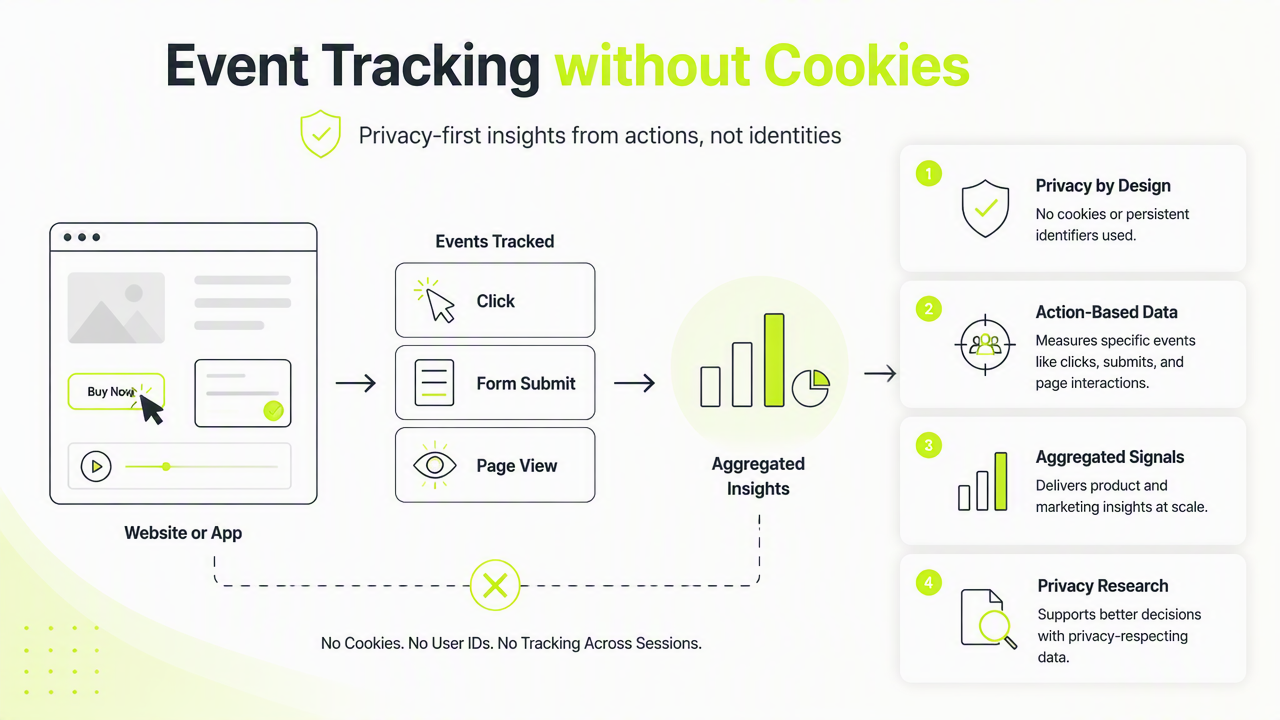
Research on privacy and data tensions by Quach, Thaichon, and Martin (2022) describes the growing pressure between digital personalization and privacy expectations in marketing systems (Springer). That tension explains why founders, growth teams, and e-commerce operators are shifting from identity-first tracking to event-first measurement.
Key insight: cookieless event data is strongest when the business question is about behavior patterns, not individual surveillance.
Core terms that prevent confusion
- Event: a recorded action, such as
cta_click,signup_submit, orcheckout_step_2. - Property: contextual detail attached to an event, such as page path, button label, plan name, or referrer.
- Session estimate: a grouped visit pattern based on short-lived context rather than a persistent user ID.
- Attribution signal: a source, campaign, or landing-page clue used to connect marketing activity with outcomes.
What can cookieless event tracking measure?
Cookieless tracking can measure on-site actions that show intent, friction, and conversion progress. It works especially well for owned-site analytics because events can be captured at the moment they happen, then reported in aggregate without building long-term user profiles.
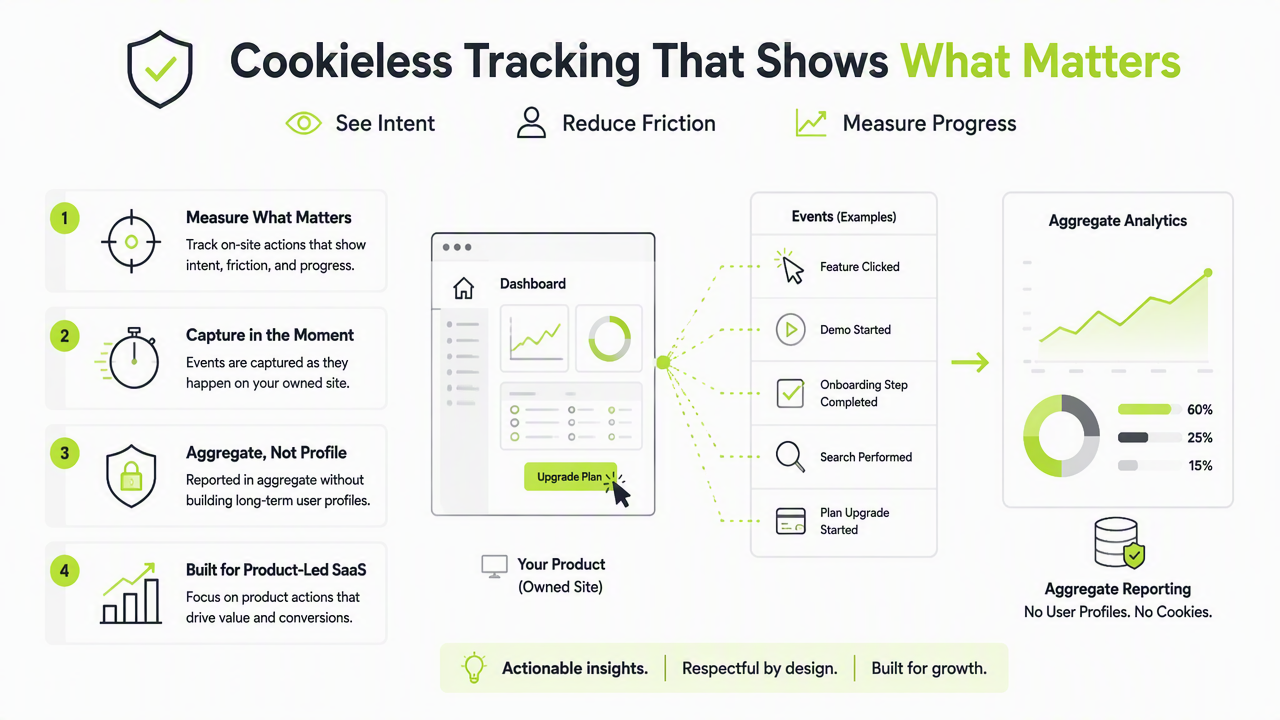
For product-led SaaS, useful events include pricing CTA clicks, signup form starts, trial activations, documentation searches, and feature announcement clicks. For e-commerce, useful events include product detail views, add-to-cart clicks, checkout step changes, coupon attempts, and outbound payment clicks.
Practical event examples by page type
| Page or flow | Event to track | Useful property |
|---|---|---|
| Homepage | primary_cta_click |
Button text, section, page path |
| Signup form | signup_submit |
Plan, form location, validation result |
| Blog or resource page | outbound_link_click |
Destination domain, link label |
| Checkout | checkout_step_complete |
Step number, cart value band |
| Product launch page | waitlist_join |
Campaign, variant, traffic source |
A 2022 literature study on AI applications for marketing by Haleem, Javaid, and Qadri covers how marketing increasingly depends on digital signals for segmentation and decision-making (ScienceDirect). Cookieless analytics narrows that signal set to actions that can be measured with less personal data.
Better event design starts with business decisions: which button, form, or checkout step needs improvement next?
How does privacy-friendly analytics differ from GA4-style tracking?
Privacy-friendly analytics focuses on aggregate behavior, minimal identifiers, and simpler reporting, while GA4-style tracking is designed for broader event collection, consent-aware advertising workflows, and deeper platform integrations. Both approaches can track events, but their assumptions differ.
Plausible describes its analytics as cookieless by design, with no persistent identifiers and no consent banners in its model (Plausible). GA4-style setups often require more governance because consent mode, advertising features, and cross-platform reporting can add configuration complexity.
The Faurya platform is best framed for teams that want clean event reporting tied to growth decisions, not a heavy advertising data stack. With Faurya, a founder can track launch-page signups, CTA performance, and funnel movement while keeping analytics focused on the actions that matter.
Decision table for analytics approach
| Need | Privacy-friendly analytics | GA4-style tracking |
|---|---|---|
| Simple site events | Strong fit | Possible, more setup |
| Ad platform integration | Limited or separate | Strong fit |
| Consent overhead | Often lower | Often higher |
| User-level analysis | Intentionally limited | More available with consent |
| Founder reporting | Clear and fast | Powerful but complex |
For 2026, the practical direction is clear: collect fewer identifiers, name events carefully, and keep raw tracking tied to a real business purpose. Visit faurya.com when evaluating a lean event strategy for SaaS, e-commerce, or launch analytics.
Conclusion
Event tracking without cookies works best when every event maps to a decision: improve a CTA, reduce signup friction, diagnose checkout drop-off, or judge a launch page. The next step is to list the five most valuable actions, define consistent event names, and choose an analytics setup that respects privacy while still guiding growth.
Generated by EarlySEO.com