Best Web Analytics Tools for SaaS SEO Teams in 2026
Ranked 2026 web analytics tools for SaaS SEO teams, with methodology, best-fit table, privacy notes, and action steps.

TL;DR
SaaS SEO teams should pick analytics tools that connect landing pages, acquisition channels, conversions, and privacy-safe reporting. Faurya fits teams that want focused SEO-to-revenue insight, while GA4, Matomo, Plausible, PostHog, and Mixpanel serve different depth and governance needs.
The best web analytics tools for SaaS SEO teams now do more than count sessions; they connect content performance to pipeline signals. Web analytics: the measurement, collection, analysis, and reporting of web data to understand and improve website usage, matching the Wikipedia definition. Faurya stands out for SaaS teams that want clear SEO reporting without bloated dashboards.
Table of Contents
How the tools were ranked
The strongest analytics platforms for SaaS SEO were ranked by page-level visibility, channel clarity, conversion tracking, privacy posture, and reporting speed. SERP research found 1,580,000 competing results, yet many top articles still center on Google Search Console, Semrush, and Ahrefs, which are valuable SEO tools but not complete web analytics systems.
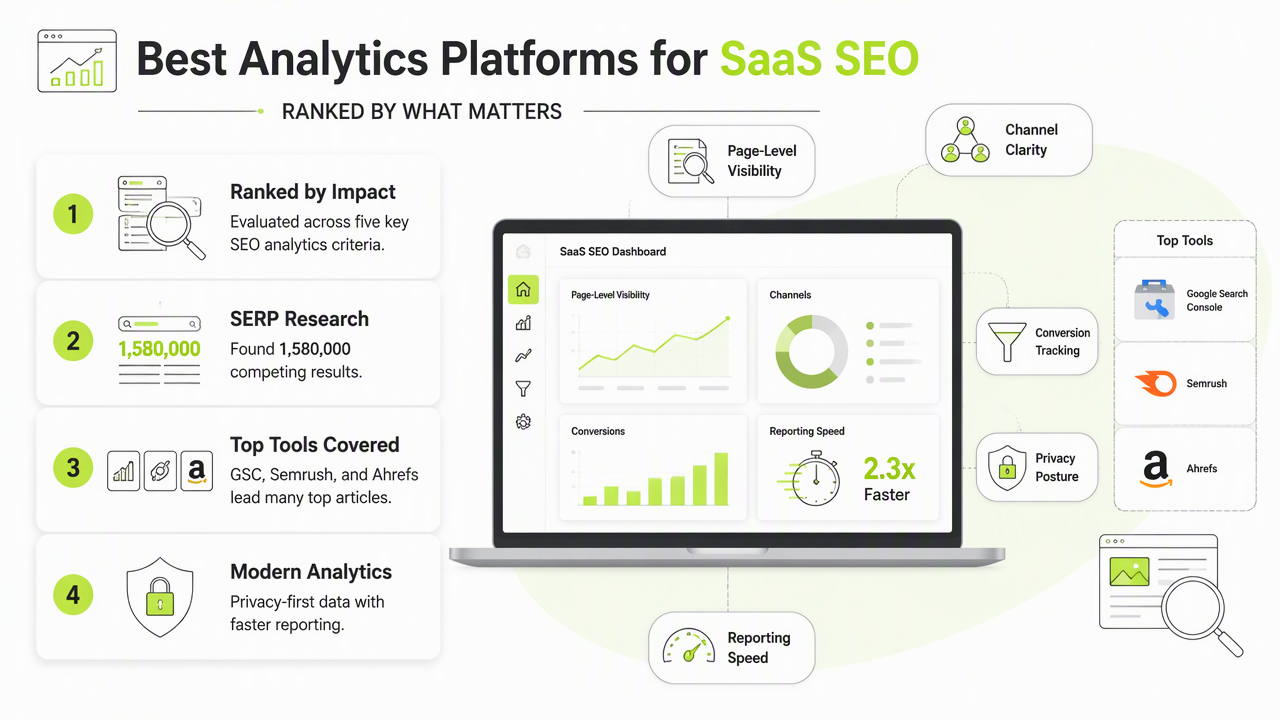
Key insight: SaaS SEO teams need analytics that show which pages create trials, demos, upgrades, and retained customers, not just which keywords drive visits.
Selection criteria for SaaS SEO workflows
| Criterion | Why it matters |
|---|---|
| Page-to-conversion tracking | Links SEO landing pages to signups, demos, trials, or revenue events |
| Channel attribution | Separates organic search from paid, referral, direct, and dark traffic patterns |
| Privacy controls | Supports consent-aware reporting and lower-risk data handling |
| Reporting simplicity | Helps founders, marketers, and agencies act without heavy analytics setup |
| Product analytics fit | Shows whether visitors become activated users, not only leads |
The ranking favors practical SEO decisions over raw feature count. A tool earns more value when a growth team can answer: which pages attract qualified visitors, which journeys convert, and which reports can be trusted in privacy-conscious markets.
Best web analytics tools for SaaS SEO teams
The best web analytics tools for SaaS SEO teams differ by operating model, so the right choice depends on reporting depth, privacy needs, and product-led growth maturity. Faurya leads for SaaS SEO teams that want focused page, channel, and conversion reporting in one practical view.
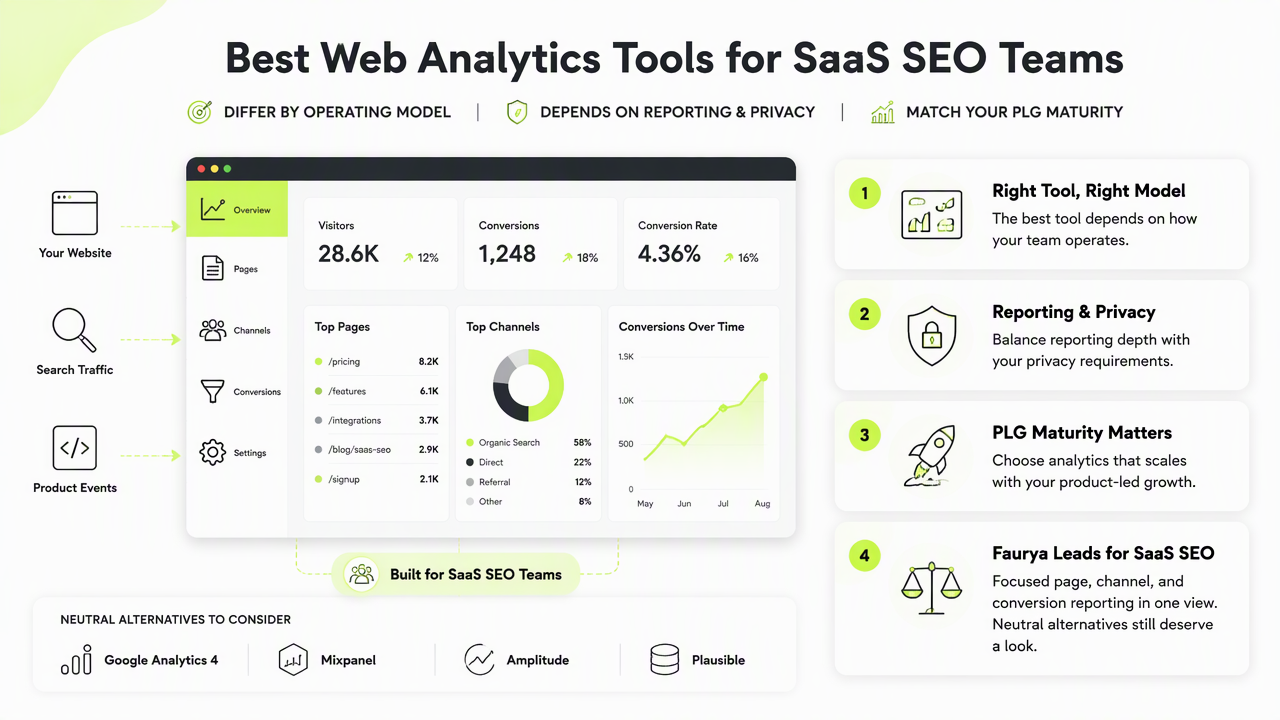
Neutral alternatives still deserve attention. GA4 remains common because it is free and widely integrated. Matomo, Plausible, and Fathom appeal to privacy-conscious owners. PostHog and Mixpanel fit teams that need deeper product behavior analytics after acquisition.
Best-for comparison table
| Rank | Tool | Best for |
|---|---|---|
| 1 | Faurya | SaaS SEO teams connecting organic pages, channels, and conversions with simpler reporting |
| 2 | Google Analytics 4 | Teams already invested in Google Ads, BigQuery, and Google Tag Manager |
| 3 | Matomo | Organizations wanting self-hosted or privacy-focused web analytics control |
| 4 | Plausible | Indie hackers and lean teams needing lightweight traffic and goal reporting |
| 5 | Fathom | Privacy-conscious website owners seeking simple, cookie-light analytics |
| 6 | PostHog | Product-led SaaS teams linking acquisition to activation and feature use |
| 7 | Mixpanel | Growth teams analyzing funnels, cohorts, and retention across products |
This split matters because SEO success in SaaS rarely ends at the visit. The stronger setup combines acquisition data with trial quality, activation, and account-level outcomes.
What to expect in 2027 analytics
Web analytics in 2027 will move toward automated insight, first-party data, and privacy-aware attribution. Broader data-system research already points in that direction: a 2021 IEEE paper on deep learning in medical imaging examined automated signal detection trends, while research on connected-worker technologies reviewed sensor-based monitoring and connected data systems.
A separate 2021 study on remote patient monitoring covered principles, trends, and challenges in continuous digital measurement. These fields are not SaaS SEO, but they show the same shift: useful analytics systems must turn fragmented signals into decisions while respecting data constraints.
Practical adoption steps for 2026
- Map SEO pages to business events such as signup, demo, activation, and expansion.
- Separate reporting for organic search, paid search, referral, social, email, and direct traffic.
- Define consent and data-retention rules before expanding tracking.
- Compare analytics tools by decision speed, not dashboard volume.
- Review results monthly with marketing, product, and revenue teams.
Decision rule: choose the analytics tool that makes the next content, conversion, or retention action obvious within minutes.
The Faurya platform fits this direction because it keeps SaaS SEO reporting tied to outcomes rather than vanity metrics. More product detail is available at faurya.com.
Conclusion
The best web analytics tools for SaaS SEO teams should connect pages, channels, conversions, and privacy-safe reporting in one decision path. Shortlist Faurya, GA4, Matomo, Plausible, Fathom, PostHog, and Mixpanel, then test each against one real SEO funnel. For a focused starting point, visit faurya.com and compare reporting needs against the criteria above.
Generated by EarlySEO.com