Analytics for SaaS Comparison Pages: Metrics That Prove Pipeline Influence
Track SaaS comparison pages with qualified visits, scroll signals, CTA clicks, outbound clicks, and assisted conversions tied to pipeline.
TL;DR
SaaS comparison pages need analytics that connect buyer intent to pipeline, not just traffic. Track qualified visits, engagement depth, CTA clicks, outbound clicks, and assisted conversions with a simple event plan that separates real evaluation behavior from casual browsing.
Analytics for SaaS comparison pages turns competitor, alternatives, and "vs" traffic into evidence of buyer intent and pipeline influence. Comparison-page analytics: measurement of visits, engagement, clicks, and conversion paths on pages that compare products or categories. Faurya helps growth teams treat these pages as measurable revenue assets, not just SEO content.
Table of Contents
What metrics matter on SaaS comparison pages?
The metrics that matter on SaaS comparison pages are qualified visits, scroll depth proxies, outbound clicks, CTA clicks, and assisted conversions. These pages often attract late-stage researchers, so traffic volume alone can hide commercial value. The supplied SERP benchmark shows 1,030,000 results for the topic, while analyzed competitors average 3,692 words, which means differentiation depends on sharper measurement, not longer content.
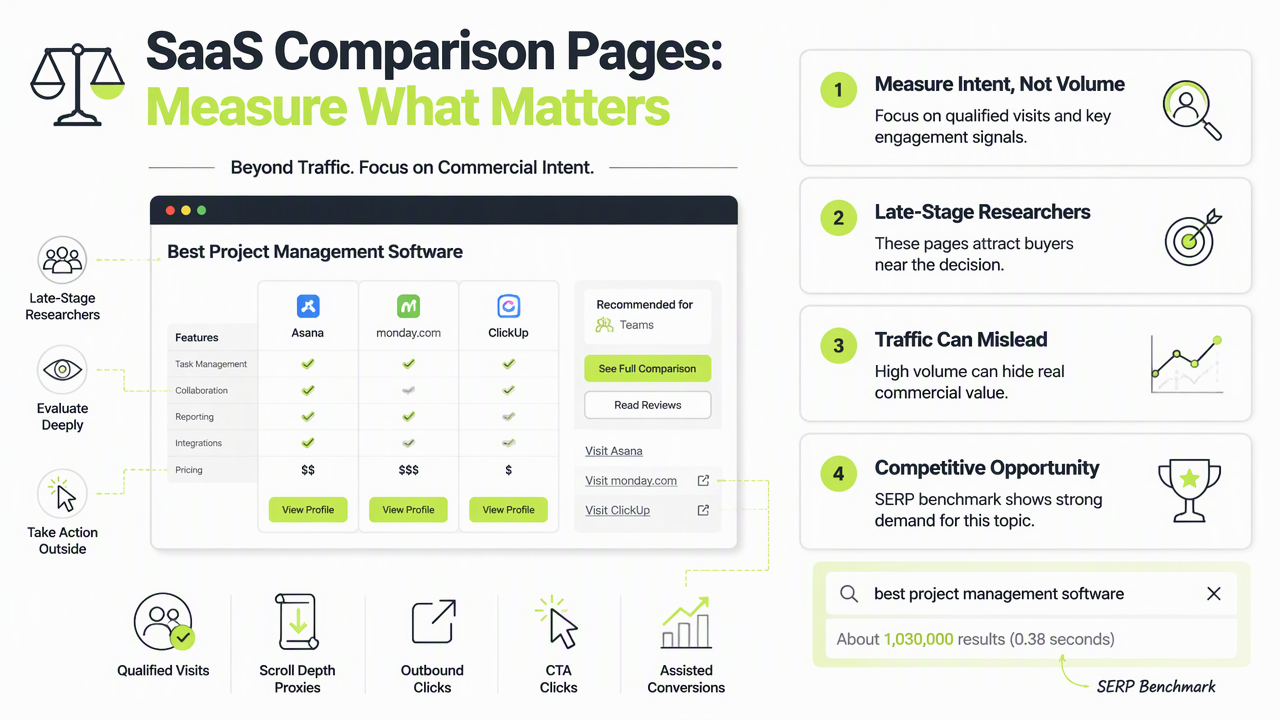
Key insight: a comparison page should be judged by evaluation behavior, not pageviews alone.
A strong measurement model separates informational readers from active buyers. A visitor from a branded competitor query, who reaches the pricing comparison area and clicks a demo CTA, carries more signal than a visitor who bounces after reading the opening paragraph.
Metric map for competitor, alternatives, and "vs" pages
| Metric | What it indicates | Tracking method |
|---|---|---|
| Qualified visits | Searchers with commercial intent | Landing page plus query class or campaign |
| Scroll depth proxy | Exposure to comparison proof | section_viewed events at key modules |
| Outbound clicks | Evaluation of sources, competitors, or marketplaces | outbound_click with destination domain |
| CTA clicks | Direct sales intent | demo_click, signup_click, or trial_click |
| Assisted conversions | Influence before later conversion | Multi-touch path or CRM campaign touch |
Scroll depth should be treated as a proxy, not proof. Better events fire when a buyer reaches named modules such as pricing tables, migration notes, security comparisons, or customer proof.
How should a tracking plan prove pipeline influence?
A tracking plan proves pipeline influence by connecting comparison-page events to accounts, opportunities, and later conversions. The goal is not perfect attribution; the goal is a consistent model that shows whether competitor-intent content helps create or accelerate sales opportunities.
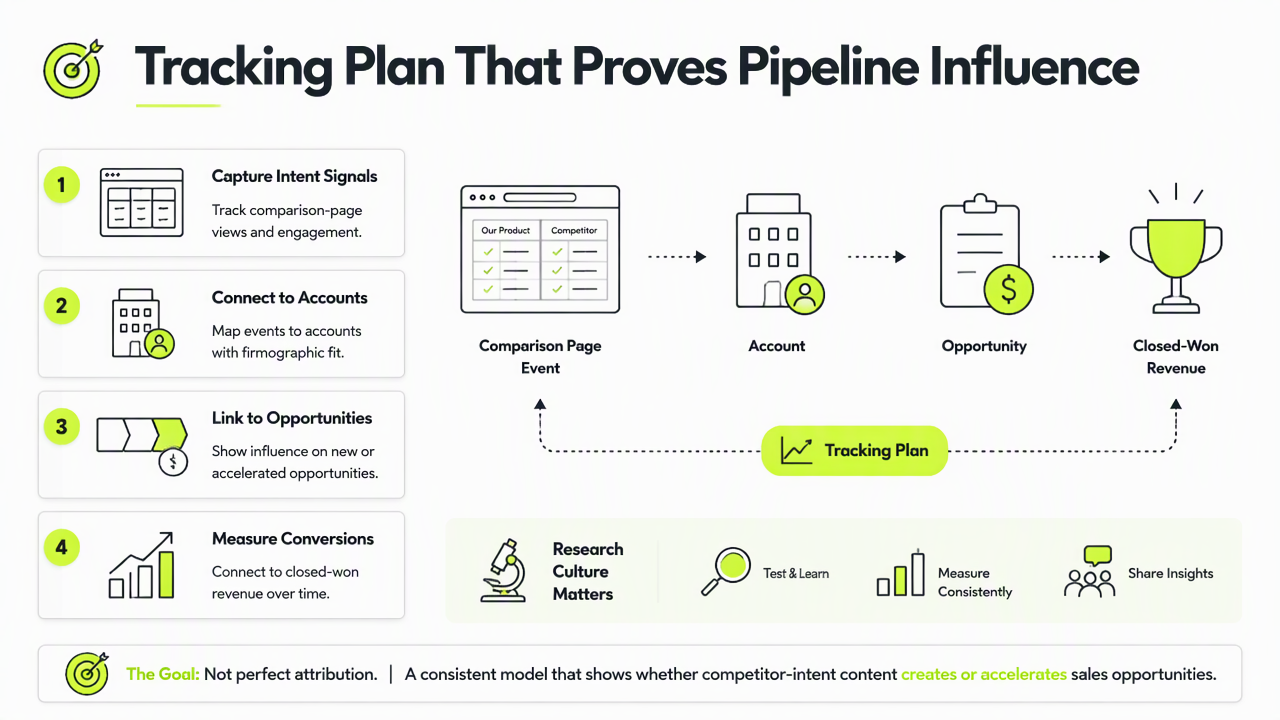
Research culture matters here. A 2024 meta systematic review by Melissa Bond and co-authors called for increased ethics, collaboration, and rigour in AI-related research, a useful reminder for analytics programs that depend on clean definitions and repeatable methods (Bond et al., 2024). A 2022 systematic review by Ahmed G. Gad focused on optimization applications, reinforcing the broader point that clear objective functions matter before optimization begins (Gad, 2022).
A simple event plan for revenue teams
- Tag every comparison URL by type:
competitor,alternative,vs, orcategory. - Capture source, campaign, device, country, and account match where consent allows.
- Track module views for pricing, feature tables, proof, migration, and FAQ blocks.
- Record CTA clicks with CTA text and page section.
- Pass high-intent events to CRM fields or campaign member status.
- Report assisted pipeline, influenced opportunities, and conversion rate by page type.
Privacy-conscious operators should avoid collecting unnecessary personal data. Aggregate page behavior can still show which competitor narratives create qualified demand.
Where does Faurya fit in the comparison-page workflow?
Faurya fits best as the operating layer for planning, publishing, and measuring comparison assets around buyer intent. The Faurya platform can support a workflow where each page has a defined competitor angle, conversion goal, and analytics plan before publication.
The supplied SERP data notes that SaaS comparison pages receive only 2.5% of AI citations, while listicles receive around 22%. That gap makes structured pages more important in 2026: answer engines need clear definitions, tables, and extractable comparisons before they can confidently cite a brand. More product context is available at faurya.com.
A practical 2026 reporting cadence
A monthly report should group pages by buyer question, not only by URL. That approach shows whether "alternative to X," "X vs Y," and category comparison pages play different roles in pipeline creation.
Useful reporting views include:
- Page type performance: competitor, alternatives, "vs," and category pages.
- Intent depth: section views, CTA clicks, and return visits.
- Revenue influence: assisted conversions, open opportunities, and closed-won touches.
- AI visibility: cited pages, structured summaries, and table quality.
With Faurya, the strongest next step is pairing each new comparison brief with an event schema before content production starts.
Conclusion
Analytics for SaaS comparison pages should prove intent, engagement, and assisted revenue rather than celebrate raw traffic. Growth teams should define page types, instrument key modules, connect events to CRM outcomes, and review influenced pipeline monthly. For a cleaner comparison-page workflow, visit faurya.com and map the next three pages to measurable buyer actions.
Generated by EarlySEO.com