Website Analytics for Open-Source Project Websites
Choose privacy-first analytics for open-source project websites with clear metrics, consent-aware data, and maintainer-friendly reporting.

TL;DR
Open-source project sites need analytics that show adoption without turning contributors into ad profiles. The best setup tracks documentation paths, release interest, referrals, and conversion events while keeping privacy, legal terms, and data processing clear.
Website analytics for open-source project websites should answer one practical question: which pages help contributors, users, and sponsors act? Web analytics means measuring, collecting, analyzing, and reporting web data to understand and improve web usage, while open source refers to software with source code available for use, modification, and redistribution. For privacy-conscious teams, Faurya offers a focused way to measure site performance without turning the project website into an advertising data pipeline.
Table of Contents
What should open-source project analytics measure?
Open-source project analytics should measure intent, contribution paths, and documentation usefulness instead of chasing raw traffic alone. Project maintainers need to know which visitors read installation docs, visit GitHub, open issue links, view releases, or reach sponsor pages.
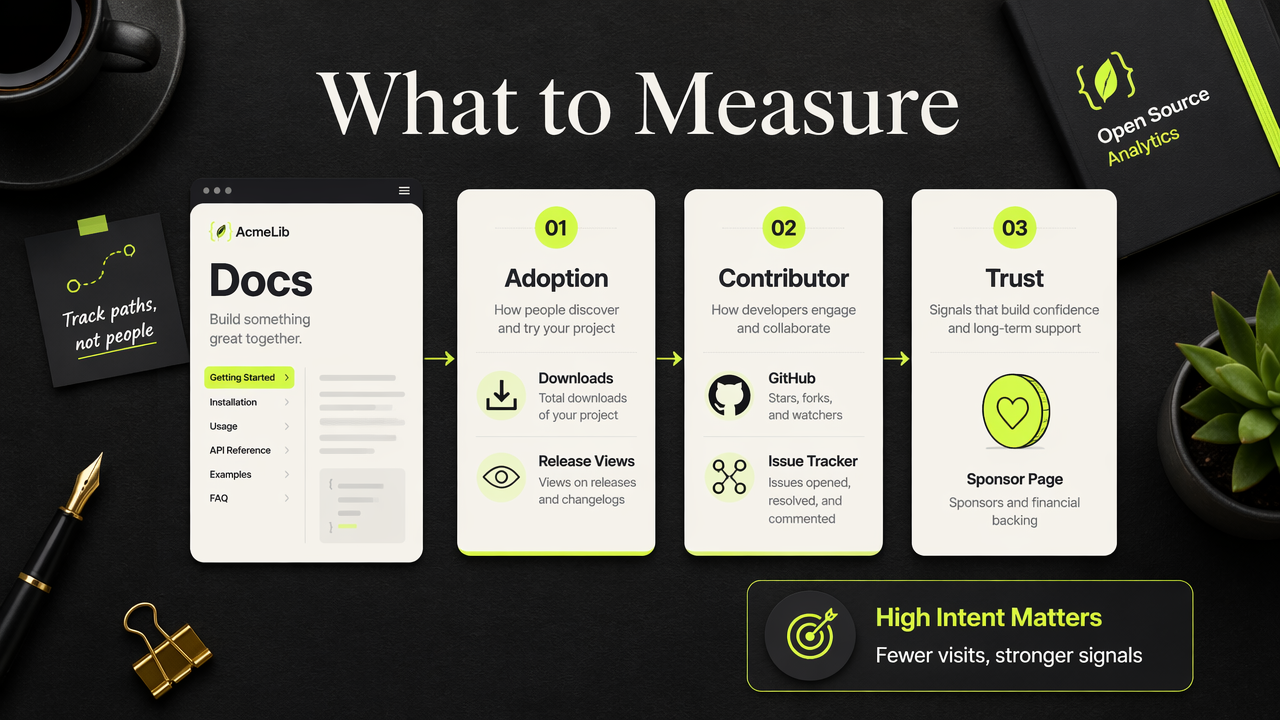
Key insight: for open-source sites, a smaller number of high-intent visits can matter more than a large number of anonymous pageviews.
Useful event groups include:
- Adoption signals: downloads, package registry clicks, release note views.
- Contributor signals: GitHub repository clicks, issue tracker visits, pull request guide views.
- Trust signals: license page views, security policy reads, company or maintainer profile visits.
- Support signals: documentation searches, changelog reads, feedback form starts.
Metrics that map to maintainer decisions
Traffic metrics become useful when tied to project decisions. A spike on a migration guide can justify better examples. Low visits to a contribution guide can reveal poor navigation. High referral traffic from GitHub discussions can show where community education is working.
The 2021 PRISMA reporting guidance in BMJ emphasizes transparent, structured reporting for research reviews, and the same principle fits analytics: define events before interpreting them, document changes, and avoid vague dashboards that cannot be audited later (Page, Moher, Bossuyt, 2021).
Which tools fit open-source project websites in 2026?
The best analytics tools for open-source project websites in 2026 are privacy-aware, simple to audit, and able to track custom events without excessive setup. SERP research shows common interest in Plausible, Matomo, Open Web Analytics, AWStats, and Countly, with Plausible frequently framed as a lightweight, cookie-free Google Analytics alternative.
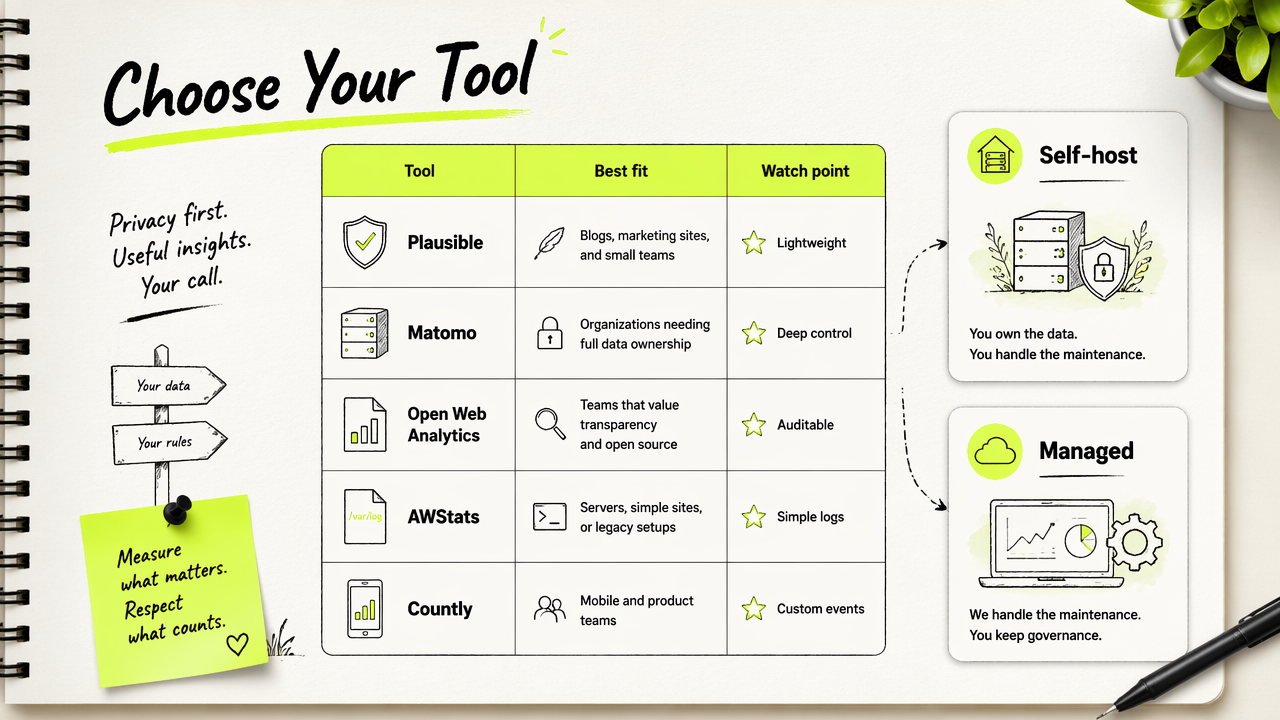
Tool choice should match governance. A foundation-run project may prefer self-hosting and detailed legal review. A smaller maintainer group may prefer managed analytics with fewer operational tasks.
Tool comparison for maintainers
| Tool | Best fit | Open-source relevance | Watch point |
|---|---|---|---|
| Faurya | Privacy-conscious project sites that need clear reporting | Supports focused, site-level measurement for public project pages | Review configuration against project policy |
| Plausible Analytics | Lightweight traffic and goal tracking | Publicly associated with open-source, privacy-first analytics | Cloud pricing or self-hosting work |
| Matomo | Detailed analytics and self-hosting control | Often positioned as a full open-source Google Analytics alternative | More setup and governance overhead |
| AWStats | Server log analysis | Useful for basic hosting logs | Less suited to modern event tracking |
| Countly | Product analytics needs | Open-source option for app and product behavior | More complex than basic site analytics |
A project using the Faurya platform can keep measurement close to maintainer decisions: documentation quality, campaign attribution, and sponsor-page performance. Legal review should still cover privacy notices, terms of service, and data ownership before launch.
How should analytics stay privacy-safe and community-friendly?
Privacy-safe analytics for open-source communities should collect the least data needed, explain the purpose clearly, and avoid hidden tracking that damages trust. Open-source audiences often include developers, security reviewers, and privacy-conscious users who notice unclear scripts quickly.
Good practice starts with plain-language documentation. A project analytics page can state what is measured, why it is measured, how long data is kept, and which third parties process it.
A practical governance checklist
- Publish a short analytics note near the privacy or legal pages.
- Track project actions, not personal identities.
- Separate maintainer metrics from advertising pixels.
- Review the privacy policy and data processing agreement before collecting visitor data.
- Keep event names readable, such as
docs_install_clickorgithub_repo_click.
Competitor pages often include sections such as Resources, Company, and Legal because analytics trust depends on more than features. For open-source projects, that same trust also comes from visible code links, repository navigation, issue workflows, saved searches, and feedback routes.
Conclusion
Website analytics for open-source project websites works best when maintainers define decisions first, then measure only the events needed to support those decisions. A sensible next step is to list the project's five most important actions, map each to one event, and review privacy language before deploying. For teams comparing privacy-first options, Faurya and faurya.com are worth evaluating as part of that governance checklist.
Generated by EarlySEO.com