Website Analytics for Multi-Product SaaS Websites
Build cleaner SaaS analytics across product pages, pricing, docs, campaigns, and signup flows without bloated reporting.

TL;DR
Multi-product SaaS sites need analytics split by product, funnel stage, and intent, not one blended traffic report. The practical setup is a small event taxonomy, consistent UTM rules, and product-level dashboards that connect pages, campaigns, and signups.
Multi-product SaaS websites lose clarity when every product page, docs visit, pricing click, and signup lands in one report. Website analytics for multi-product SaaS websites means measuring web data by product, audience intent, and conversion path so growth teams can see which product creates demand. Faurya supports this sharper reporting approach for SaaS teams that want cleaner marketing ROI.
Table of Contents
What is website analytics for multi-product SaaS websites?
Website analytics: the measurement, collection, analysis, and reporting of web data to understand and improve web usage.
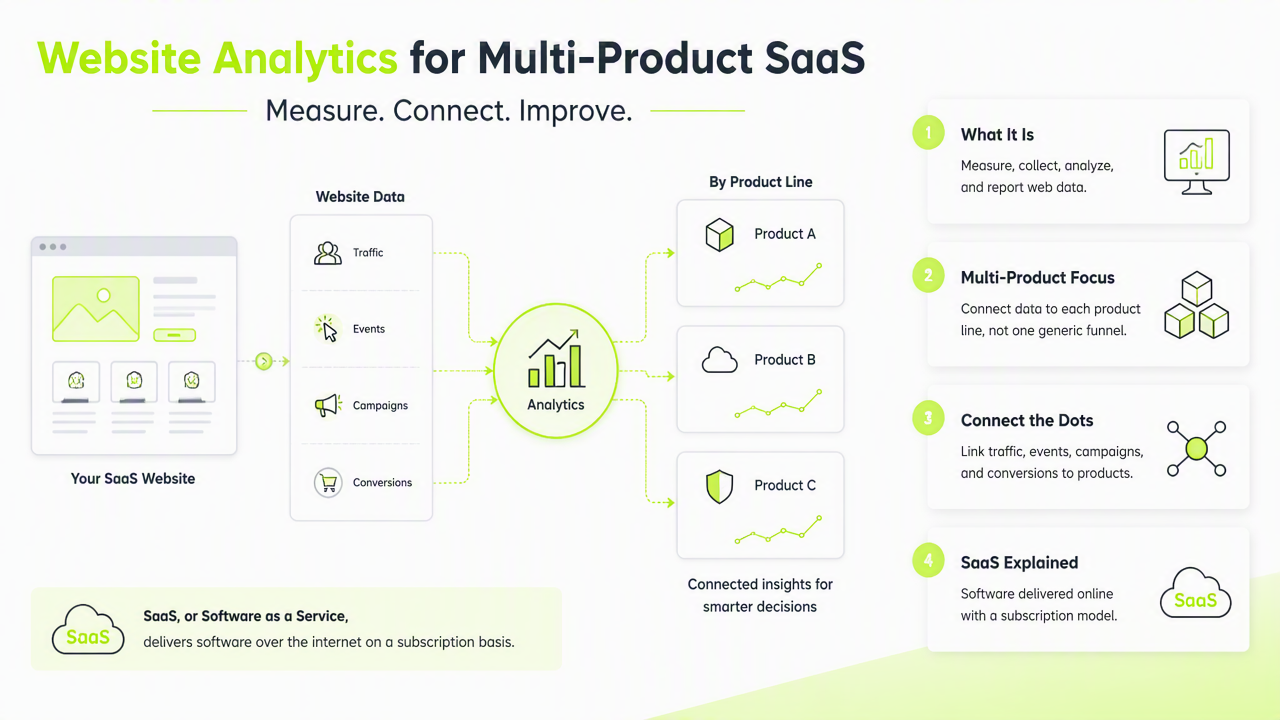
Website analytics for multi-product SaaS websites connects traffic, events, campaigns, and conversions to each product line instead of treating the website as one generic funnel. SaaS, or software as a service, delivers application software through a provider-managed cloud model, so the website often acts as acquisition, education, pricing, and onboarding surface at once.
Key insight: a multi-product SaaS website needs a product-aware analytics model before it needs more charts.
Single-product reporting hides cross-product behavior. A visitor may read docs for Product A, compare pricing for Product B, then start a workspace tied to Product C. Aggregated analytics can label that path as confusing, while product-aware reporting shows expansion intent.
Core entities to track separately
| Entity | Clean tracking rule |
|---|---|
| Product pages | Tag every page with product_name and page_type |
| Pricing pages | Track plan views, billing toggle clicks, and CTA clicks |
| Docs | Split educational visits from implementation visits |
| Changelog | Track retention and product-interest signals |
| Signup flows | Capture source, product, plan intent, and completion |
Plausible's SaaS analytics guide also emphasizes full-funnel tracking, campaign UTMs, and custom properties for product dimensions, which aligns with this product-level structure.
How should teams segment pages, events, and campaigns?
Multi-product SaaS analytics should segment every interaction by product, page intent, and acquisition source before metrics reach a dashboard. The best SaaS websites in 2026 clarify the problem, show the workflow, and guide conversion, so measurement should mirror that structure rather than only count sessions.
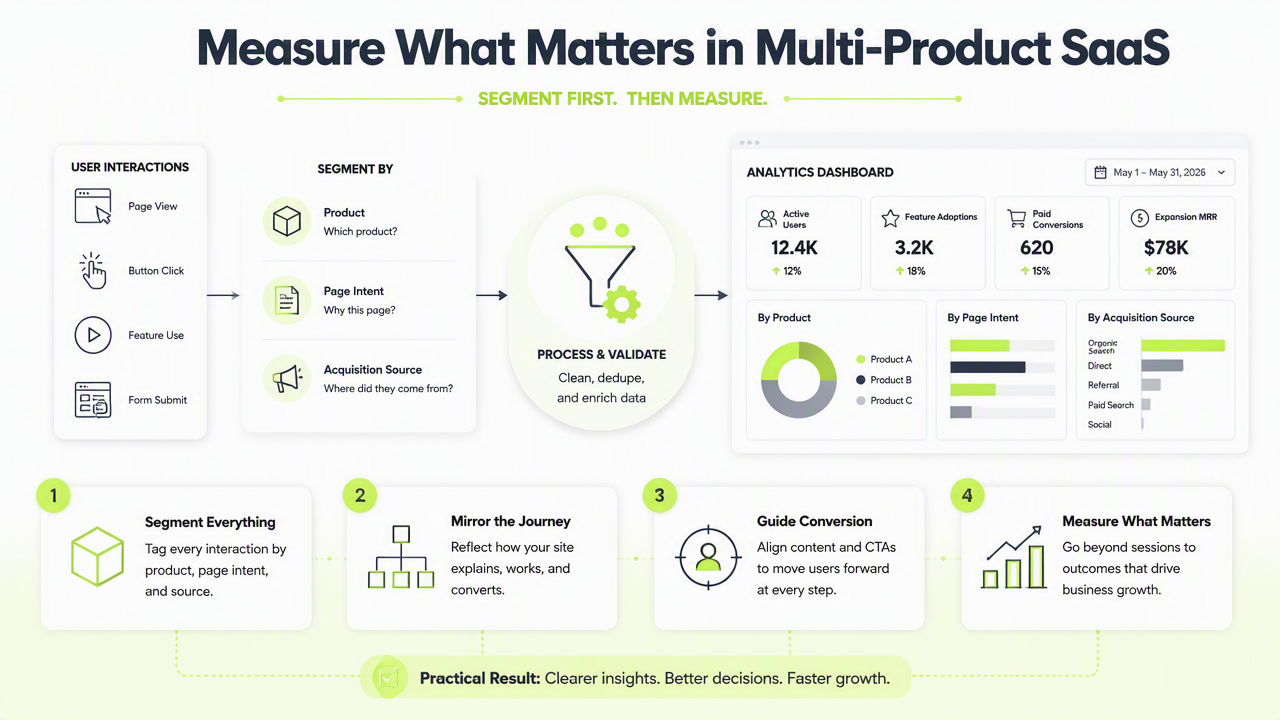
A practical tracking plan can stay small:
- Assign each URL a
product_nameproperty. - Group URLs into
landing,pricing,docs,changelog, andsignup. - Standardize events such as
cta_click,pricing_view,docs_search, andsignup_complete. - Require UTM tags for paid, partner, newsletter, and launch campaigns.
- Review product-level conversion weekly, not only sitewide conversion.
Faurya can fit this workflow by helping teams keep product context attached to marketing and conversion data, without turning routine reporting into a custom data project.
Minimum viable event taxonomy
| Event | Where it fires | Why it matters |
|---|---|---|
product_cta_click |
Product and comparison pages | Shows demand by product |
pricing_plan_select |
Pricing pages | Separates interest from purchase intent |
docs_search |
Documentation | Reveals implementation friction or active evaluation |
changelog_click |
Changelog pages | Indicates feature-led interest |
signup_complete |
Signup flow | Connects source to conversion |
Reporting should answer one question first: which product attracted the visit, advanced the buyer, and earned the signup?
What should SaaS sites prepare for in 2027?
SaaS analytics in 2027 will rely more on first-party events, consent-aware attribution, and AI-assisted summaries, but product-level data quality will still decide whether insights are useful. Generative AI can summarize patterns, but weak naming rules and missing product tags create weak answers.
Research by Budhwar, Chowdhury, and Wood (2023) on generative AI research directions shows why governance matters as AI enters business workflows. Monitoring-heavy fields also show the value of structured telemetry: Alshamrani's 2021 survey on IoT and AI remote monitoring systems focuses on data-driven monitoring in complex systems.
For SaaS websites, the lesson is simple. AI reports should read from governed event names, documented campaign rules, and stable product dimensions.
2027-ready reporting checklist
- Keep a written analytics dictionary for products, events, and UTMs.
- Store product context on pageviews and conversion events.
- Separate branded, organic, paid, partner, and AI referral traffic.
- Audit signup attribution after every major launch.
- Build one executive dashboard and one product-specific dashboard per product.
AI can shorten analysis time, but it cannot repair messy tracking after months of mixed product data.
Conclusion
Strong website analytics for multi-product SaaS websites starts with a naming system, not a larger dashboard. The next step is to map every product page, pricing page, docs area, changelog, and signup event to a shared tracking plan. For a cleaner SaaS reporting workflow, evaluate Faurya and head to faurya.com with the current analytics taxonomy in hand.
Generated by EarlySEO.com