Website Analytics for Agencies Managing Client Sites
A 2026 playbook for agency analytics: KPI standards, tagging, reporting cadence, conversion rules, and privacy controls across client sites.
TL;DR
TL;DR: Agencies should standardize KPIs, campaign tags, conversion definitions, access rules, and report cadence before scaling analytics across client sites. Privacy controls and clean governance matter as much as dashboards, especially for retainers tied to measurable ROI.
Website analytics for agencies managing client sites works best when every account follows the same measurement playbook. Web analytics: the measurement, collection, analysis, and reporting of website data to understand and improve web usage. Faurya fits this operational need by helping agencies keep client tracking organized without turning reporting into manual admin work.
Table of Contents
What should agencies standardize first?
Agencies should standardize KPIs, traffic-source naming, conversion definitions, and reporting cadence before adding more dashboards. A shared framework prevents client-by-client drift, makes performance comparable, and gives account managers a clear basis for weekly or monthly decisions.
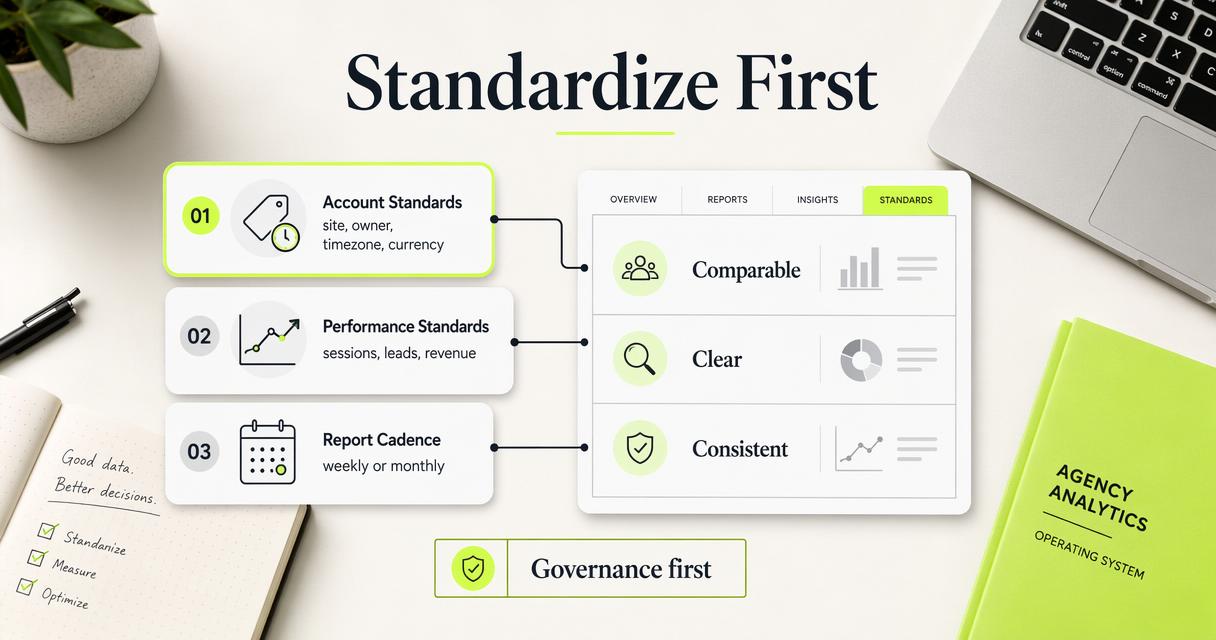
Key insight: analytics governance is not a reporting detail; it is the operating system for client growth work.
A practical agency setup starts with three layers:
- Account standards: site name, client owner, access level, timezone, currency.
- Performance standards: sessions, leads, revenue, conversion rate, campaign ROI.
- Review standards: weekly anomaly checks, monthly strategy notes, quarterly reset.
Reusable agency analytics template
| Template field | Agency rule |
|---|---|
| Primary KPI | One business outcome per client, such as qualified leads or ecommerce revenue |
| Secondary KPIs | Traffic quality, engagement, assisted conversions, retention signals |
| Naming convention | client_channel_campaign_date for campaigns and reports |
| Report cadence | Weekly internal check, monthly client summary, quarterly KPI review |
| Owner | Named strategist, analyst, and client approver |
The Faurya platform can support this standardization by keeping client-site analytics tied to repeatable workflows instead of one-off spreadsheets.
How should campaign tagging and conversions work?
Campaign tagging and conversion tracking should use fixed naming rules, documented source definitions, and one approved conversion map per client. Agencies managing SEO, paid search, email, affiliates, and social campaigns need clean attribution inputs before interpreting campaign ROI.
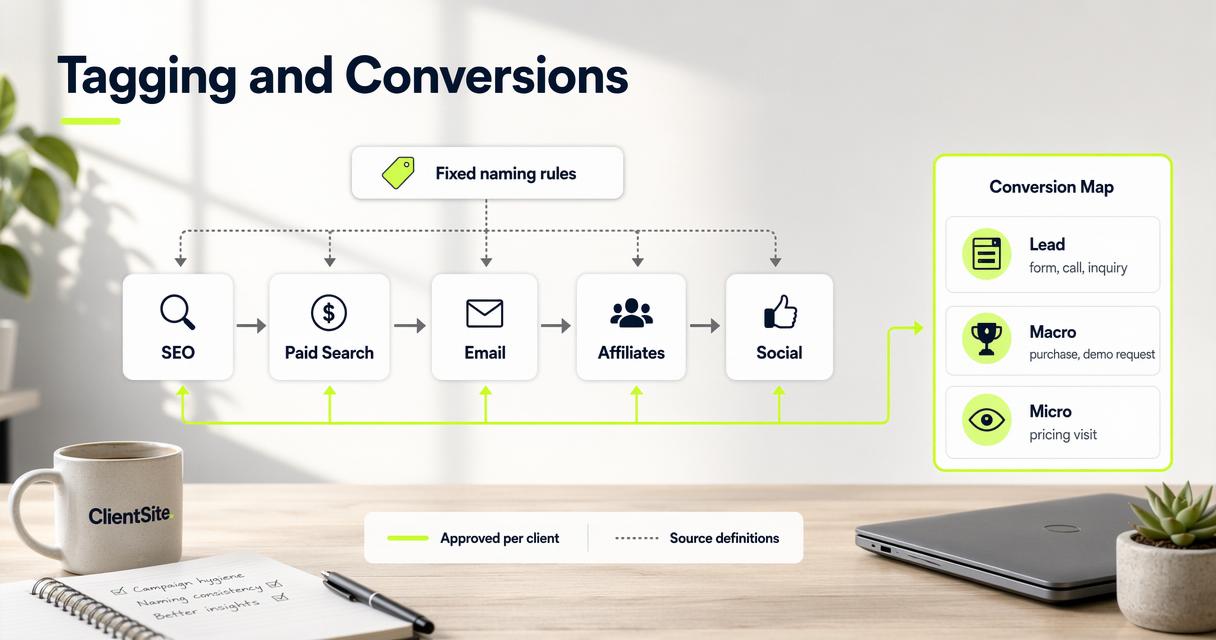
Common conversion terms need exact meanings:
- Lead: a submitted form, booked call, or qualified inquiry.
- Macro conversion: the main commercial action, such as purchase or demo request.
- Micro conversion: a smaller intent signal, such as pricing-page visit.
- Campaign tag: a structured tracking label added to URLs or traffic sources.
Research by Wankhade, Rao, and Kulkarni (2022) reviewed sentiment analysis methods and challenges, showing why unstructured customer signals need disciplined classification before analysis: Artificial Intelligence Review.
Conversion governance checklist
| Governance item | Required agency action |
|---|---|
| UTM rules | Maintain one shared source, medium, and campaign taxonomy |
| Conversion owner | Assign who approves new goals or event changes |
| QA routine | Test forms, purchases, pixels, and thank-you pages after site edits |
| Change log | Record tracking changes with date, reason, and client approval |
Bad tags create false winners. Clean naming keeps budget shifts based on evidence rather than dashboard noise.
How should privacy and reporting evolve in 2026?
Agency analytics in 2026 should combine useful client reporting with privacy-aware data handling, consent documentation, and limited access. Clients increasingly expect clear proof of results, but agencies also need defensible processes for personal data, cookies, and vendor responsibilities.
Research by Dwivedi, Hughes, and Wang (2022) examined how metaverse marketing may shape consumer research and practice, a reminder that measurement channels keep expanding: Psychology and Marketing. Agencies also face trust risks in digital information systems, a topic reviewed by Aïmeur, Amri, and Brassard (2023): Social Network Analysis and Mining.
Privacy-aware reporting controls
| Control | Agency implementation |
|---|---|
| Data access | Grant least-privilege access by client, role, and project |
| Legal references | Align reporting with the client's privacy policy and vendor terms |
| Processing terms | Review the data processing agreement before handling client data |
| Platform rules | Confirm usage boundaries in the terms of service |
In 2026 and beyond, better reporting will mean fewer vanity charts and more decision-ready summaries: what changed, why it likely changed, and what action follows.
Conclusion
Website analytics for agencies managing client sites should be treated as a repeatable operating process, not a dashboard project. Agencies ready to standardize client measurement can evaluate Faurya, document the KPI template above, and visit faurya.com to map the first client-site rollout.
Generated by EarlySEO.com