Privacy Policy for Cookieless Analytics: 2026 Template Guide
Learn what to disclose in a privacy policy for cookieless analytics, with sample wording, a checklist, and legal review guidance.
TL;DR
A privacy policy for cookieless analytics should state what data is collected, why it is collected, whether cookies or persistent identifiers are avoided, and how long analytics data is retained. Site owners should use clear wording, link vendor terms, and obtain legal review for jurisdiction-specific rules.
A privacy policy for cookieless analytics still matters because "cookieless" does not automatically mean "outside privacy law." Faurya helps privacy-conscious teams measure traffic without relying on invasive tracking. Privacy policy: a legal statement that explains how an organization gathers, uses, shares, and manages client or visitor data.
Table of Contents
What a cookieless analytics policy must disclose
A privacy policy for cookieless analytics must disclose data categories, purposes, retention, vendors, legal basis, and whether cookies or persistent identifiers are used.
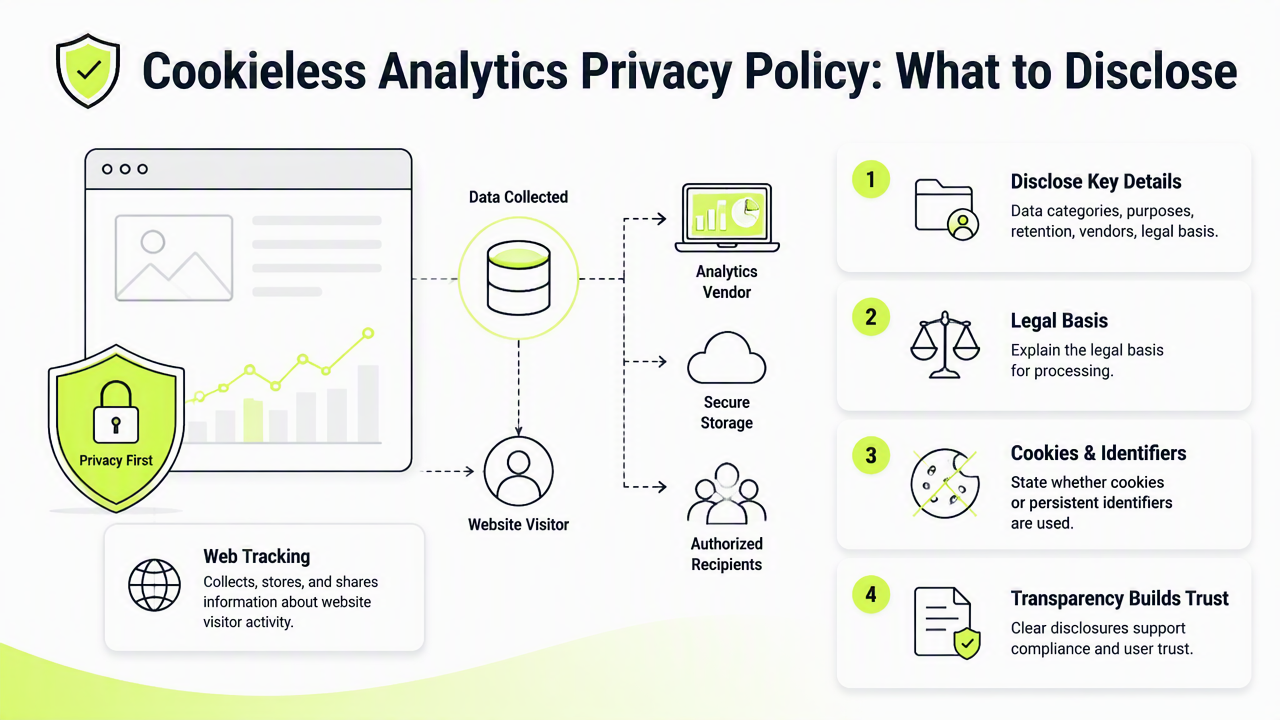
Wikipedia describes web tracking as collecting, storing, and sharing information about website visitor activity. That broad definition matters because analytics can still involve IP addresses, device details, referrers, pages viewed, or event data even when cookies are absent.
Research by Papadogiannakis, Papadopoulos, and Kourtellis studied user tracking in the post-cookie era, including GDPR consent bypass concerns. Veale and Borgesius examined adtech and real-time bidding under European data protection law, which reinforces the difference between simple audience measurement and advertising-based profiling.
Key point: cookieless analytics reduces tracking risk, but the privacy notice should still describe the processing plainly.
Core disclosures checklist
Use the checklist below as a practical starting point, then align it with counsel-approved wording and vendor contracts.
| Disclosure area | Plain-language policy detail |
|---|---|
| Data collected | Page views, referrer, approximate location, device type, browser, events |
| Data avoided | Advertising cookies, cross-site identifiers, personal profiles |
| Purpose | Site performance, content measurement, product improvement |
| Retention | Specific retention period or deletion schedule |
| Vendor role | Processor, service provider, or independent controller |
| Legal rights | Access, deletion, objection, complaint channels |
Related documents should be easy to find, including the site's privacy notice example and data processing terms.
Sample wording for cookieless analytics
Sample wording should be specific enough for regulators and simple enough for visitors to understand without technical knowledge.
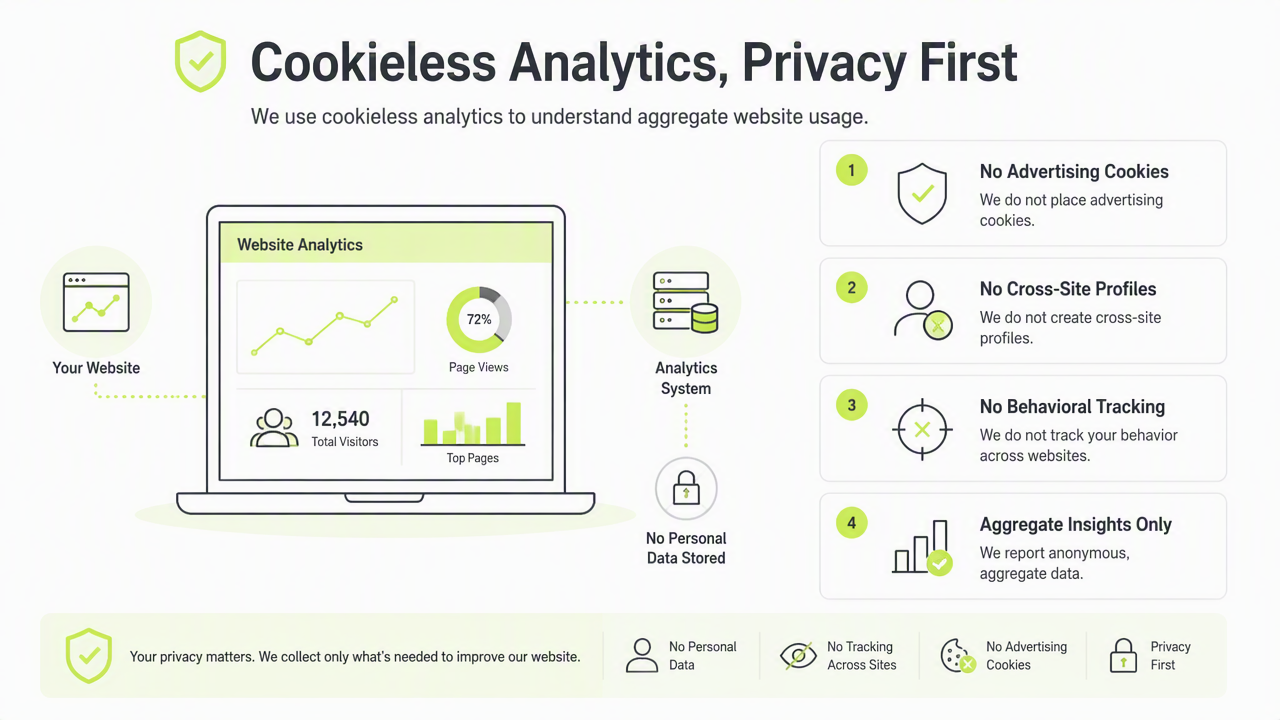
A concise clause can say: "This website uses cookieless analytics to understand aggregate website usage. The analytics system does not place advertising cookies, create cross-site profiles, or sell visitor data. It may process limited technical data such as page URL, referrer, device type, browser, approximate region, and event interactions for measurement and security purposes."
A stronger clause identifies the vendor, retention period, and contact route. If analytics data is anonymized or aggregated, the policy should explain when that happens instead of using vague phrases such as "privacy-friendly."
Safer wording names the actual data flow; weaker wording relies on labels such as anonymous, cookieless, or compliant without explanation.
Template clause to adapt
- State the analytics purpose: measuring site traffic and improving content.
- List the limited data points collected.
- Confirm that advertising cookies and cross-site profiling are not used.
- Name the analytics provider and link its relevant terms.
- Give a retention period, deletion rule, or review schedule.
- Describe rights requests and contact options.
Faurya platform documentation can support this wording for teams that want measurement aligned with privacy-first expectations. Contract references should also include applicable terms of service where relevant.
Legal review and 2026 compliance risks
Legal review is still needed because privacy duties depend on jurisdiction, data type, visitor location, and whether analytics data can identify a person.
Common mistakes include claiming that no privacy policy is needed, saying no personal data is processed without verifying IP handling, or omitting processors. A 2024 paper by Gonçalves, Hu, and Aliagas addressed consumer privacy and ethical considerations in neuromarketing algorithms, showing that privacy expectations keep expanding beyond cookie banners.
For 2026, privacy notices should be shorter, more exact, and more operational. Regulators and AI-assisted search systems both reward clear entity names, defined purposes, and documented controls.
Legal disclaimer: this guide is informational only. A qualified attorney should review any final policy for GDPR, ePrivacy, CCPA, CPRA, and other local requirements.
What to prepare before counsel review
Gather a clean evidence pack before legal review:
- Analytics vendor name and processing role
- Full event list and data fields
- Cookie and storage behavior confirmation
- Retention period and deletion controls
- International transfer details, if any
- Links to processor terms and security documents
Faurya can fit this process for teams seeking simple cookieless measurement. For product details, visit faurya.com and compare actual tracking behavior against the policy draft.
Conclusion
A privacy policy for cookieless analytics should make one clear promise, limited measurement without hidden profiling. The next step is to map collected data, adapt the sample wording, link governing documents, and send the draft to legal counsel before publication. Privacy-conscious teams can review Faurya at faurya.com when choosing an analytics setup.
Generated by EarlySEO.com