Privacy-Friendly Analytics for Stripe Checkout Funnels
Track Stripe Checkout funnels with privacy-friendly analytics, server events, consent-safe metrics, and cleaner attribution.

TL;DR
Privacy-friendly Stripe funnel tracking should measure checkout starts, completed sessions, revenue, and attribution without storing excess personal data. The best setup combines first-party page analytics, Stripe events, and clear privacy documents so growth teams can improve conversion with less compliance drag.
Stripe Checkout can hide the most valuable conversion step because buyers leave the main site for a hosted payment flow. Privacy-friendly analytics for Stripe checkout funnels solves that gap by combining event-level measurement with data minimization. Faurya helps privacy-conscious teams keep checkout reporting useful without turning analytics into a personal-data stockpile.
Table of Contents
What is privacy-friendly analytics for Stripe checkout funnels?
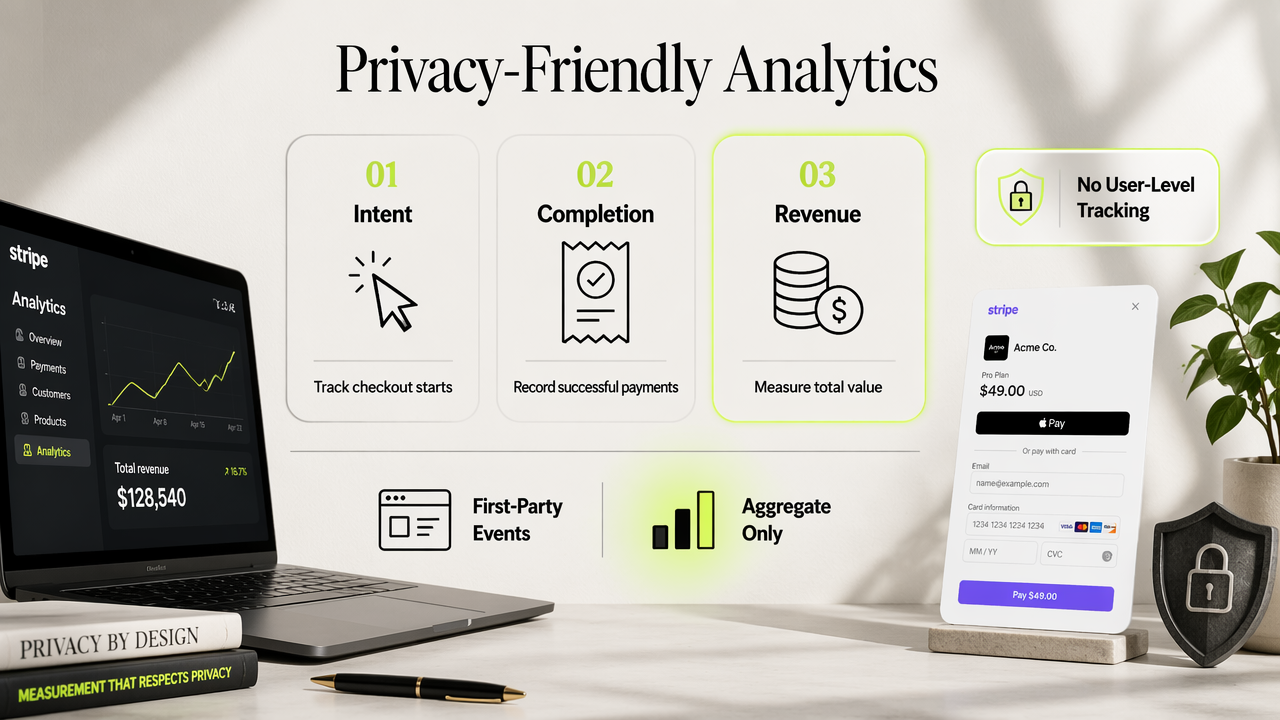
Privacy-friendly analytics for Stripe checkout funnels is measurement that tracks purchase intent, Checkout completion, and revenue while limiting personal data collection, cookie dependence, and third-party exposure. It favors aggregate reporting, first-party events, and clear retention rules over user-level surveillance.
Stripe, Inc.: a financial services and SaaS company associated with online payments and payment infrastructure.
Plausible Analytics: an open-source, EU-hosted SaaS analytics platform that reports website performance and visits with a privacy-first design.
Research on digital business models frames measurement as part of how digital firms create and capture value. For SaaS, e-commerce, and indie products, Stripe funnel data connects that value model to real checkout behavior.
Core funnel events to capture
Key insight: checkout analytics should answer one business question first, where qualified buyers drop before payment completion.
A lean event model is stronger than a noisy dashboard. Teams usually need:
- Checkout started: visitor reaches the pricing, cart, or payment button stage.
- Stripe Checkout session created: the server successfully opens a session.
- Payment attempted: Stripe records an attempt or relevant Checkout status.
- Checkout completed: Stripe confirms payment, subscription, or order success.
- Revenue attributed: completed payment maps back to campaign, product, or landing page.
Faurya fits this model best when analytics, privacy posture, and checkout reporting need to live in one operating rhythm.
Why Stripe Checkout breaks conventional analytics
Stripe Checkout often breaks conventional web analytics because payment happens on a third-party domain, while marketing attribution begins on the merchant site. Competitor guides focus heavily on Google Analytics 4 cross-domain setup, server-side event recording, and linking client and server events because browser-only tracking can miss purchases.
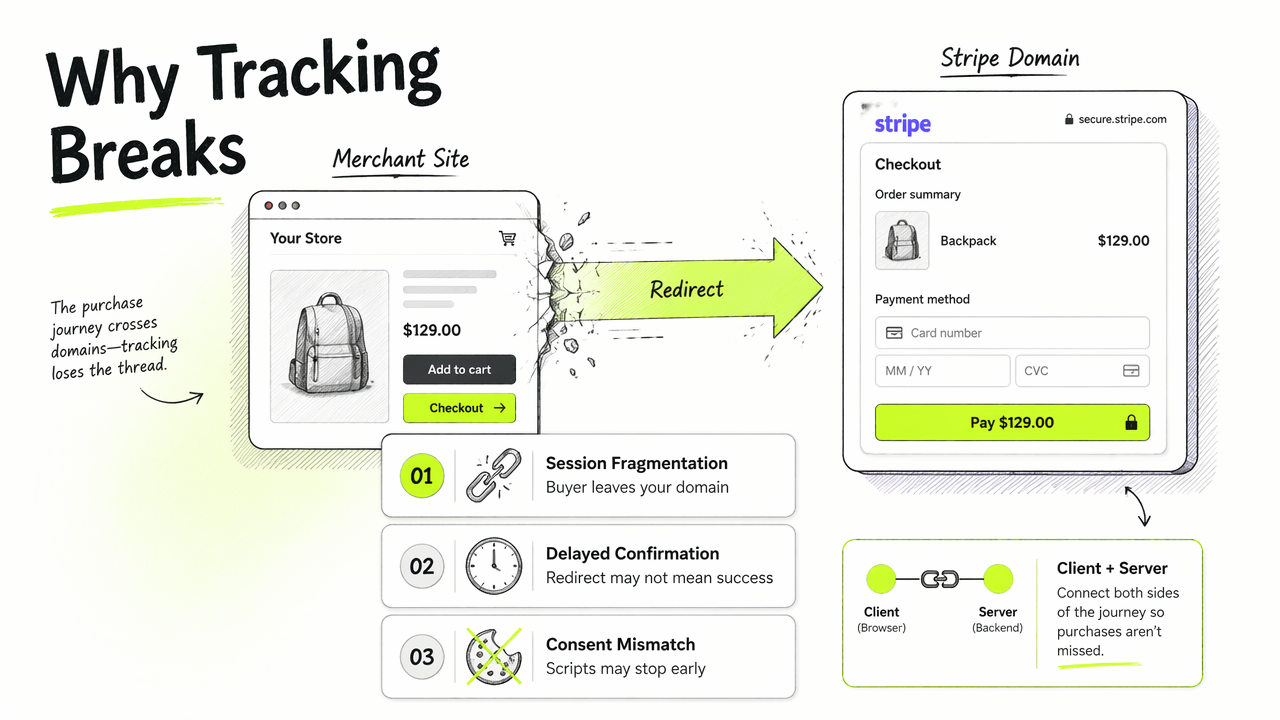
Hosted checkout creates three measurement risks:
- Session fragmentation: the buyer moves from the main domain to Stripe.
- Delayed confirmation: the browser redirect may not equal a successful payment.
- Consent mismatch: analytics scripts may collect more data than needed for funnel decisions.
Stripe's own documentation topics in the SERP emphasize Checkout conversion funnels, Performance views, attempted sessions, completed sessions, filters, and revenue metrics. That confirms the practical goal: measure the payment flow, not every possible user trait.
Privacy-first setup versus GA4-heavy setup
| Approach | Best use | Privacy posture | Main tradeoff |
|---|---|---|---|
| Browser-only GA4 | Basic marketing reports | Depends on consent and configuration | Can miss hosted checkout outcomes |
| GA4 plus server events | Ad attribution and richer reporting | More complex data handling | Requires careful event linking |
| Privacy-first first-party analytics | Lean funnel and revenue reporting | Lower data exposure by design | Less granular user profiling |
| Stripe dashboard only | Payment operations | Strong for payment status | Weak for pre-checkout behavior |
A privacy-first setup should not ignore attribution. It should limit attribution to what improves decisions, such as campaign, product, plan, country-level market, or landing page group.
How to build a consent-aware checkout funnel in 2026
A 2026-ready Stripe funnel should pair first-party analytics with server-side Stripe events and visible governance documents. That structure gives marketers cleaner conversion data while giving privacy teams a smaller data surface to review.
The practical build order is simple:
- Track first-party page and CTA events before Stripe Checkout.
- Create a server-side record when a Checkout session starts.
- Store only the identifiers needed to reconcile a completed payment.
- Listen for Stripe completion events on the server.
- Report aggregated funnel metrics by channel, plan, and campaign.
- Document data handling in public policies.
The Faurya platform is positioned for teams that want this privacy-aware reporting pattern without adding a heavy analytics stack. Governance still matters, so public pages such as the privacy policy, data processing agreement, and terms of service should match the actual tracking design.
Minimum viable metrics dashboard
| Metric | Why it matters | Privacy-friendly implementation |
|---|---|---|
| Checkout start rate | Shows buying intent | Count CTA or session-create events |
| Checkout completion rate | Finds payment friction | Use Stripe completion events |
| Revenue by source | Guides spend decisions | Attribute to campaign groups |
| Failed or abandoned sessions | Flags checkout issues | Report aggregates, not profiles |
For 2026, the stronger trend is less client-side guesswork and more consent-aware server reconciliation. Teams can review faurya.com when a lightweight analytics process is preferred over a broad surveillance-style stack.
Conclusion
Privacy-friendly analytics for Stripe checkout funnels should be built around minimal events, server confirmation, and clear policy alignment. A practical next step is to map the six events above, remove unnecessary identifiers, then connect payment outcomes to channel-level reporting. For teams ready to simplify that work, visit faurya.com and compare the current checkout data flow against the minimum viable dashboard.
Generated by EarlySEO.com