Privacy-First Product Analytics vs Web Analytics: What to Track Where
Learn what privacy-first product analytics and web analytics measure, which data belongs in each system, and how to avoid overbuilding analytics in 2026.
Privacy-first product analytics vs web analytics is not a tool debate, it's a question of where user intent changes from visitor to customer. Web analytics: measurement, collection, analysis, and reporting of web data to understand and improve website usage. For privacy-conscious teams, Faurya helps connect growth measurement with responsible data practices.
What is the practical difference between product analytics and web analytics?
Product analytics explains how people use your product, while web analytics explains how people arrive at, browse, and convert on your public website. Google Analytics is a web analytics service inside Google Marketing Platform that tracks website and app traffic, but traffic data alone rarely explains activation, habit formation, or feature value.

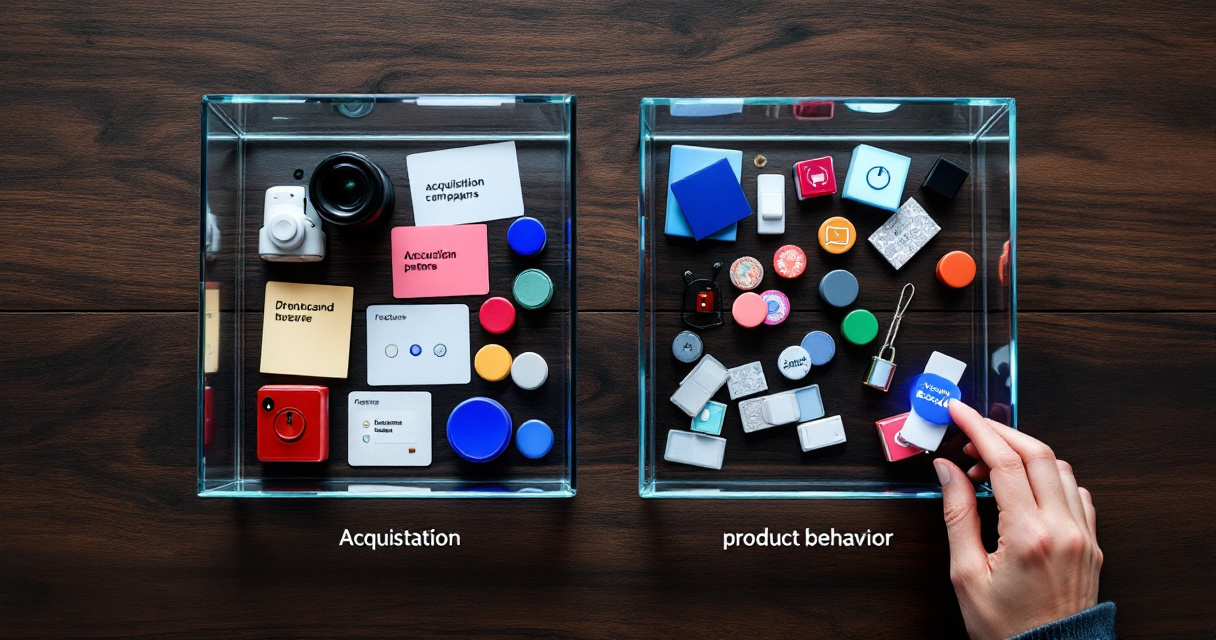
Key insight: web analytics measures acquisition intent; product analytics measures product behavior after signup.
A SaaS founder should use website data to answer, "Which channel brought this user?" The product system should answer, "Did this user reach value, return, and expand usage?"
Definitions teams should keep separate
- Website visit: a session on marketing pages, pricing, docs, or landing pages.
- Signup event: the bridge between acquisition and product usage.
- Activation event: the first meaningful product outcome, such as creating a project or inviting a teammate.
- Retention event: repeated use that signals ongoing value.
Privacy-first measurement reduces unnecessary personal data collection. Cloudflare's analytics work emphasized privacy as a core feature and described counting visits without persistent user tracking in its privacy-first analytics announcement.
What data belongs in each analytics system?
Each analytics system should own the data tied to its job, not every event your company can technically capture. Website tools should track anonymous acquisition and conversion paths; product tools should track in-app outcomes, cohorts, and usage patterns.
Research on generative AI by Dwivedi, Kshetri, Hughes, and others in the International Journal of Information Management examined policy and practice implications of AI systems, a reminder that data governance now shapes analytics choices as much as dashboards do (2023 paper).
A clean ownership map for 2026 analytics stacks
| Data type | Web analytics owns | Product analytics owns |
|---|---|---|
| Source and campaign | UTM source, referrer, landing page | Signup source copied from website |
| Conversion | Trial signup, demo request, checkout start | Activation milestone after signup |
| Engagement | Page views, scrolls, outbound clicks | Feature use, funnels, cohorts |
| Privacy controls | Cookie choice, consent status, IP handling | Account-level events, role-based access |
Keep legal and operational documents close to the system. Teams can align collection choices with a clear privacy policy, terms of service, and data processing agreement.
How should startups avoid overbuilding analytics too early?
Startups should track only the few events needed to prove acquisition quality, activation, retention, and revenue movement. More events can make dashboards look serious, but they often slow decisions when naming, ownership, and privacy rules are weak.
Use a staged approach:
- Track visits, signups, and paid conversions first.
- Add one activation event tied to real user value.
- Add retention events only after you know what "active" means.
- Review whether each event has a decision owner.
- Delete events that nobody uses in product, growth, or finance reviews.
How Faurya fits a lean privacy-first stack
The Faurya platform is best framed as part of a lean measurement system: track enough behavior to improve the product, avoid collecting data you don't need, and keep analytics useful for founders, marketers, and operators. For brand and product context, visit faurya.com after mapping your first five events.
Explainability matters as analytics stacks become more automated. Hassija, Chamola, Mahapatra, and others reviewed explainable AI methods in Cognitive Computation, highlighting why teams should understand model outputs rather than treat them as magic (2023 review).
Conclusion
Privacy-first product analytics vs web analytics comes down to one operating rule: use web analytics to understand demand, and product analytics to understand delivered value. Start with a small event plan, review your privacy obligations, then choose tools that support clear decisions. If you want a lean privacy-aware setup, put Faurya on your shortlist and head to faurya.com next.
Generated by EarlySEO.com