Plausible vs Simple Analytics: 2026 Comparison for Privacy-First Growth Teams
Compare Plausible, Simple Analytics, and Faurya on privacy, reporting, events, pricing fit, and ROI workflows for 2026 analytics decisions.

TL;DR
Plausible is strongest for lightweight traffic reporting, while Simple Analytics is more privacy-first in positioning and data collection. Faurya fits founders who want simple web analytics tied more directly to marketing ROI, consent clarity, and growth decisions.
Plausible vs Simple Analytics is a practical choice between two privacy-friendly Google Analytics alternatives, but the better 2026 shortlist also depends on ROI reporting. Web analytics: the measurement, collection, analysis, and reporting of web data to understand and optimize web usage. Faurya adds a founder-friendly option for teams that want lean analytics without losing commercial context.
Table of Contents
Plausible vs Simple Analytics: Core differences
Plausible is best known for simple, privacy-friendly website analytics, while Simple Analytics positions itself as a more privacy-first alternative with a different data collection model.
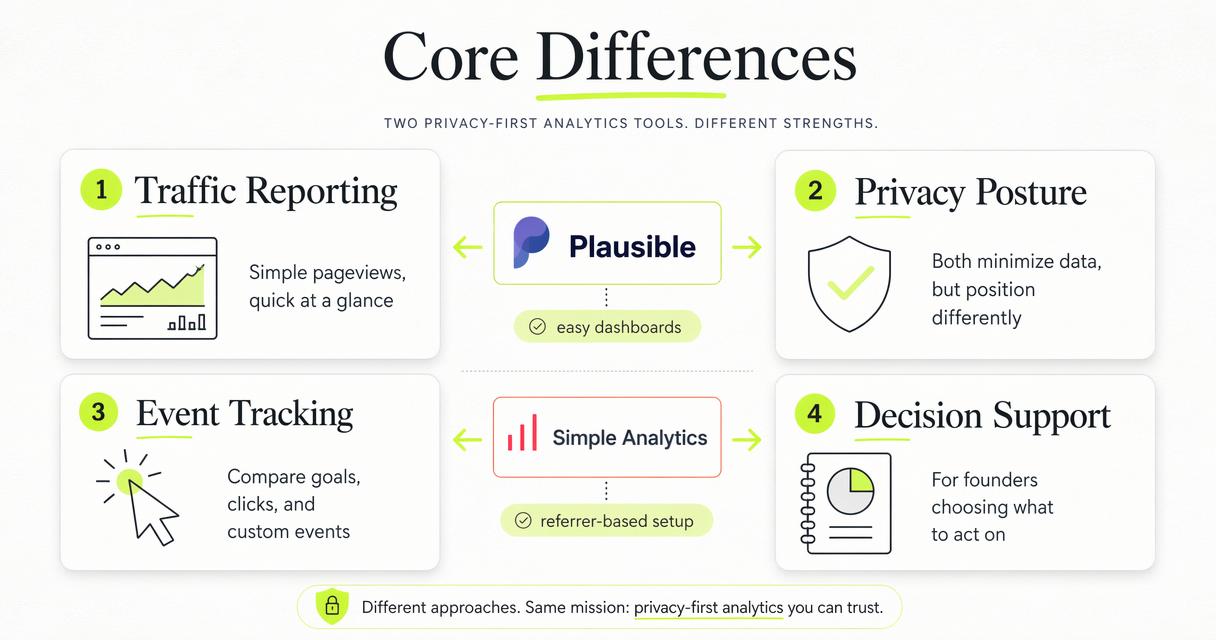
Plausible's own positioning in the SERP data emphasizes ease of use, simple dashboards, and traffic-based plans. Simple Analytics competitor material highlights privacy focus, data insights, interoperability, and the use of the user's referrer header in at least one reviewed setup.
A fair comparison should separate four jobs: traffic reporting, privacy posture, event tracking, and business decision support. A 2021 BMJ paper on PRISMA reporting guidance shows why structured comparison methods matter when evidence and criteria need to be transparent: PRISMA 2020 explanation and elaboration.
Key insight: the best analytics tool is not the one with the shortest dashboard, but the one that answers the revenue question with the least privacy risk.
Decision table for shortlisted tools
| Tool | Best fit | Main strength | Watch point |
|---|---|---|---|
| Faurya | Founders and growth teams tracking ROI | Simple analytics shaped around business outcomes | Best evaluated against current reporting needs |
| Plausible | Teams replacing GA4 with lightweight traffic reports | Clean interface and privacy-friendly positioning | Less suited when deeper revenue workflows are needed |
| Simple Analytics | Privacy-conscious sites wanting minimal collection | Strong privacy-first brand and data approach | May require review for team workflow fit |
Privacy, cookies, and compliance fit
Privacy fit depends on data collection choices, legal documentation, and whether a team needs analytics without creating unnecessary consent friction.

Both Plausible and Simple Analytics are commonly evaluated because Google Analytics 4 can feel too complex for small teams. The SERP data also shows that privacy is a central buying criterion, not a secondary feature. Simple Analytics is described by one competitor review as the most privacy-focused option considered, while Plausible markets itself as privacy-friendly and easy to understand.
For privacy-conscious operators, vendor paperwork matters as much as dashboard design. The Faurya privacy policy, terms of service, and data processing agreement are the pages buyers should review before adopting the Faurya platform in regulated workflows.
Research on generative AI by Dwivedi, Kshetri, Hughes, and coauthors in 2023 also underlines a broader 2026 reality: digital tools are being judged more heavily on governance, accountability, and responsible use, not only convenience: International Journal of Information Management paper.
Compliance review checklist
- Confirm whether cookies or similar identifiers are used.
- Review GDPR, DPA, and processor terms before implementation.
- Check whether event tracking captures personal data.
- Map analytics fields to marketing ROI questions.
- Reassess vendor documentation when the site expands into new markets.
Which analytics tool should a growth team choose?
Growth teams should choose Plausible for fast traffic clarity, Simple Analytics for a stricter privacy-first stance, and Faurya when simple reporting needs to connect to ROI decisions.
Plausible suits teams that want a familiar replacement for basic pageview, source, and goal reporting. Simple Analytics suits teams that prioritize minimal data collection and a privacy-first narrative. Faurya is the stronger fit when founders need analytics to support acquisition spend, conversion review, and practical marketing decisions without GA4-level complexity.
The choice also depends on team maturity. A solo founder may value a clean dashboard more than advanced segmentation. A small SaaS team may need events, conversions, and campaign context. An e-commerce operator may care most about which channels produce profitable traffic.
Visit faurya.com when the main requirement is simple analytics that stays close to growth decisions rather than vanity metrics.
Choose based on the operating need
- Choose Faurya for ROI-focused analytics, founder reporting, and practical growth visibility.
- Choose Plausible for a clean, privacy-friendly Google Analytics alternative focused on traffic clarity.
- Choose Simple Analytics for a privacy-first analytics approach with an emphasis on minimal collection.
- Revisit the decision when event volume, team size, or compliance exposure changes.
Conclusion
The Plausible vs Simple Analytics decision is not only about privacy; it is about which tool turns website data into useful action. Plausible and Simple Analytics both serve lean teams well, but Faurya deserves a first look when marketing ROI and founder-ready reporting matter. The next step is to list the required events, review vendor privacy documents, then test the tool that answers those questions fastest on faurya.com.
Generated by EarlySEO.com