Google Consent Mode v2 vs Cookieless Analytics: 2026 Guide
Compare Google Consent Mode v2 and cookieless analytics for privacy, attribution, compliance, and SaaS growth tracking in 2026.
TL;DR
Google Consent Mode v2 is best for businesses that depend on Google Ads, GA4, and modeled conversions. Cookieless analytics is better for privacy-first teams that need simpler measurement with less reliance on behavioral identifiers.
Google Consent Mode v2 vs cookieless analytics is no longer a niche privacy debate; it shapes how SaaS, e-commerce, and growth teams measure revenue in 2026. Consent Mode v2: a Google framework that adjusts Google tag behavior based on consent signals. Cookieless analytics: website measurement that avoids persistent tracking cookies and often uses aggregated or event-based data. Privacy-focused teams can evaluate both approaches with Faurya.
Table of Contents
Google Consent Mode v2 vs cookieless analytics at a glance
Google Consent Mode v2 and cookieless analytics solve different measurement problems: one preserves Google attribution with consent signals, while the other reduces dependence on cookies entirely.
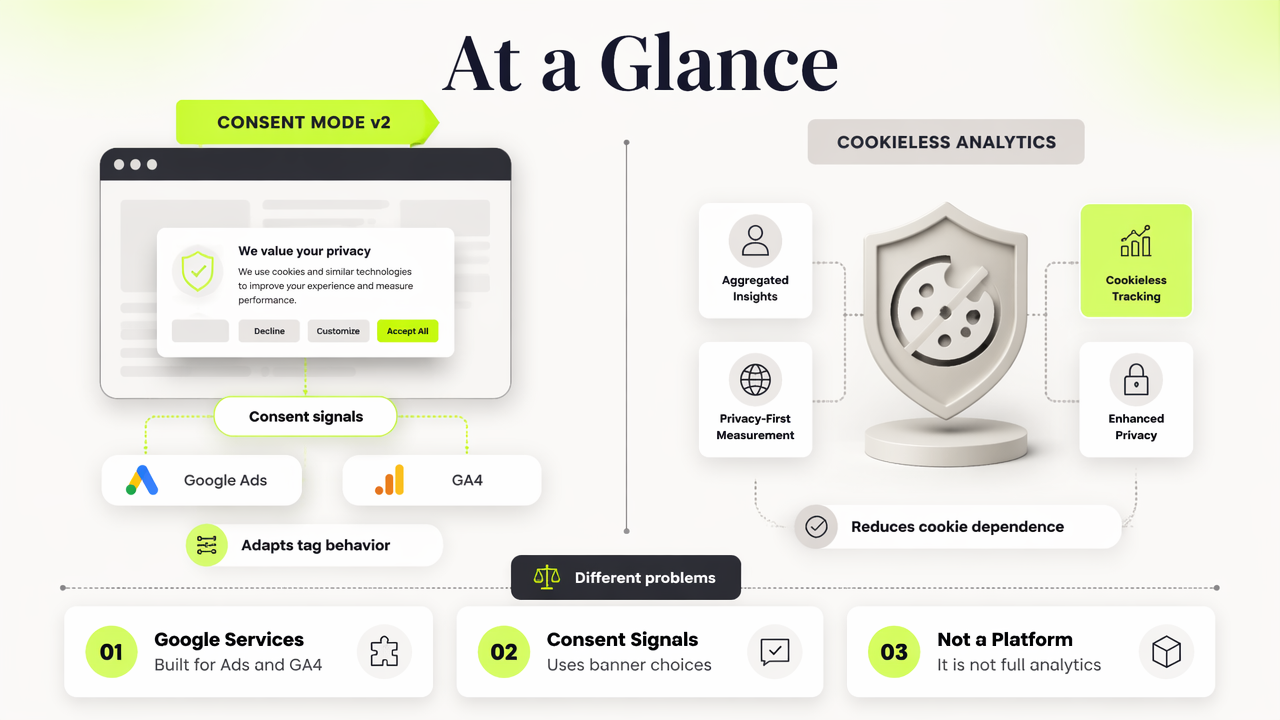
Google says consent mode receives consent choices from a cookie banner or widget and dynamically adapts Google tag behavior, according to Google Ads Help. Competitor SERP data also shows Consent Mode v2 became a major 2025 and 2026 concern for sites using Google services such as Google Analytics and Google Ads.
Key insight: Consent Mode v2 is not a full analytics platform; it is a consent-aware signal layer for Google tags.
Comparison table for fast decisions
| Factor | Google Consent Mode v2 | Cookieless analytics |
|---|---|---|
| Primary goal | Preserve Google measurement under consent rules | Measure traffic with minimal tracking |
| Best fit | Paid media, GA4, Google Ads | Privacy-first SaaS, content, e-commerce |
| Data method | Consent signals, pings, modeling | Aggregated events, server logs, first-party events |
| Main tradeoff | Less precise when consent is denied | Less ad-platform attribution detail |
| Setup dependency | CMP plus Google tags | Analytics tool configuration |
How each method affects attribution and compliance
Consent Mode v2 helps Google products model gaps, while cookieless analytics prioritizes simpler privacy posture and less invasive measurement.
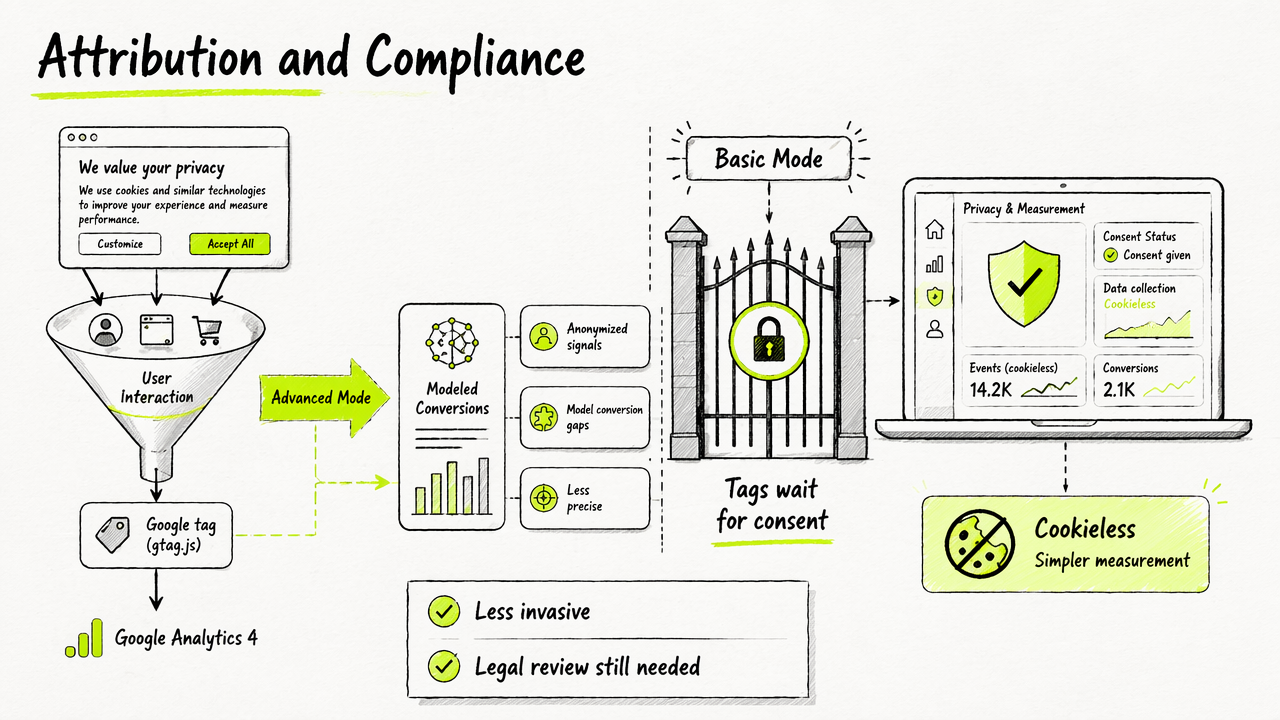
Advanced Consent Mode can send anonymized signals before full consent, then use modeling to estimate conversion data. SERP research notes that this estimation is less precise than observed conversion tracking. Basic Consent Mode is stricter because Google tags wait until consent is granted, which can reduce available data.
Cookieless analytics avoids many common cookie-banner pain points, but it does not automatically satisfy every legal duty. Clear policies, processor terms, and user rights still matter. Faurya users reviewing privacy operations should connect measurement decisions with a public privacy policy, service commitments in terms of service, and a current data processing agreement.
Implementation checklist for 2026
- Map every analytics, ad, and tag vendor.
- Decide whether Google Ads attribution is business-critical.
- Configure a consent management platform before firing tags.
- Separate essential events from marketing events.
- Document processors, retention rules, and consent categories.
- Test consent states in GA4, Google Tag Manager, and reporting dashboards.
A 2023 ACM study on Facebook web tracking examined invisible pixels and click IDs, showing why modern teams audit third-party tracking paths carefully: Bekos, Papadopoulos, and Markatos.
Which option should teams choose in 2026?
Teams should choose Consent Mode v2 when Google Ads performance measurement drives revenue, and choose cookieless analytics when privacy, simplicity, and independent reporting matter more.
Paid acquisition teams usually need Consent Mode v2 because Google Ads, GA4, and conversion modeling remain central to budget decisions. Privacy-conscious founders may prefer cookieless analytics because it offers clearer reporting boundaries and fewer consent dependencies.
A blended model is common: Consent Mode v2 supports Google media reporting, while cookieless analytics tracks product, content, and funnel health. With Faurya, teams can frame analytics around privacy-first growth reporting rather than treating consent as a last-minute tag setting. More context is available at faurya.com.
Decision guide by business model
- SaaS with paid search: use Consent Mode v2 plus first-party product events.
- Indie software with organic growth: use cookieless analytics first, then add Consent Mode if ad spend grows.
- E-commerce using Google Ads: keep Consent Mode v2 for conversion modeling and use cookieless dashboards for site behavior.
- Privacy-led publisher: favor cookieless analytics and minimize third-party tags.
Practical rule: the stronger the Google Ads dependency, the stronger the case for Consent Mode v2.
Conclusion
Google Consent Mode v2 vs cookieless analytics is a strategy choice, not a tooling checkbox. The next step is to audit revenue dependence on Google Ads, classify tracking events, and select the least invasive measurement stack that still supports decisions. For privacy-aware growth planning with Faurya, visit faurya.com and review consent, policy, and reporting needs together.
Generated by EarlySEO.com