First-Party vs Third-Party Web Analytics: 2026 Decision Guide
Compare first-party, third-party, and cookieless analytics for attribution, privacy, cookie banners, browser blocking, and data accuracy in 2026.
TL;DR
First-party analytics gives startups more control, cleaner site-level reporting, and stronger privacy posture. Third-party analytics can expand ad attribution, but browser blocking, consent rules, and cookie limits make it less dependable for owned-site decisions.
First-party vs third-party web analytics is now a board-level measurement choice, not a tracking-code preference. Privacy rules, browser limits, and ad-platform modeling have changed how growth teams trust traffic, attribution, and conversion data. Privacy-conscious teams can evaluate options like Faurya when owned measurement needs to stay simple and direct.
Table of Contents
What is first-party vs third-party web analytics?
First-party vs third-party web analytics compares data collected directly by a website owner with data collected or processed across other domains, platforms, or advertising networks. First-party analytics supports owned-site measurement. Third-party analytics supports broader audience, retargeting, and cross-site attribution, often through third-party cookies.
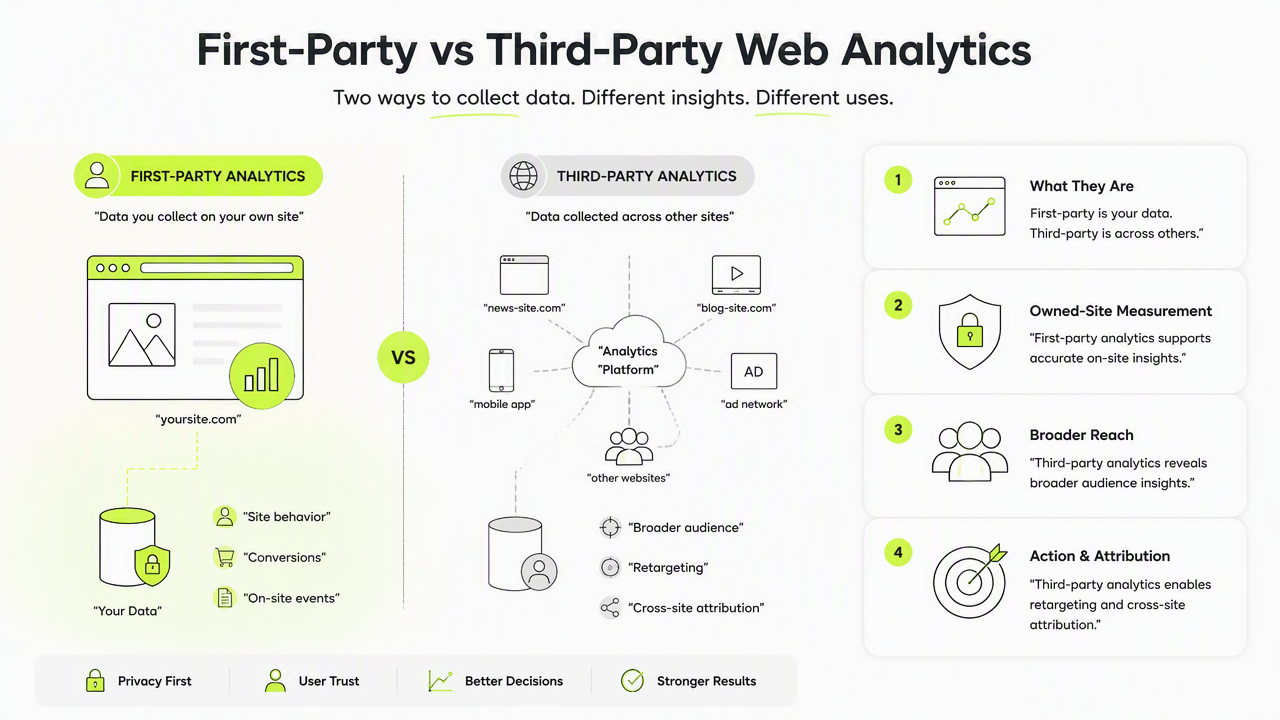
Web analytics: measurement, collection, analysis, and reporting of web data to understand and optimize website usage.
Third-party cookies: HTTP cookies used mainly for web tracking in the advertising system.
Key insight: first-party analytics answers "what happened on the owned site," while third-party analytics tries to connect that activity to activity elsewhere.
Core comparison points for 2026 teams
| Factor | First-party analytics | Third-party analytics | Cookieless analytics |
|---|---|---|---|
| Data source | Owned website or app | External platforms and networks | Events, logs, consented IDs, or aggregates |
| Main use | Product, content, funnel reporting | Ads, retargeting, audience matching | Privacy-first performance trends |
| Consent impact | Often simpler, still jurisdiction-specific | Usually higher consent burden | Usually lower, depending on design |
| Blocking risk | Lower when implemented carefully | Higher due to browser and tracker controls | Lower when no tracking cookies are used |
| Accuracy style | Strong for owned behavior | Variable across browsers and consent states | Strong for trends, weaker for user-level paths |
How do privacy rules and browsers change attribution?
Privacy regulation and browser blocking make third-party measurement less stable for attribution, cookie banners, and campaign ROI. Third-party cookies can be rejected, shortened, or blocked before a conversion is recorded. First-party data usually creates a clearer audit trail because collection happens closer to the customer interaction.
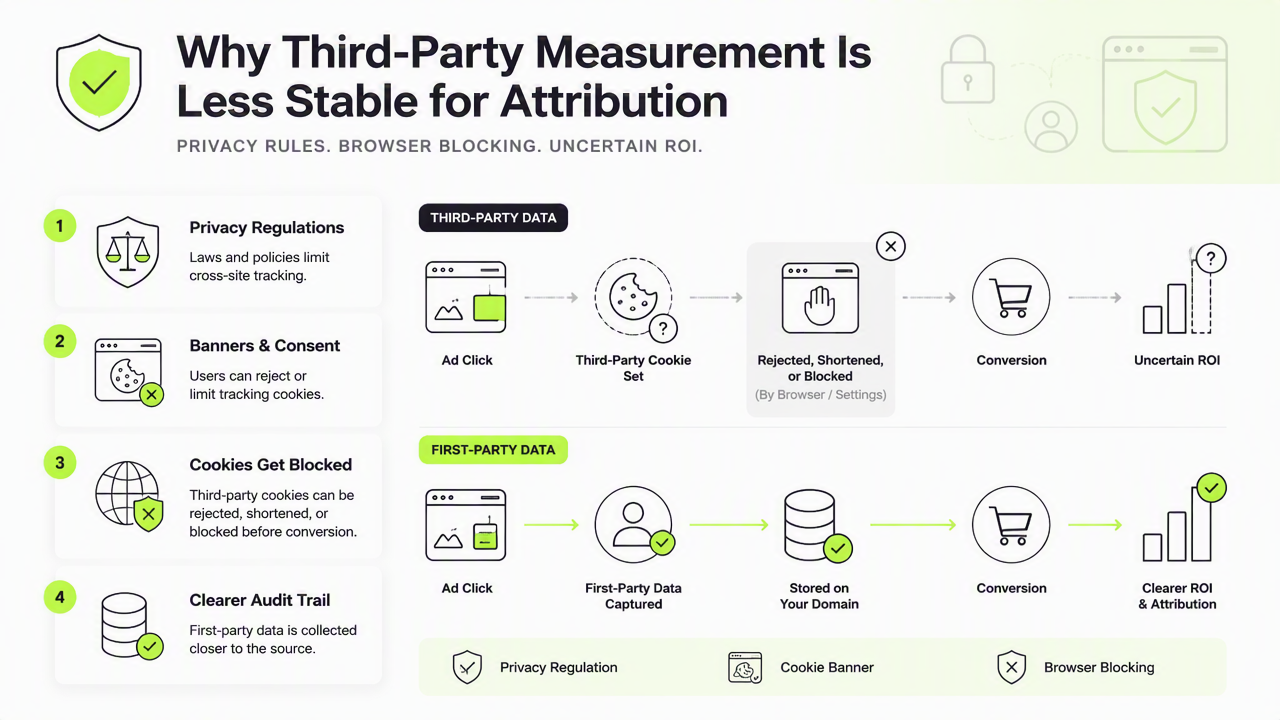
Attribution suffers most when a team tries to compare ad-platform reports, site analytics, and CRM data as if all systems observe the same events. They do not. Consent choices, browser privacy features, and server-side event matching can all create different counts for the same campaign.
Academic methods such as Partial Least Squares Structural Equation Modeling, covered by Hair, Hult, and Ringle in PLS-SEM Using R, show why measurement models need clear constructs before decisions are trusted. Digital measurement also changes as machine learning systems mature, a topic reviewed by Janiesch, Zschech, and Heinrich in Machine learning and deep learning.
Decision matrix for startup analytics choices
- Choose first-party analytics when product funnels, landing pages, signups, and revenue events matter most.
- Choose third-party analytics when paid media optimization, retargeting, and platform-specific reporting dominate.
- Choose cookieless analytics when compliance simplicity, reduced banner friction, and trend reporting matter more than user-level tracking.
- Combine methods carefully when finance, marketing, and product teams need one shared reporting model.
Key insight: attribution accuracy improves when one system is named the source of truth for each decision, instead of forcing every tool to reconcile perfectly.
Which analytics approach should a startup choose in 2026?
A startup should choose first-party analytics for owned growth decisions, third-party analytics for ad-network optimization, and cookieless analytics for privacy-first trend reporting. The best setup often uses first-party data as the base layer, then adds paid-media data only where it improves decisions.
For SaaS founders, first-party events such as signup, activation, trial start, and paid conversion usually matter more than anonymous reach metrics. For e-commerce owners, product views, cart events, checkout steps, and order value need consistent naming across analytics, payment, and CRM systems.
Research on emerging digital environments, such as Dwivedi, Hughes, and Baabdullah's 2022 paper on metaverse challenges and policy questions in the International Journal of Information Management, reinforces a broader point: measurement systems keep changing as privacy, identity, and user behavior shift.
Privacy-first implementation path
A practical rollout starts with a tracking plan, not a tool. Each event should have an owner, a purpose, and a retention rule before tags are added.
- Map business questions to events.
- Separate product analytics from ad attribution.
- Define consent categories before launch.
- Review reports monthly for missing or duplicated events.
The Faurya platform fits teams that want a focused first-party measurement layer without turning basic reporting into a large analytics project. With Faurya, lean teams can keep attention on traffic quality, conversion paths, and privacy-aware reporting rather than tool maintenance.
Conclusion
First-party vs third-party web analytics should be decided by reporting purpose, not habit. Startups should make first-party data the trusted base, add third-party sources only for channel optimization, and consider cookieless reporting where privacy simplicity matters. For a practical next step, compare current tracking needs against the matrix above, then visit faurya.com when a cleaner analytics setup is needed.
Generated by EarlySEO.com