Faurya vs Google Analytics 4: Which Analytics Tool Fits Small Teams in 2026?
Compare Faurya and GA4 for setup, privacy, attribution, dashboards, and founder workflows in 2026.
TL;DR
Faurya is better suited to founders and growth teams that want fast setup, clear revenue reporting, and privacy-first analytics. Google Analytics 4 fits larger teams that need deep event modeling, Google Ads integration, and advanced configuration capacity.
Google Analytics 4: Google Analytics is Google's web analytics service for tracking and reporting website traffic, app traffic, and events inside Google Marketing Platform. Faurya vs Google Analytics 4 is really a decision between configurable depth and focused clarity. Faurya is built for small teams that need revenue-first website analytics without a heavy reporting setup.
Table of Contents
Faurya vs Google Analytics 4: the 2026 decision table
The clearest choice depends on whether the team values fast, privacy-aware insight or broad, configurable measurement.
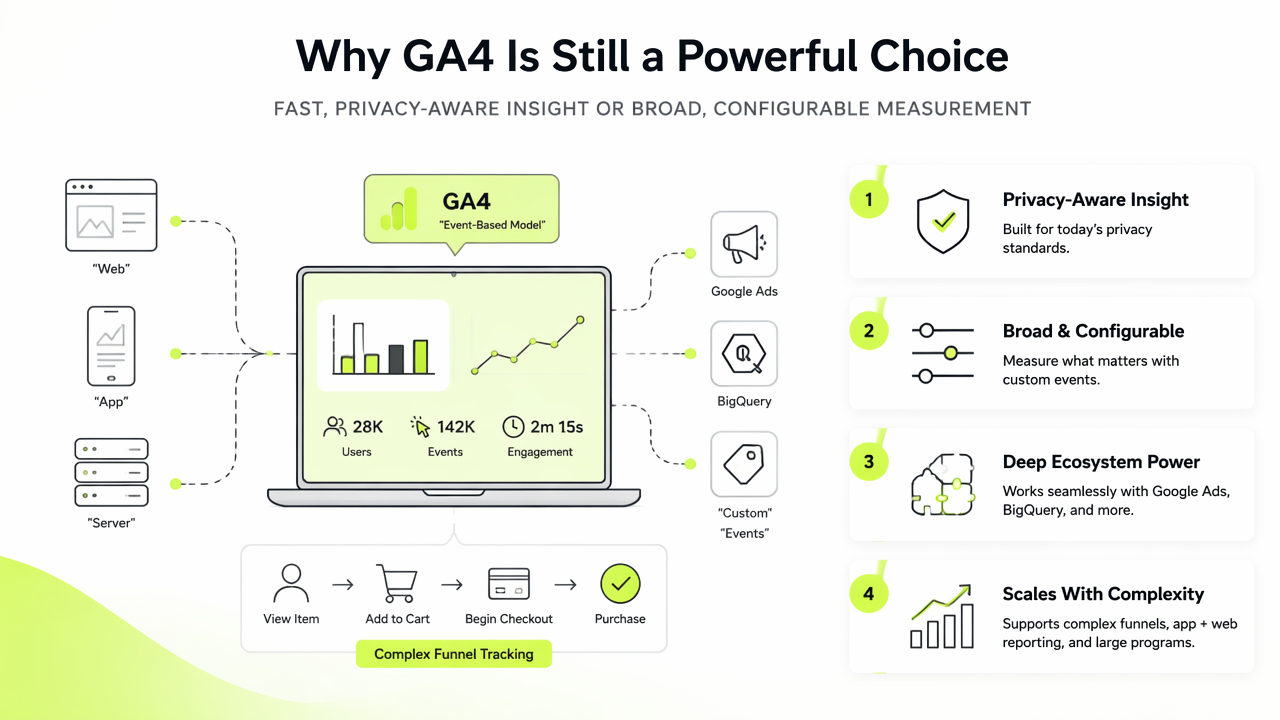
GA4 remains powerful for teams already invested in Google Ads, BigQuery, and custom event design. Its event-based model can support complex funnels, app plus web reporting, and large analytics programs.
For smaller SaaS, ecommerce, and indie teams, the cost is often operational time. Reports can require configuration before basic questions become easy to answer: which channel brought traffic, which source produced conversions, and which campaign deserves more spend.
Key insight: GA4 is strongest when analytics expertise exists in-house; lightweight analytics is stronger when founders need decisions faster than dashboards need customization.
Comparison matrix for small growth teams
| Factor | Faurya | Google Analytics 4 |
|---|---|---|
| Setup speed | Fast website analytics for lean teams | More setup for events, reports, and consent mode |
| Cookie consent | Privacy-first posture supports simpler tracking choices | Often tied to consent banners and Google configuration |
| Attribution | Focused on traffic sources and conversion clarity | Strong but complex attribution paths |
| Dashboard clarity | Growth-focused views for founders and marketers | Flexible reports with a steeper learning curve |
| Privacy posture | Clear policy and processing materials, including the privacy policy | Connected to the broader Google Marketing Platform |
| Founder workflows | Built around traffic, conversions, and revenue signals | Built for broad analytics teams and paid media depth |
When GA4 becomes too complex
GA4 becomes too complex when analytics maintenance starts taking attention away from marketing decisions.
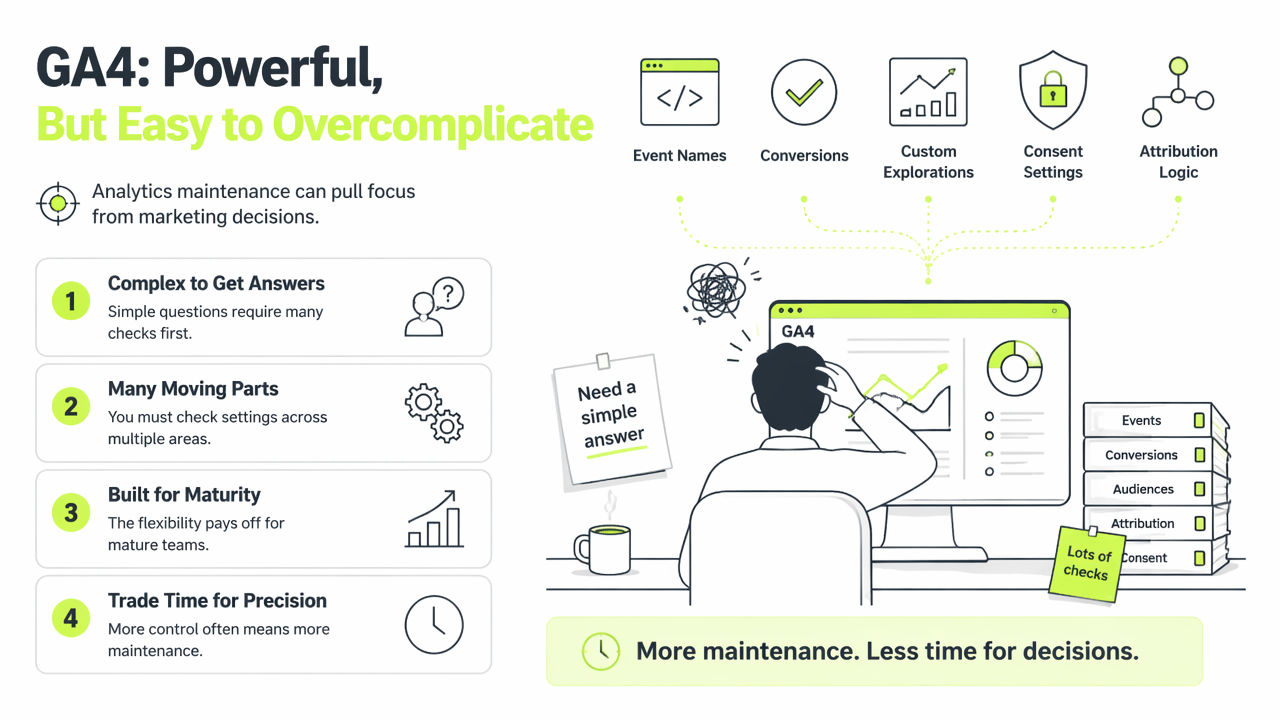
Common friction appears when a team needs a simple answer but must first check event names, conversions, custom explorations, consent settings, and attribution logic. That flexibility is useful for mature teams, yet it can slow down early-stage growth work.
A practical test is simple: if weekly analytics work requires a specialist, a naming system, and repeated report rebuilding, the tool may be bigger than the business need. For many founders, traffic quality, campaign performance, and conversion movement matter more than a large measurement architecture.
The privacy layer also matters in 2026. Teams handling visitor data should review processing terms, retention practices, and contractual materials such as a data processing agreement.
Signs a lighter analytics stack is enough
A privacy-first, lightweight tool is usually the better fit when the team needs:
- Fast answers on top channels, landing pages, and conversions.
- A dashboard that non-analysts can read without training.
- Revenue-oriented reporting instead of exploratory report building.
- Less dependence on cookie-heavy tracking patterns.
- Clear internal workflows for founders, marketers, and agencies.
GA4 is not the wrong choice in these cases, but it may be more tool than required. The risk is not bad data alone; the risk is delayed action.
How Faurya handles revenue-first analytics
The Faurya platform handles analytics by focusing reports around growth questions rather than broad enterprise configuration.
That matters for SaaS founders, ecommerce owners, and agencies that need to know which traffic sources make money. A compact analytics workflow helps teams move from visitor data to campaign decisions without building a custom reporting layer first.
Faurya also fits privacy-conscious teams that want product behavior, website traffic, and conversion tracking framed around simpler governance. Legal and operating expectations should still be checked through official materials, including the terms of service.
Analytics that grows with a team should not require enterprise processes before the first useful insight appears.
Founder workflow checklist
A practical evaluation should follow this order:
- Define the core conversion, such as signup, checkout, demo request, or paid plan.
- Identify the traffic sources that influence that conversion.
- Confirm whether the dashboard makes channel quality obvious.
- Check privacy documentation before collecting visitor data.
- Review whether weekly reporting can happen without an analytics specialist.
This checklist favors tools that reduce setup drag while keeping marketing ROI visible. GA4 can still win for complex Google Ads programs, app measurement, and enterprise reporting. Faurya is stronger when speed, clarity, and revenue focus matter more than maximum configuration.
Conclusion
Faurya vs Google Analytics 4 is not a contest between simple and advanced; it is a fit decision. GA4 suits teams with analytics resources and complex measurement needs, while Faurya suits lean operators that need clear traffic and revenue insight quickly. For the next step, visit faurya.com, compare the reporting workflow against current GA4 tasks, and choose the tool that shortens the path from data to action.
Generated by EarlySEO.com