Cross-Domain Analytics for SaaS Websites: A Practical 2026 Guide
Learn how SaaS teams track users across marketing sites, apps, checkout flows, and subdomains while preserving attribution and privacy.

TL;DR
Cross-domain analytics works best when SaaS teams define one customer process, preserve referral and UTM context, and track signup or checkout events consistently. Privacy-safe tools, clear consent records, and documented data processing terms reduce reporting risk while keeping growth analysis useful.
Cross-domain analytics for SaaS websites turns fragmented visits into one measurable path from ad click to signup, checkout, and activation. Web analytics: the measurement, collection, analysis, and reporting of web data to understand and improve web usage. Faurya helps privacy-conscious teams keep that path readable without overbuilding the analytics stack.
Table of Contents
What is cross-domain analytics for SaaS websites?
Cross-domain analytics for SaaS websites connects activity across domains, subdomains, and third-party flows so one visitor is not counted as several unrelated users. For SaaS, that often means tracking movement from a marketing site to an app subdomain, billing portal, help center, demo scheduler, or checkout provider.
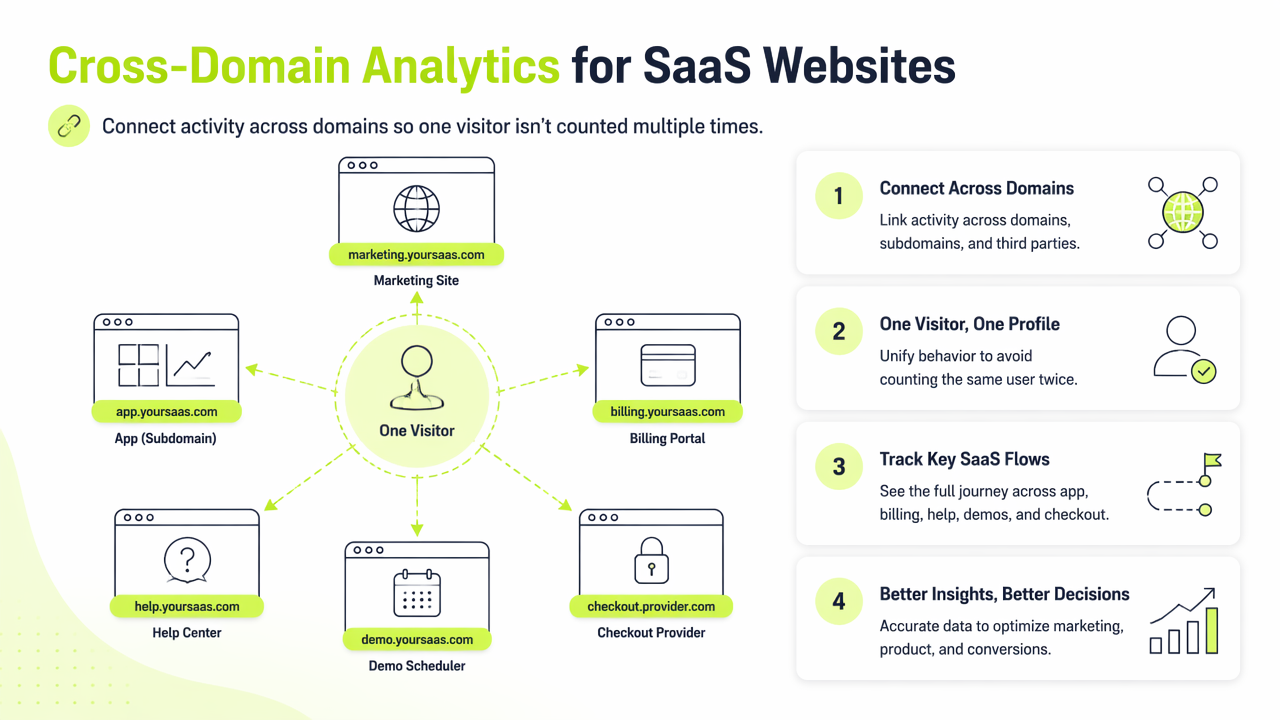
SaaS is a cloud service model where the provider delivers application software while managing the underlying resources. That model creates measurement handoffs because product, payment, and marketing pages may live on different hosts.
Key insight: cross-domain measurement is not just a Google Analytics setting; it is a governance choice about identity, consent, attribution, and event design.
Core measurement terms for SaaS teams
| Term | Practical meaning |
|---|---|
| Referrer | The previous page or domain that sent the visit |
| UTM parameters | Campaign tags used to preserve source, medium, and campaign context |
| Client ID | Browser-level identifier used by tools such as GA4 to connect sessions |
| Signup event | The conversion event that marks account creation |
| Checkout handoff | Movement from the SaaS site to a payment or subscription flow |
Google Analytics Help lists cross-domain measurement as the method for attributing activity to a single user as that person moves across domains. The same principle applies outside GA4 when SaaS teams use server-side analytics, data warehouses, or privacy-first tools.
How should SaaS teams track journeys across domains?
SaaS teams should track cross-domain journeys by defining the business path first, then mapping every domain, event, consent point, and redirect that can affect attribution. A short setup beats a broad tag dump because signup quality, activation, and revenue matter more than raw pageview volume.
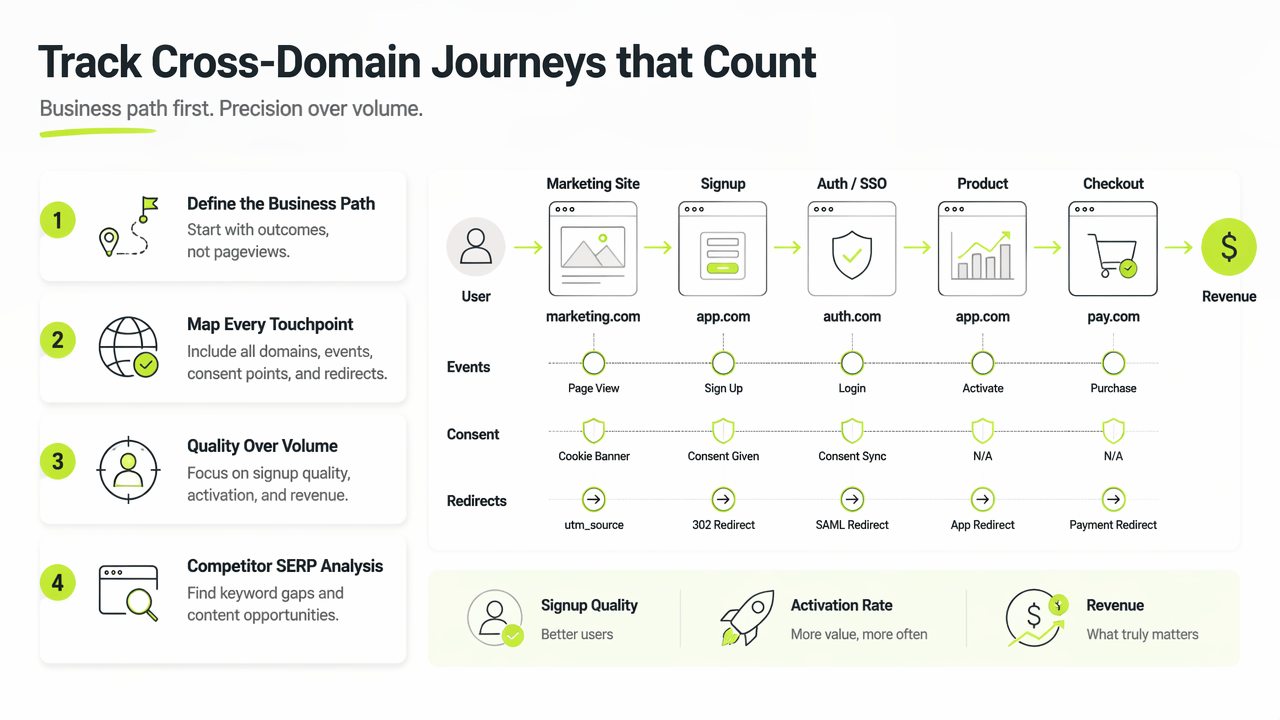
Competitor SERP analysis found 5 analyzed articles with an average length of 2,755 words, yet many guides still focus heavily on GA4 setup. The missed opportunity is tying referral preservation, UTM continuity, and checkout events to actual SaaS reporting decisions.
Key insight: the most useful report answers which channel created qualified accounts, not which domain received the last click.
Implementation checklist for handoffs
- List every owned domain and subdomain, including
app,www, docs, and billing. - Decide which conversions matter: demo booked, signup, trial started, payment, or expansion.
- Preserve UTMs through redirects, forms, and checkout links.
- Exclude internal domains from referral reports where appropriate.
- Test the full path from landing page to confirmation page.
- Document consent behavior in relation to the Faurya privacy policy and the Faurya data processing agreement.
For example, a visitor may land on www, click into app, start a trial, and pay through a hosted billing page. The reporting model should keep the original campaign source attached to signup and revenue events.
How does privacy-safe reporting change in 2026?
Privacy-safe reporting in 2026 favors fewer identifiers, clearer consent, and event models that still support marketing ROI. Browser restrictions, consent expectations, and AI-assisted reporting all push SaaS teams toward cleaner first-party data rather than unlimited client-side tracking.
Research by Bond, Khosravi, and de Laat in 2024 examined ethics and rigour in AI-related systems, a useful reminder that automated reporting needs transparent data practices, not just attractive dashboards (study). Budhwar, Chowdhury, and Wood also discussed generative AI research directions in organizational contexts, which reinforces the need for careful governance around automated decisions (study).
A simple governance model for cross-domain data
| Decision | Safer default |
|---|---|
| Identity | Prefer first-party, consent-aware identifiers |
| Attribution | Store original source and latest meaningful touch |
| Events | Track fewer, named milestones tied to revenue |
| Contracts | Align analytics use with service terms |
The Faurya platform fits SaaS teams that need practical reporting across product, marketing, and revenue handoffs without turning analytics into a permanent engineering project. For teams comparing options, faurya.com is a sensible starting point when privacy and growth reporting carry equal weight.
Conclusion
Cross-domain analytics for SaaS websites should connect the customer path, preserve campaign context, and respect privacy rules from the first tracking plan. The next step is to audit every domain, event, redirect, and consent point, then choose a reporting setup that makes signup and revenue attribution clear. Visit faurya.com to evaluate whether Faurya fits that workflow.
Generated by EarlySEO.com