Cookieless Attribution Model: What Founders Can Measure in 2026
Learn how cookieless attribution works, which models fit privacy-safe measurement, and what founders can measure without third-party cookies.

TL;DR
A cookieless attribution model replaces third-party cookie tracking with first-party events, UTMs, referrals, consented identifiers, and aggregated signals. Founders should use simple models for campaign decisions, aggregated reporting for channel direction, and privacy-safe tooling for durable ROI measurement.
Third-party cookie loss did not end marketing measurement, but it did end the illusion of perfect user-level visibility. A cookieless attribution model measures campaign impact without third-party cookies by combining first-party data, referral context, consented events, and aggregated reporting. Faurya helps privacy-conscious teams connect those signals without making attribution feel like guesswork.
Table of Contents
What is a cookieless attribution model?
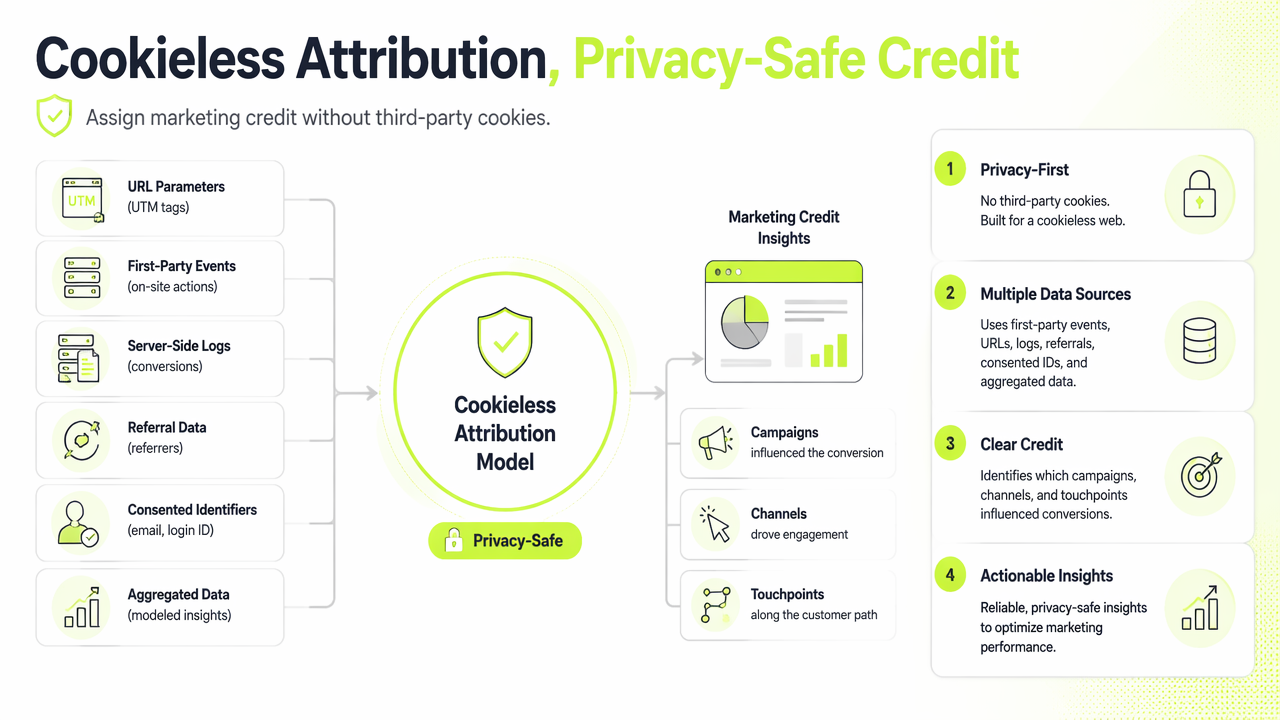
A cookieless attribution model is a privacy-safe method for assigning marketing credit without relying on third-party browser cookies. It identifies which campaigns, channels, or touchpoints influenced a conversion using first-party events, URL parameters, server-side logs, referral data, consented identifiers, and aggregated patterns rather than cross-site tracking.
Attribution: the process of identifying user actions that contribute to a desired marketing outcome, then assigning value to those actions.
Customer data platform: a system that collects and organizes customer data from multiple touchpoints into a unified profile.
Key insight: cookieless attribution can show which channels create demand, but it usually cannot recreate every anonymous cross-site click path.
What attribution can and cannot show
The practical value sits in decision quality, not perfect surveillance. Research on omnichannel funnel optimization by Umoren, Didi, and Balogun discusses awareness, engagement, and conversion across consumer touchpoints, which matches the core challenge of attribution across fragmented journeys in this 2021 paper.
Cookieless measurement can usually show:
- Which UTM campaigns drove form fills, trials, or purchases
- Which referral sources introduced qualified traffic
- Which channels assisted conversion at an aggregate level
- Which landing pages converted from known campaign traffic
It usually cannot show every anonymous ad impression, every cross-device path, or every hidden influence from dark social, word of mouth, and offline touchpoints.
Which attribution models work without third-party cookies?
The strongest cookieless models are first-touch, last-touch, UTM-based, referral-based, and aggregated attribution because each can run on first-party or contextual data. None is perfect alone, so growth teams often combine a simple deterministic model with broader aggregate analysis for budget decisions.
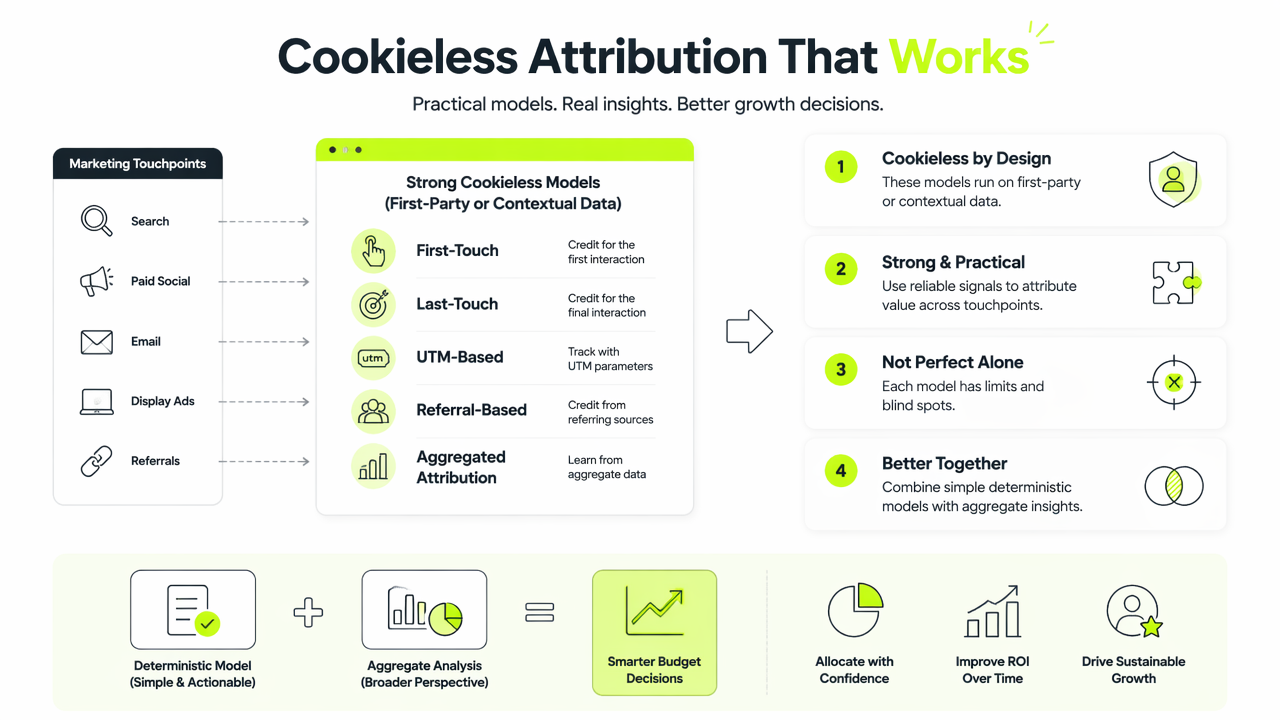
Model comparison for privacy-safe measurement
| Model | Best use | What it measures | Main limitation |
|---|---|---|---|
| First-touch | Demand generation | The first known campaign or source | Misses later nurturing |
| Last-touch | Conversion reporting | The final known source before conversion | Overcredits bottom-funnel channels |
| UTM-based | Paid and owned campaigns | Tagged campaign, medium, source, and content | Breaks when links are untagged |
| Referral-based | Partnerships and PR | The referring domain or site | Often misses app and private sharing |
| Aggregated attribution | Budget planning | Channel-level contribution trends | Less useful for person-level journeys |
A balanced setup might credit a newsletter signup to first-touch organic search, a paid search demo request to last-touch, and quarterly budget shifts to aggregated channel trends. Research by Lanz, Goldenberg, and Shapira on user-generated content platforms shows why influencer and creator touchpoints also need careful measurement outside standard ad-click paths in the 2023 Journal of Marketing Research article.
Governance matters as much as the model. A public privacy policy should explain data collection, while processing terms should match the actual analytics workflow.
How should founders implement cookieless attribution in 2026?
Founders should implement cookieless attribution by standardizing UTMs, collecting first-party conversion events, preserving referrer context, documenting consent, and reviewing aggregate channel performance monthly. The goal is a repeatable measurement system that supports decisions without depending on invasive browser-level tracking.
A clean rollout starts with the business question. For example, an indie SaaS founder may need to know which campaigns create trials, while an e-commerce operator may care more about paid acquisition cost, returning customer revenue, and partner referrals.
A practical measurement stack
A lean 2026 setup can follow five steps:
- Define conversion events such as signup, checkout, demo request, or activation.
- Standardize UTM naming for source, medium, campaign, and content.
- Capture first-party events on the owned domain or server.
- Store consent and processing rules with clear documentation.
- Compare model output against revenue, retention, and customer quality.
The Faurya platform fits teams that want privacy-conscious attribution across campaign, referral, and conversion signals. For teams handling customer or account data, the data processing agreement and terms of services should be reviewed before implementation.
Practical rule: if an attribution report cannot change a budget, campaign, or landing page decision, the model is probably too complex.
Conclusion
The best cookieless attribution model in 2026 is not the most complex one; it is the one that reliably links campaigns to decisions while respecting privacy limits. Founders should start with UTMs, first-party events, referrals, and aggregate trends, then use Faurya when those signals need a clearer operating layer. For the next step, visit faurya.com and map the first three conversion events worth tracking.
Generated by EarlySEO.com